A Sweet Break: KitKat, Diwali & the Great Fairy-Light Fiasco
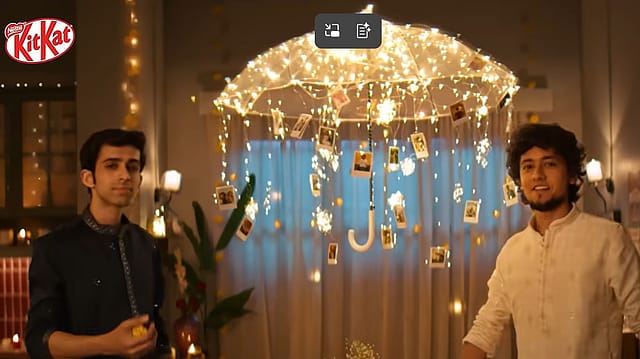
Two young men have set out to decorate a room for Diwali and ended up decorating themselves. Fairy lights wind around their kurtas. The bulbs are working beautifully. Getting them onto something more suitable is proving difficult.
The friends eventually sit down, still tangled in the evidence of their efforts, and have a KitKat. Soon, an umbrella provides the answer. The lights go over it, photographs hang beneath it, and the troublesome wires become an arrangement their guests can admire. One of the hosts is rather quick to accept the credit. Anyone who has completed a group assignment will know the type.
KitKat’s “Break Hai Toh Vibe Hai” lets its two hosts be a little silly. They look faintly ridiculous, sitting there illuminated, but remain good company. Their solution has the charm of something improvised with whatever happens to be around. The umbrella earns its moment when the guests look up.

Look Who's Talking Regime Change
23 Oct 2026 - Vol 05 | Issue 43
There is plenty to recognise here, even for people whose decorating ambitions end at plugging in a ready-made lamp. Preparing to enjoy yourself can become surprisingly exhausting. The cushions need arranging, somebody has misplaced the tape, and a person who offered to help is now issuing instructions. By the time the doorbell rings, a chair and something to eat have acquired considerable appeal.
KitKat has found a comfortable place in that interval. It has been looking for such places in India for more than three decades.
When the squirrels did the entertaining
Most of us can find an excuse to stop what we are doing for a minute. KitKat has built much of its advertising around that willing audience. The setting can change without anyone needing the idea explained again.
Marketing and branding experts reckon that KitKat has spent years giving people a reason to associate a pause with its chocolate. "That allows the brand to change the characters and the occasion without starting the conversation from scratch,” says Ashita Aggarwal, professor of marketing at SP Jain Institute of Management & Research.
The product does some of the explaining. Its fingers snap apart, making the action in “Have a break, have a KitKat” visible in the eater’s hands. There is something satisfying about an advertising line that can be demonstrated before the first bite.
When KitKat entered India in 1995, chocolate brands were trying to find more occasions to be eaten. Cadbury’s Perk addressed light hunger with “Thodisi Pet Pooja”. KitKat’s fingers offered a convenient way to eat a portion, keep the rest or share it. The wafer rivals were competing for an increasingly ordinary place in the day.
KitKat would go on to make some pleasingly extraordinary things happen in that place.
In the 2010 squirrel commercial, a young man taking a KitKat break receives an animated song-and-dance performance. The courtship is absurd, energetic and far more entertaining than anything he might reasonably have expected from the afternoon. Written by Anuja Chauhan and directed by Shyam Madiraju, the JWT film gave the brand a wonderfully cheeky pair of performers.
The birds brought their performance into a classroom. A student takes a bite and sees a pair dancing on his teacher’s bouffant, while the class carries on around him. The joke depends on the delighted spectator noticing something everyone else has missed.
By 2013, a tired doctor was being treated to dancing babies. His KitKat break briefly turned the nursery into a performance venue. When the last bite disappeared, the babies returned to their usual behaviour, leaving him to wonder what he had just witnessed.
The films were confident enough to be daft. The pleasure came from waiting to see what the creatures would do, and enjoying the human response when they did it. Remembering the brand required very little effort. KitKat had supplied the occasion for the joke.
That is a demanding inheritance for any subsequent commercial. A pair of dancing squirrels can linger in the memory for years. A perfectly respectable festive gathering has to work harder.
The break goes home
KitKat has visited Diwali before, with a considerably larger travel budget for its protagonist. In 2014, its astronaut Nakshatra Verma was missing home from space. Her break brought the imagined spectacle of an illuminated India into view, giving her a way to feel part of the celebration from orbit.
It was a big, sentimental idea, made for a festival when being away from home can feel especially lonely. The view supplied the emotional payoff. KitKat’s pause allowed the character to experience something she might otherwise have missed.
The current film finds its pleasure much closer to the sofa. Its friends already have a home to gather in and people coming over. Their difficulties are small enough to be funny. The lights can be rearranged. The evening is still theirs to enjoy.
That modesty suits the film.
Festive advertising can become terribly earnest about telling people how they should celebrate, whom they should remember and which relationship needs repairing before the closing pack shot. KitKat gives its hosts a manageable decorating problem and allows the friendship to carry the story.
The credit-grabbing joke is a useful finishing touch. The friends remain recognisable after the beautiful arrangement appears. Someone has a good idea, someone enjoys the compliments, and the gathering proceeds. The chocolate has done enough without being asked to reconcile an entire family.
A pause with plenty of company
Other KitKat campaigns have found less visible things getting in the way of a good break.
In 2018, Sanya Malhotra and Fatima Sana Shaikh appeared in “Karo jo karna hai, break mein banta hai”, encouraging people to enjoy themselves without worrying about judgement. It gave the pause a familiar social complication. Finding a little time for yourself does not always stop other people having opinions about how you spend it.
The pandemic brought a different set of frustrations. The 2020 “Life Hai, KitKat break banta hai” work, featuring Ayushmann Khurrana, addressed young people whose everyday routines had been disrupted. A short break offered a chance to approach those situations with a little more good humour.
By 2024, Khurrana was helping the brand tackle distractions with “Break par sirf break”. Queen’s “I Want to Break Free” accompanied the invitation to disengage. Anybody who has spent a coffee break answering messages will understand why the instruction needed repeating. Physically leaving a desk is sometimes the easiest part of stopping work.
The wider “Break Better” campaign carried that problem across 60 countries, with an employee pursued by emails, messages and video calls.
KitKat has also made room for the ways people choose to relax. A June 2024 Netflix partnership offered an “Ultimate Break” through a film and co-branded packs. In July 2025, Spotify helped it invite listeners beyond their repetitive playlists, with special packs unlocking personalised music recommendations.
These are sensible companions for a snack associated with downtime. They also reveal how much competition now fits into a few spare minutes. A chocolate brand seeking a place in someone’s break is entering an interval already crowded with programmes, playlists and the phone in their hand.
Its 2025 “Snap to Decide” campaign found another use for the wafer itself. Featuring Jackie Shroff, it drew on the online habit of letting the longer piece of a snapped KitKat settle a choice. A small dilemma could be left to the chocolate. There are worse ways to decide what to have for lunch.
Across these executions, KitKat has managed to give an old line fresh situations to inhabit. The advantage is considerable: it can join a conversation about distraction, music or festive preparations while remaining easy to recognise. A rival would need to build its own reason to be remembered when somebody thinks about taking a break.
Let the evening be a little messy
The latest film belongs comfortably in that history, although its humour is gentler than the animal spectacles. Viewers who loved the sheer oddness of the squirrels or babies may miss that surprise. The umbrella is a charming solution to a familiar problem, and the film takes few risks with either.
The risk with festive advertising is that everyone borrows the same warmth. "The friendship works here, but the humour needs to be distinctive enough for viewers to remember KitKat after the decorations are forgotten,” says Aggarwal.
Its affection for the two friends makes the familiarity agreeable. They are allowed to muddle through. The decoration eventually looks good, but the fun has already begun while they are making a mess of it. Watching them sit down, still wrapped in lights, is part of the evening’s entertainment.
There is a useful choice of characters here, too. The men are busy getting the room ready and worrying about how it will look. Festive preparation gives them something to do together, with enough scope for clumsiness and teasing. The friendship feels warmer for the shared effort.
The closing festive assortment makes the invitation to buy clear. KitKat would like a place among the things brought home for the gathering. The film gives that request a human setting: people taking a moment together before the room fills up.
Its nicest suggestion is that a celebration can survive a change of plan. The original decorating scheme has plainly gone wrong. An umbrella works, the guests enjoy it, and the hosts have a story to tell about how the arrangement came together.
With luck, somebody will remember to wind the lights properly before putting them away. KitKat may need another festive commercial next year, though, so perhaps the boys should be left in charge.