Add Sachin, Make it Incredible: But Does Credibility Guarantee Celebrity Fit?
Imagine the average Indian marketing meeting.
“We have a credibility problem.”
“Add Sachin.”
“The category is full of mistrust.”
“Add Sachin.”
“Consumers don’t know who we are.”
“Add Sachin.”
“Our kitchen drawers do not close smoothly.”
There is a brief silence. And then comes: “Sachin?”
Credible. Add Sachin. Incredible. It is among the safest recipes in Indian advertising. Take a brand promise. Add the country’s most trusted cricketer. Stir gently until credibility transfers.
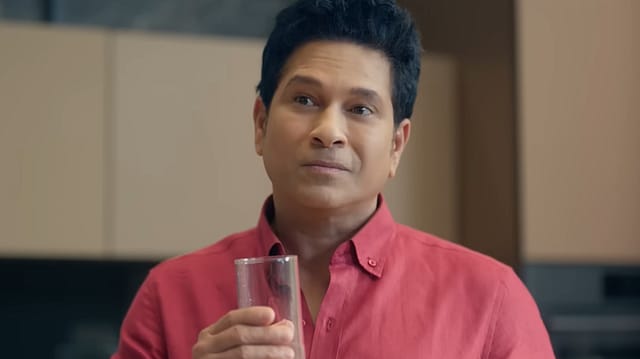
Häfele has now taken its “Maximising What Matters the Most” campaign forward with Sachin Tendulkar. The series places him alongside Ajay Bhaiya, cast as a trusted member of his household staff, inside a modern kitchen filled with clever drawers, coffee machines, durable surfaces, lighting and appliances.
The Modi Years
02 Oct 2026 - Vol 05 | Issue 40
A Nation Rebuilt
The products promise convenience, precision and intelligent use of space. Sachin supplies familiarity and reassurance.
There is nothing inherently wrong with that. But watch enough celebrity advertising and a mischievous question begins knocking from inside one of Häfele’s soft-closing drawers: Does Sachin Tendulkar actually use this stuff?
God Promise, Used Car
Spinny provides the perfect comparison.
The used-car platform placed Sachin in a series of 15-second films and then asked him to remain almost completely silent. He drank coffee, carried flowers, handled a camera and ironed clothes while the brand’s promises appeared on screen: Three-year warranty. Thousands of cars. Best price guarantee. God Promise.
The wordplay did the selling. Indians recognise “God promise” as the childhood oath that supposedly upgrades an ordinary claim into unquestionable truth. Sachin is the “God of Cricket”. Put the phrase beside his face and the campaign completes itself.
It is economical, culturally fluent and refreshingly quiet.
It is also slightly forced. Sachin’s godliness was earned through Test hundreds, straight drives and almost a quarter-century of international cricket. Spinny drafted that accumulated faith into the more troublesome business of second-hand cars.
You trusted him against Wasim Akram. Will you therefore trust the odometer? The category certainly needs reassurance. Buyers of used cars worry about hidden damage, manipulated mileage, accident history, inflated prices and what may go wrong after the cheque clears. Sachin arrives as a human warranty.
But does Sachin buy second-hand cars? He is reportedly a strategic investor in Spinny and an avowed automobile enthusiast. The company has also built campaigns around his emotional attachment to his first car, a modest Maruti 800. That gives the relationship more substance than a conventional endorsement contract.
Yet the typical Spinny buyer may be investing years of savings in a pre-owned hatchback because a new car remains beyond reach. Sachin’s contemporary automobile universe is rather different. He can validate the integrity of the company. Can he authentically represent the anxiety of its customer?
Credibility Is Not Category Credibility
This is where celebrity advertising frequently confuses two very different assets.
Sachin is credible. That does not automatically give him credibility about every product placed within camera range. A respected surgeon is credible. Nobody asks the surgeon to recommend luggage. A celebrated chef is credible. That does not make the chef an authority on mutual funds. Sachin represents discipline, consistency, preparation, humility and longevity. Those qualities can travel across categories.
Expertise cannot always make the same journey. “Credibility is transferable, but relevance is not automatic,” says Ashita Aggarwal, professor of marketing at SP Jain Institute of Management & Research. Sachin may make consumers trust the messenger, but the brand must still establish why he is the right messenger for that particular product.
Marketing research calls this the match-up hypothesis: endorsements tend to work better when consumers perceive a meaningful fit between the celebrity’s image or expertise and the product.
Virat Kohli selling sportswear requires little explanation. A beauty icon endorsing cosmetics contains an obvious match. A celebrated chef recommending cookware brings visible expertise. Sachin standing beside kitchen fittings requires the creative idea to complete a longer journey.
Mind the Gap in the Kitchen
Häfele does possess the ingredients for a clever Sachin connection.
He built a career upon precision. He located gaps others could not see. He extracted maximum value from limited space and made difficult movement look effortless. That maps almost suspiciously well onto a brand selling intelligent storage, smooth drawer systems and efficient kitchens.
Sachin spent 24 years showing India what could be extracted from the smallest opening. Häfele wants to do the same with a corner cabinet.
The campaign could make that connection structural. Instead, much of its communication places Sachin in a carefully designed kitchen and allows Ajay Bhaiya to supply domestic familiarity.
The obvious question returns: who among them understands the daily inconvenience better? Sachin owns the kitchen in the narrative. Ajay Bhaiya is more likely to know which drawer jams, where the coffee machine lives and how much punishment a countertop absorbs.
Celebrity presence is not the same as product experience. If consumers cannot imagine the ambassador facing the problem the product solves, the endorsement may attract attention without achieving authenticity. “The celebrity becomes a trust shortcut, but the route from trust to purchase remains incomplete,” reckons Aggarwal.
There is another delightful detail. The campaign is presented as taking place in Sachin’s kitchen, but the films were shot at Häfele’s Design Centre in Mahalaxmi, Mumbai. It is Häfele’s kitchen playing Sachin’s kitchen while Sachin plays a kitchen user and Ajay Bhaiya plays the man who probably knows where everything is. Advertising contains multitudes.
Master Blaster, Now Available in Every Category
Häfele and Spinny are far from alone.
In July 2026, agricultural solutions provider SML appointed Sachin as brand ambassador to deepen engagement with farmers. The campaign line was almost inevitable:
“SML, Fasal Ka Master Blaster.”
One hopes the crops appreciated the cover drive.
Luminous uses him to promote power solutions. Ageas Federal has drawn upon his reputation for fulfilling promises. Over his long advertising career, Sachin has sold energy drinks, tyres, insurance, cars, appliances, financial products and enough other categories to furnish a small township.
The appeal is obvious. He carries extraordinary fame with relatively little reputational turbulence. Parents trust him. Children recognise him. Advertisers do not wake each morning fearing a scandalous social-media post.
Sachin is celebrity advertising’s fixed deposit. But safety can become laziness. Once brands treat credibility as a universal adapter, they stop searching for a sharper connection. “Trust” becomes the answer before anyone has defined the question.
The same cricket puns then return in fresh uniforms. Master. Innings. Straight drive. Partnership. Century. Promise. A campaign can begin to feel as though Sachin has wandered onto the wrong advertising set but is too polite to mention it.
The Sachin Test
There is a simple way to judge these partnerships. Remove Sachin from the advertisement. Replace him with another widely trusted celebrity.
Does the idea collapse?
Spinny’s “God Promise” passes that test. Remove Sachin and the central wordplay disappears. Another celebrity may convey trust, but the campaign loses its cultural wink.
Häfele’s campaign faces a harder examination. If another pleasant, affluent celebrity can stand beside Ajay Bhaiya and operate the same drawers without weakening the narrative, Häfele may be buying Sachin’s credibility rather than using his meaning.
That distinction matters. A celebrity can provide reach. A relevant celebrity can provide memory. A seamlessly matched celebrity can make the product story feel inevitable. The strongest partnership produces an idea that could not work as powerfully with another ambassador. “If the celebrity can be replaced without damaging the campaign, the brand has rented fame. It has not built fit,” adds Aggarwal.
Spinny has made intelligent attempts to close the gap. Sachin is an investor. He loves cars. His first-car memories give the association an emotional spine.
Häfele can also build a credible bridge through precision, preparation and maximising space. But the bridge must appear inside the advertising rather than in a strategist’s presentation explaining it afterwards.
That is the larger lesson.
Sachin Tendulkar can make almost any brand credible. The brand must still make Sachin believable. Otherwise, credibility enters the room, the campaign becomes incredible and nobody asks whether the celebrity would ever use the product once the camera stops rolling.