100% RIP: Why Indian Food Advertising’s Favourite Number is Fighting for its Life
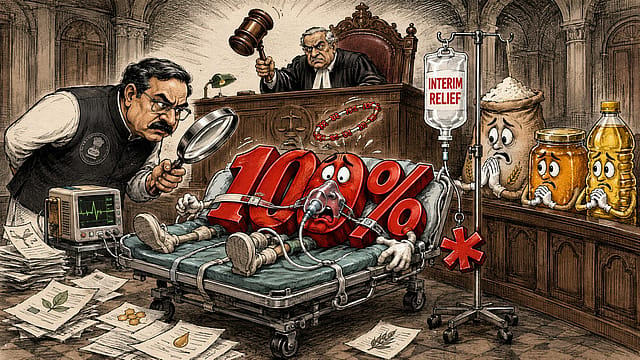
Advertising loves 100%. Mathematics should consider suing. One hundred per cent pure. One hundred per cent natural. One hundred per cent vegetarian. One hundred per cent real. Nothing uncertain. Nothing complicated. No room left for doubt, nuance or an inconveniently large asterisk.
For years, Indian food brands have used 100% as a tiny numerical halo. Put it on a packet and an ordinary product begins to look complete, uncontaminated and morally superior to whatever is sitting beside it.
Now the halo has entered the courtroom.
The Delhi High Court has temporarily stopped the Food Safety and Standards Authority of India from taking any decision to cancel ITC’s food licence over claims used for Aashirvaad MP Chakki Atta. The disputed declarations include “100% Atta”, “100% Madhya Pradesh Wheat”, “Made from 100% MP Wheat only” and “0% Maida”.
The Modi Years
02 Oct 2026 - Vol 05 | Issue 40
A Nation Rebuilt
Read together, they create a formidable piece of packaging arithmetic. Atta: 100%. MP wheat: 100%. Maida: zero. Confidence: overflowing. The court has not ruled that these claims are legally permissible. Nor has it struck down FSSAI’s position. Justice Swarana Kanta Sharma granted ITC interim protection while questions involving territorial jurisdiction and the procedure followed by the regulator remain under consideration. The matter will return to court on September 9. For now, ITC has received breathing room.
But the larger marketing battle has already escaped the flour bag.
Show Your Working
In May 2025, FSSAI advised food businesses to stop using “100%” on labels, packaging and promotional material. Its concern was that the expression was undefined under the relevant regulations and could be ambiguous or misleading.
In simple terms, the regulator is asking advertising to do something it has traditionally disliked: Show your working. What exactly is 100%? Does “100% natural” describe the ingredients, the manufacturing process or merely the brand manager’s optimism? Does “100% veg” tell consumers anything that the mandatory vegetarian symbol does not? Does “100% pure” establish measurable purity or simply place a spotless white coat around the product? And when a packet announces “100% Atta”, is it providing useful information or turning the absence of maida into advertising theatre?
The peculiar brilliance of 100% is that it rarely remains confined to the words immediately following it. Consumers can read the number as a wider promise of quality, health, safety and superiority.
The brand may be referring to composition. The shopper may hear perfection.
Marketing and branding experts reckon that 100% is advertising’s favourite shortcut to certainty. A brand may use it for one specific attribute, but consumers often interpret it as a larger guarantee of purity, health and superiority. The regulatory challenge is to distinguish a precise, verifiable claim from a number that creates a halo far bigger than the underlying fact. "That is the hidden power of the claim. It does not merely describe the product. It closes the argument," says Ashita Aggarwal, professor of marketing at SPJIMR.
This is not an isolated disagreement between FSSAI and Aashirvaad.
Dabur approached the Delhi High Court after regulatory action involving “100% Pure” and “100% Natural” declarations across products including honey, ghee, coconut water, coconut milk, edible oils and apple cider vinegar. The court granted the company interim relief earlier in August. Dabur argued that the products had not been alleged to be adulterated, unsafe, substandard or spurious. The fight concerned how they were described.
AWL Agri Business has also challenged notices concerning claims such as “100% Veg” and “Cholesterol Free – For Healthy Lifestyle” on Fortune Soya Health refined soybean oil. Three major food businesses. Several familiar claims. One increasingly endangered number. Indian food advertising may be approaching the Great Numerical Correction.
Why Brands Worship 100%
Consumers do not shop with laboratories.
They stand before crowded shelves, compare prices, glance at ingredients and make rapid decisions. Advertising, therefore, converts complicated propositions into shortcuts: Fresh. Natural. Healthy. Pure. And the most muscular shortcut of them all: 100%.
Unlike an adjective, a number looks measured. “Completely natural” sounds like copy. “100% natural” sounds as though somebody in a lab coat checked. The percentage supplies scientific theatre even when the consumer cannot see the calculation behind it. That is why the current fight matters to branding. Remove “100%” and companies may have to replace absolute assurance with precise explanation. Instead of “100% pure”, they may need to identify the ingredient, process or standard that supports the claim. Instead of selling perfection, they may have to provide particulars.
You might call it a tragedy for hyperbole and a possible victory for information. But the brands have a serious counterargument.
If a product genuinely contains only wheat sourced from Madhya Pradesh, why should its manufacturer be prevented from saying “100% MP Wheat”? If a packet contains atta and no maida, why should those facts become impermissible merely because they have been expressed forcefully? A blanket rejection of the number can also become excessive. If a company can independently establish that a product contains only the stated ingredient or comes entirely from the stated source, preventing it from communicating that fact may reduce clarity rather than protect the consumer, argues Aggarwal.
FSSAI, meanwhile, is pursuing a legitimate consumer-protection question. Brands are defending their ability to make truthful statements about what their products contain.
Between them lies the most interesting issue of all: Can a claim be factually accurate but psychologically larger than the fact? Aashirvaad may be describing its flour. FSSAI is interrogating everything the number encourages consumers to imagine about it. This battle could eventually change the language across atta, honey, ghee, oils, juices and other packaged foods. The front of the pack may become less absolute, more specific and considerably less dramatic.
“Made only with MP wheat” may survive. “Contains no maida” may survive. “100%” may have to produce its papers. For decades, the number walked through Indian advertising dressed as proof. FSSAI has stopped it at the gate. One hundred per cent has not died yet. The Delhi High Court has granted it interim life support.