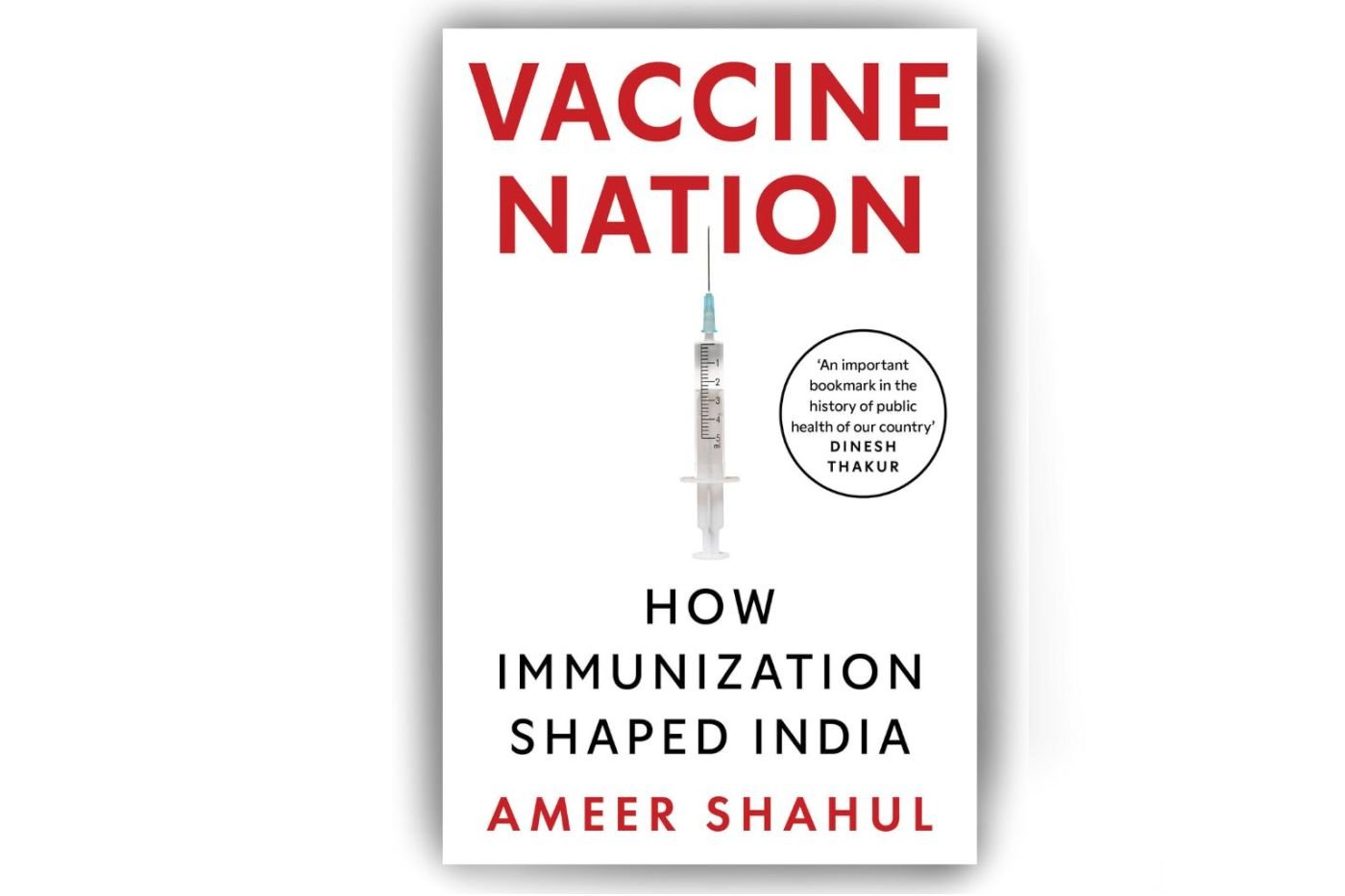
Book Review: Vaccine Nation: How Immunization Shaped India
“Days after Indira Gandhi took office as the Prime Minister of India in 1966.. a mare at a stud farm in Pune was bitten by a snake some 1500 kms away.”
And so draws Ameer Shahul, a journalist-turned-author, us into a far more complex and meticulously-researched chronicle of India’s vaccines history in his second book, Vaccine Nation. India’s tryst with vaccines spans several generations of stalwarts and pioneers drawn from various backgrounds and disciplines; and the country’s history itself through the colonial rule, India’s partition and various governments of independent India. It is a journey that has seen some rough and bumpy patches of lethargy, corruption and discrimination against the voiceless; and also some exhilarating peaks of success, particularly in providing affordable vaccines by breaking the cost barriers of multination pharma companies in a David versus Goliath manner. And Shahul does full justice in painstakingly chronicling the entire journey. Divided into five sections, it traces the evolution of India’s vaccine research, development and deployment efforts through the colonial times to Universal Immunisation Programme and more recent, Mission Indradhanush, the Covid-19 vaccination drive and vaccine diplomacy under the current government.
The book traces the initial scientists and reasons for setting up vaccine institutes in India, albeit by and for the colonial rulers. The journey starts when Soviet-born British researcher Waldemar Haffkine came to India in 1893 with hopes to start field trials of a cholera vaccine. It then lead to efforts in developing, or testing, or both, vaccines against plague, small pox, typhoid, tuberculosis, polio, measles, rotavirus and hepatitis and finally the more recent Covid-19.

Zeroing In on ECI
09 Oct 2026 - Vol 05 | Issue 41
Constitutional legitimacy versus political opportunism
As Shahul himself notes, this “transformation from colonial laboratories to global powerhouse in vaccine research and production has not been accidental. It is the result of persistent, multi-generational efforts by several policy makers, healthcare workers and institutions that believed in the power of prevention.”
Shahul deftly weaves together different strands: how each disease shaped pandemics and epidemics globally and in India; the scientists and institutions involved; the science behind the germs and their transmission, and the infections and the development of vaccines to tackle them. It is also peppered with egoistic squabbles between scientists and last but most importantly, how public health is given the short shrift, be it due to apathy towards Indian masses during colonial times, or corrupt nexus between politicians and powerful pharma lobbies in independent India.
It is not easy to tell such a complex multi-generation saga. To Shahul’s credit, he has crafted a narrative that should serve as a valuable source of reference and background information. It includes the clear-headed vision of scientist Sahib Singh Sokhey who headed the health sub-committee under a National Planning Committee set up in 1938-39 by Congress under the leadership of Subhash Chandra Bose, who advocated for vaccines to remain under the public sector, and for compulsory licensing in the country’s initial efforts at a patents act. The contributions of pioneering stalwarts, too many to name here, but Shanti Swarup Bhatnagar, Gursaran Prasad Talwar and Jacob John to name a few, are also well described. Some of these initiatives and visions may look like history now to the younger generation, given the vibrant Indian private sector now engaged in vaccine production and the revisions of The Patents Act, but how the discourse evolved makes interesting reading.
However, in trying to get the history right—of the scientist or institution; or the epidemic or pandemic; or the process of a specific vaccine research or development; or the historical, societal, cultural or logistic barriers to immunisation and ways to surmount these—the author tends to switch back into history and then suddenly contextualise it to a more recent development that may read like an abrupt switch of timelines, or outbreaks or characters.
Vaccine Nation also does, sometimes, read pedantic and dry in places, and the author tries to lighten up the text with interesting anecdotes, such as how vaccinated human carriers against small pox set forth in a ship all the way from Baghdad to reach India to kick-start a vaccination drive; to even the little-known possibility of Jinnah diagnosed with TB, and several other such snippets; and how a mare from a stud farm owned by the Poonawallas succumbed to a snake bite for want of the anti-snake venom arriving in time, which spurred the journey of Serum Institute of India that we know today.
Vaccine Nation is a valuable resource for public health students, researchers and future generations and an interesting read.