Book Review: From Dynasties to Democracy: Politics, Caste And Power Struggles In Rajasthan
ALTHOUGH RAJASTHAN is India’s largest state by area and its sociopolitical conditions merit studies, rigorously done accounts of its contemporary history and politics are far rarer compared with certain other big states.
Why is it so? After all, it is a region that comes up frequently in any study of medieval India and in the form of claims and counterclaims about the militant prowess of its storied clans and communities.
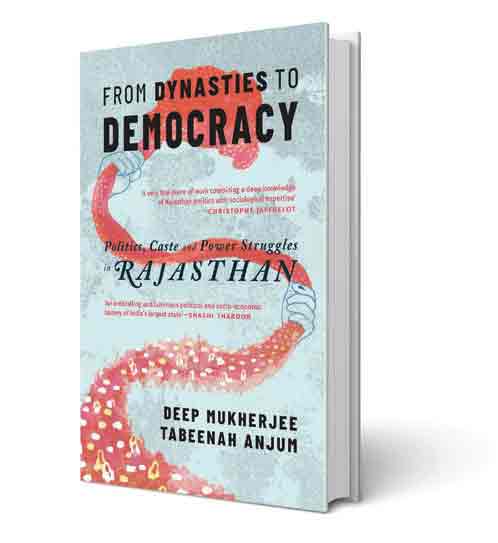
We now have a book that is a blend of journalism and research of five years from two writers who have covered the state for a long time as reporters. From Dynasties to Democracy: Politics, Caste and Power Struggles in Rajasthan by Deep Mukherjee and Tabeenah Anjum seeks to fill a gap in the study of Rajasthan’s post-Independence politics—power structures in one of the most caste-obsessed states where a Dalit sporting a moustache is a cause for deep anguish among the upper castes.
Complex hierarchical relations endure from centuries ago but there are gains regardless as the state transforms from what the authors describe as a former “feudalocracy” to democracy. These bonds are so complex that the following apocryphal perspective offers a clue: if a Brahmin, Rajput, Jat and a Meena (a Scheduled Tribe) are engaging in a lazy chat in a teashop in the state, which is notorious for its anti-Dalit violence, it is the Meena who would be the loudest. That’s not a luxury most intermediate castes can afford in a similar situation.
The book, while focusing on its unique political culture, puts the spotlight on political heavyweights who have influenced state governance and leadership. Rajasthan, the book highlights, is one of the early states in free India to not give an emphatic win to Congress. Nonetheless, unlike other states such as Gujarat and Madhya Pradesh that became bastions of Hindutva politics, the western Indian state didn’t grant the Bharatiya Janata Party (BJP) absolute power even though it did flourish there. It is also one of the few states where strong regional aspirations and social justice demands did not produce a local party of standing, unlike in Bihar or Uttar Pradesh.
Bengal Thriller 2026: The Plot Thickens
17 Apr 2026 - Vol 04 | Issue 67
Mamata Banerjee faces her toughest battle
The leaders whose roles are analysed quite decently in the book include titans of the stature of Bhairon Singh Shekhawat besides Ashok Gehlot, Vasundhara Raje and Sachin Pilot, amongst others. Shekhawat’s clever political posturing and perhaps craving to be a moderniser of sorts is detailed by the authors who dwell on his opposition to glorifying sati as well as his posturing to not antagonise his Rajput support base. The authors also do a commendable job in bringing to the fore the oft-repeated expressions synonymous with Rajasthan: Rajput pride, Jat dominance, crimes against Dalits, farmers’ agitation, et cetera.
Readers will also discover how a departed Congress politician managed to unite two communities, Gurjars and Meenas, even at the height of hostilities and clashes, and still command respect from a traditional rival caste group long after his untimely demise. Who was the only Dalit chief minister of Rajasthan? Why is it that no single community ever absolutely dominated the state’s political landscape? You find answers to these questions and more in this book, which chronicles the state of affairs in Rajasthan from 1949 to 2024.
Worryingly, despite their numbers and role in elections, women here continue to play a spectator’s role as opposed to large parts of the rest of India. The same applies to the Dalits and Adivasis who find themselves constantly excluded. Mukherjee and Anjum place various episodes from contemporary history in context, including claims about 16th-century king Maharana Pratap, violent protests against the movie Padmaavat and the many ironies that constitute Rajasthan.
One of the authors is an award-winning photographer, which makes the absence of photographs in this otherwise fine book all the more striking given that it engages with a state renowned for its magnificent forts, distinctive attire, sweeping desert landscapes and much else.