Cities of Drift: Urban nostalgia and ideological fatigue in Sarnath Banerjee's new graphic novel
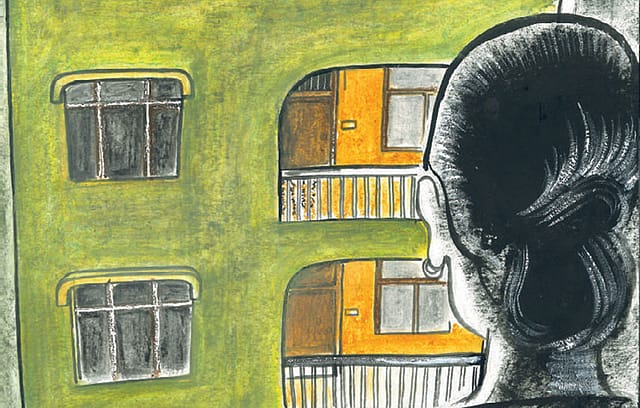

THROUGHOUT HIS WORKS, Sarnath Banerjee’s description of his favourite cities, Delhi and Kolkata, has been a recurring theme. This continues in Absolute Jafar, Banerjee’s sixth graphic novel, where he sharpens his gaze onto these two places as if they are themselves the story— chaotic, nostalgic and ironic.
Jafar, the eponymous character born in Berlin out of an Indo-Pak romance, is unsure of his inheritance—a German, an Indian or a Pakistani. “Madam, you are a Pakistani, your husband is Indian, and your child is Indian but born in Berlin, and you live in Germany. Couldn’t you make it a little more complicated?” an immigration officer tells Mahrukh, and her husband, Brighu, as they return to Delhi from Berlin with their son.
While Jafar seems to be the protagonist of the story, he is merely the mystical and elusive metaphor around which the stories circle. The novel unfolds as the narrator Brighu, a compulsive “all-weather walker”, tells the tales of Delhi and Kolkata to his son, Jafar, in a non-linear style— conversations, recollections, cultural references, myths and histories—as if he is trying to hold on to the ‘fading memory’ of these cities.
The Identity Project
11 Sep 2026 - Vol 05 | Issue 37
Amit Shah leads the mission for a national demographic correction
These cultural memory threads become the leitmotif of the novel, and through them, Banerjee, with his rich humour, continues to play his role as the chronicler of the English-speaking, café-hunting Indian middle class. The recollections take place in cafés and bars and parks that he visits with his lover-turned-wife Mahrukh even as the couple suffers under the infamous Indian bureaucracy.
Repeated visits to government buildings (whose names and even acronyms are hard to remember) for approvals to travel outside the country, life-saving lawyers, and excruciating waits to meet senior government officials become a staple of the novel. In one of his long waits at a government office, Brighu jokes about finding Nirvana, a state of enlightenment especially familiar to those in pursuit of an Indo–Pak romance.
And all these accompany sketches that are seemingly sardonic but are never. This visual language resembles suspended animation which lets readers subconsciously contemplate rather than rush through. To achieve this, Banerjee keeps watercolours muted, done intentionally to look archival, painting mainly with browns, greys and washed-out blues. Many panels do not feature accompanying texts, and in one instance, Banerjee uses an actual image juxtaposed with a sketch. The overall effect is less cinematic than literary, allowing us to read the novel as much for its witticism as for its imagery.
Through Brighu, Banerjee, also reflects on masculinity. Similar to most of his characters, likely semi-biographical, this gives us a critique of an Indian middle-class educated male, who is self-aware but often passive. This is subtle, but undoubtedly ever-present.
Brighu is also self-aware and politically literate, yet emotionally tentative. He can analyse, introspect, understand and argue with the world—and himself—but when it comes to taking action, he hesitates. He is the portrait of a man—and by extension, a class—caught between critique and complicity. Brighu recognises the absurdities of his world but remains implicated in them.
Absolute Jafar seems monotonic and repetitive, but it sustains an intensity. Banerjee is asking us to look beyond the text and imagery, which are made deliberately to give readers time to pause and introspect. In the end, the book does not offer any resolution: it is like Brighu: suspended, indecisive. The novel does not possess much dramatic flourish, but the careful look at India and its inheritance of juxtaposed chaos and coherence makes Banerjee one of the most attentive observers of the country’s internal life.