Book review: Red Dawn Over China by Frank Dikötter

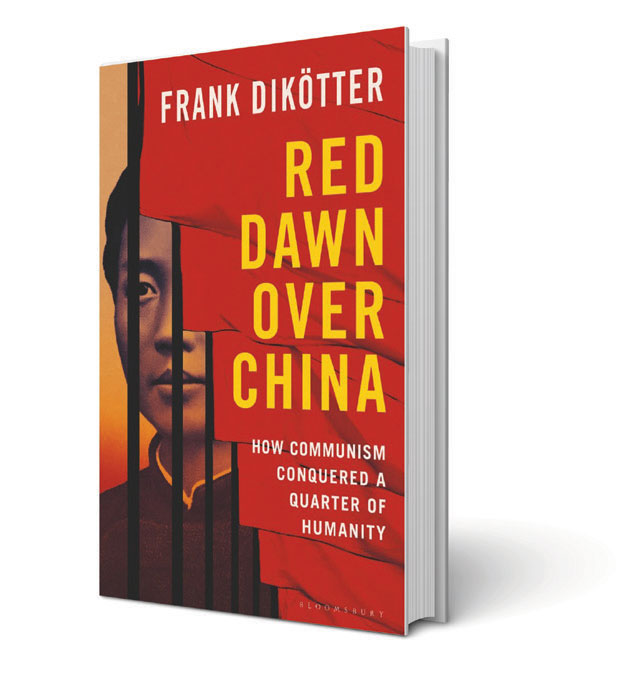
THE BOLSHEVIK REVOLUTION was not a revolution but a coup. The triumph of the Chinese Communist Party (CCP) under Mao Zedong was not inevitable either. It was not the culmination of a popular movement riding the inexorable forces of history. It was a slow and cynical seizure of power through years of ruthless violence, mass murder, deception and manipulation, helped by foreign states, willing friends and unwitting foes.
Historian Frank Dikötter made his name underscoring the bloodshed that has accompanied every turn in communist China’s story, before and after the establishment of the People’s Republic in 1949. Red Dawn over China is a prequel to the trilogy Mao’s Great Famine (2010), The Tragedy of Liberation (2013), and The Cultural Revolution (2016). Here, Dikötter critiques the history of its rise to power as told by the Party and the acceptance of this narrative by Western historians. The title is a play on Edgar Snow’s Red Star over China (1937) which created the Mao legend for the world and made him a household name in China.

Losing Memory
16 Oct 2026 - Vol 05 | Issue 42
The making of a medical and social emergency
For one, from its foundation in 1921 till the end of World War II in 1945, the CCP was utterly marginal to Chinese politics. Before 1940, the Party had one member per 1,700 of the population. When they went underground in 1927, the communists had only 2,600 members in a population of 20 million. Let alone France or Germany, even Salazar’s repressive Portugal had 25,000 communists in 1934. Chinese communists numbered roughly what their counterparts in the US did, a country never at the forefront of the global communist project.
China was not a land ripe for revolution of the Marxist kind. Even feudalism in China was nothing like its Soviet version: there were few landlords and still fewer rich peasants, no real kulaks to hunt and kill. There was hardly much land to redistribute as most of the holdings were too small. Yet Moscow insisted on class struggle and the CCP left behind a scorched landscape wherever it passed through: mass executions, destruction of public and private property, burning whole cities to the ground. Page after page of Red Dawn is strewn with decomposing corpses and body parts. But for all that, even Mao’s Long March was just a disorderly retreat on the point of extinction, later glorified in CCP annals as strategic genius.
The usual moralising of Dikötter’s China books is absent here. It’s the depth of his research that makes the book: Dikötter builds his thesis on 300 volumes of internal Party documents that somehow had made their way to Hong Kong and have been largely ignored by historians as well as the eyewitness accounts of foreigners.
Always the pragmatist, Stalin usually preferred dealing with the Generalissimo, Chiang Kai-shek, himself a pragmatist albeit staunchly anti-communist, than Mao whose rise to the top of the Party wasn’t inevitable either, given his more accomplished rivals. They were felled by the same ruthlessness that ended in the CCP’s ultimate victory. But it was Japan that came to Mao’s rescue with a full-scale invasion in 1937 following its occupation of Manchuria in 1931. Chiang was forced to stop his pursuit of the communists just as his armies were about to vanquish them and accept a union with Mao. Money and arms poured in as Mao held back the communist fighters, letting the Nationalists bear the brunt of Japanese military might, only to occupy territory behind enemy lines. In all this, the US was a naïve enabler. As one observer had said about the communists: “They are so trained in duplicity that duplicity becomes second nature, and after a while they no longer trust anyone at all.” The communists swelled their ranks by ensuring every surviving villager had the blood of his neighbour on his hands.
Dikötter’s sympathy lies with the Chinese peasants and the poor who died in millions. This is not a history of ideas but violence. After all, as Mao had said: “Revolution is not a dinner party.”