Aparna Sen at 80
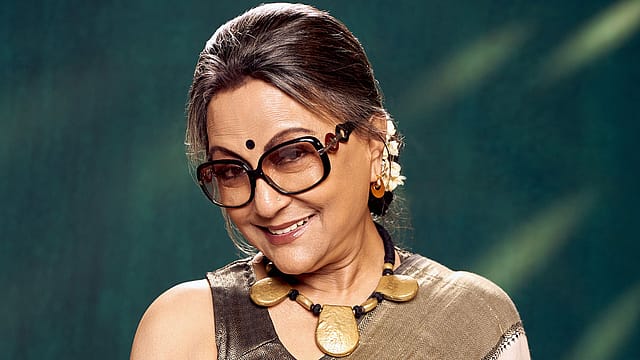
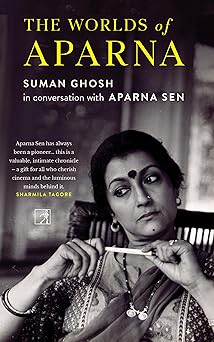
The Worlds of Aparna is made up of supplementary materials from a documentary made by author and director Suman Ghosh about actor and director Aparna Sen. After the completion of the documentary titled Parama: A Journey with Aparna Sen, Ghosh, who is also a professor of Economics at Florida Atlantic University, realised that there had been no scope to use major parts of the interviews he had collected. Thus, was born The Worlds of Aparna, a book that takes a deep dive into Sen’s childhood, upbringing, career, opinions and beliefs, through conversations with her family and friends as well as with herself. Ghosh spoke to Open about the book. Excerpts…
This book is written in a Q&A format rather than a narrative one. How did you decide to go with this structure?
See, first of all, I'm not a writer by profession, I am a filmmaker. And there are certain advantages of a filmmaker talking to another filmmaker, and through that forming a sort of biography. I would actually say that a few books influenced my decision. For example, you know, there is a book where Cameron Crowe interviews Billy Wilder. It’s called Conversations with Wilder. Of course, there’s the iconic Truffaut and Hitchcock book (Hitchcock/Truffaut, by François Truffaut). And finally, there’s a documentary by Shyam Benegal interviewing Satyajit Ray (The Music Room, 1985) based on which Seagull published a book (Satyajit Ray by Shyam Benegal). So, you know, reading those books, I always felt that a fellow colleague will give a perspective which a standard journalist or a writer will not. And also, her replying to my questions is a different form of engagement rather than writing on her life like a typical biography… This format, I think, is more illuminating.
The Modi Years
02 Oct 2026 - Vol 05 | Issue 40
A Nation Rebuilt
When it comes to Aparna San, there will be so many people that you could talk to, to gain a perspective on her life and her work. So how did you select the interviewees?
I chose the people who are there in the book to uncover different aspects of her. So for example, Shabana [Azmi, actor] talks about her both as someone who acted for her, and as a close friend. Konkona [Sen Sharma, actor and Sen’s daughter], of course, worked as an actress on her films and as a daughter… Similarly, I needed a scholarly perspective on her body of work, which is why I spoke to Samik Bandyopadhyay. And finally, there is Kalyan Roy, her husband with whom she has had a deep friendship for last few decades since they were married… I also wanted a director of her generation talking about her and Goutam Ghose was the person. I know that there were issues with Ghose during the Nandigram protests [movement against the building of a Tata Motors factory in West Bengal’s Nandigram area]. So I wanted to bring in how this friendship was sustained given such political differences…
I loved how the structure of the book was such that Sen’s subjective viewpoints were interspersed with the maybe more objective, or at least a different subjectivity, observations of the interviewees. Was this following on the documentary structure, or was there a different reason for it?
… when I was making the documentary, I couldn’t include everybody’s views on, but in the book, I could, which gave different perspectives on the same question. … I had actually almost 12 to 13 hours of footage which was made into an 80-minute-long documentary. So I wanted to put those unused bits out there, which gave rise to the way the book is structured, as you mention.
Why is the question about the lack of the subaltern perspective in Sen’s films so important to you that you felt the need to ask it to multiple people and gain multiple perspectives on it?
Well, first of all, I have to maintain objectivity about my subject, even if she is my friend and an iconic director. If you see the directors working around that time [that she started out with], or senior to her, their quest was humanity in all its forms… but somehow I felt that Aparna Sen’s characters are very much in the upper middle class milieu when you contrast it with, say, Goutam Ghose or Buddhadeb Dasgupta or Ritwik Ghatak or Mrinal Sen… or Shyam Benegal, for example, or Adoor Gopalakrishnan. Everybody has straddled that milieu which crosses beyond just the upper middle class or the middle class, which I find as a lacuna in Aparna Sen’s work. That is my criticism. But of course, that is my subjective viewpoint. I loved Shabana Azmi’s answered to that: why does one person have to address every issue in the world? She has done what she has comfortable with, and that’s it. I can understand that viewpoint. But even talking about feminism, I would have liked to know what she would think about, say, village girls, or the feminism which say Mahasweta Devi [espoused]… that is missing in her [Sen’s] oeuvre. But I am also raising this because I know as a person how empathetic she is to the cause, and not only the feminist cause, but as she mentioned in the book, to many issues in the world. And I find that except Sati … there is a gap, I think, in her work. So that’s what prompted me to ask this question to everyone.
Something that I found interesting in the book was that Aparna Sen herself seems to think of herself as more of a director than an actor, because she says that her acting is not that important. Which aspect of her—the actor or the director —had the most profound impact on you?
Definitely director, for sure, because subsequently I became a director myself. But now, when I look back, her impact as an actress, however she might deny it, is immense. During that time in Bengali cinema, in the late ’60s and ’70s, when she was at her peak doing hardcore commercial films, she brought about a modernity in female actresses which was very unique. Compare her with Suchitra Sen or Madhabi Mukherjee and all, she was completely different—a modern, non-nyaka (coy) Bangali actress. I don’t think she would ever do a film where she would be the dedicated wife or whatever. Also now, when I go and look back at her performance, say in Paromitar Ek Din (2000), in which she played a person that is completely different from who she is as a person, I think that, as [director and actor] Anjan Dutt mentions in his interview, she was not given roles which challenged her.
So you know Aparna Sen personally, through addas, but you also know her professionally, because you worked with her as an actress [in your film Basu Poribar (2019)]. What’s the difference between those two personas?
Oh, I always say that there are two Aparna Sens. One is Rina di and the other is Aparna Sen. Rina di is a very Mashima-pishima (aunt-like) type—she will take care of you when you go to her place, like a mother… though outwardly you see a very modern, sophisticated and suave lady. The other side is Aparna Sen, which we know is a very, very strong personality. She has a strong say in everything. She has guts and honesty. And till now, she has spoken about atrocities whenever possible. That is the Aparna Sen we know, the internationally renowned filmmaker, fashion diva and more.
Since Sen and you do speak about how she often operates from a place of solitude or isolation, do you feel that she also has a kind of disillusionment with the world?
See, Aparna Sen—she’s a fighter. And you know, even last year in the RG Kar protests [protests against the rape and murder of a young doctor in Kolkata’s RG Kar Medical College and Hospital], you saw that she took to the streets at almost 80 years old. She is such a feisty woman. I think till her last breath, she will be going… I’m sure she and many others are disillusioned in the current scenario, not only in India but in the world. But she’s a person who will keep on.
Finally, I loved how Kalyan Roy’s interview ended, where he said that, I hope people are able to see her for how she read our collective past, and how she archived it in her art. Do you think that right now, her art is a little underrated in India?
See, it’s not only Aparna Sen, I would say that in India, everything centres mainly around Satyajit Ray and maybe Mrinal Sen and Ritwik Ghatak. Even now in India, if you talk about the heydays of Bengali cinema, these three greats are mentioned. I find that objectionable in the sense that, it’s as if nothing existed after that— Adoor Gopalakrishnan, Shyam Benegal, they don’t matter. Satyajit Ray was, of course, one of the greatest filmmakers ever born. But even in Bengali cinema, apart from the three greats, there was Tapan Sinha, there is Goutam Ghose, Buddhadeb Dasgupta, Rituparno Ghosh.
So I think there is a huge gap, and these directors are underrated, for sure… And that was one of the reasons I wanted to do this documentary and the book. There was no good book on Aparna Sen! Can you believe it? So as a junior colleague, I just wanted to, in a sense, create a homage, but also a contribution. I don’t know it will be read or not, but this is my contribution to celebrating one of the icons of Indian cinema.