“We started thinking of it as a series of events,” says Nikhil Chopra, curator, Kochi-Muziris Biennale 2025
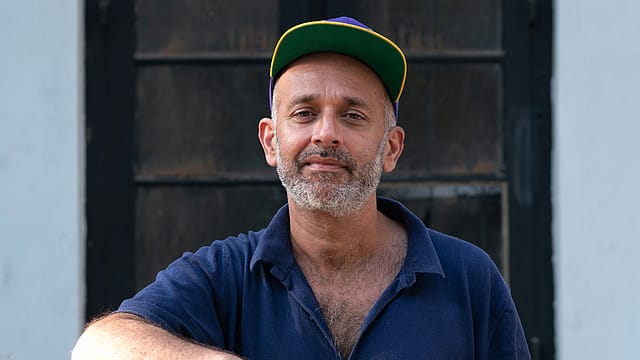
For the curator of Kochi-Muziris Biennale 2025, it began with a practical challenge. With access to only part of Aspinwall House, the Biennale’s traditional centre, the curatorial team had to work across a wide range of venues, from warehouses to island infrastructure. What emerged was a deliberately dispersed exhibition, shaped by the constraints of space and access, and by the need to create continuity across multiple sites rather than rely on a single focal point. Having lived fragments of his own life in Kerala, and having returned repeatedly as an artist and collaborator, Nikhil Chopra approached this edition as someone embedded in Kochi’s culture and constraints.
How did you arrive at the theme for this Biennale?
I am not a stranger to this town. I spent part of my childhood here as a young student at Bharatiya Vidya Bhavan in Ernakulam. I was six or seven, so the memories are faint. I remember being culturally shocked coming to Kochi from Shimla, eating on a banana leaf for the first time. That stayed with me.
Then I went to Dubai and Bahrain, and almost all my teachers were Malayalis. Later, when I went to art school, again—my teachers were Malayali. So Kerala has always sort of followed me, or we’ve followed each other, meeting culturally across the years.

India's Action Hero
27 Mar 2026 - Vol 04 | Issue 64
Riding the Dhurandhar Wave
I’ve performed here at the Biennale before, then returned last year for an invitations project. So there was already a sense of context—an understanding of what this place is, what its strengths are, what its weaknesses are. We also run HH Art Spaces in Goa, working in very similar conditions—old, derelict Portuguese bungalows—and figuring out how to activate them. We consciously moved away from the Bombay white-cube gallery scene, and that really informed our thinking.
We knew these were difficult spaces for contemporary art. So rather than treat this as an exhibition, we started thinking of it as a series of events—the main exhibition being one long, 110-day event. The time spent here, living here, really informed how we worked with the conditions as opposed to against them. That’s where the curatorial note, the proposal, and the invitation to artists came from.
This Biennale doesn’t have a single centre. Practically, what did that change?
Access became the central question—what access do we have, and therefore what access can we create? Not having all of Aspinwall House was a heartbreak from the get-go. It’s such a great venue. Seeing that wall cut through it every day over the past few months was part of the Biennale’s own healing—coming to terms with itself.
Instead of feeling deprived, we started to feel that this might actually be a blessing. A chance to break out of the mould and create something new. Finding new spaces became part of the mandate. We moved here in June and went from warehouse to warehouse, space to space, looking at our artist list and imagining how they would react.
Island Warehouse was a real game-changer. Suddenly we realised that this could be a place where we could attempt to create an extraordinary experience. Placing art in an enormous warehouse became a creative and fresh endeavour. It allowed us to spread into Mattancherry, cross the river to Willingdon Island. The Water Metro station was just coming into effect—on hindsight, all the stars aligned, though at the time it was all a risk.
This Biennale has demanded nerves of steel. I kept telling my team that. You have to be agile, with your feet firmly on the ground. We knew we would open—but to open like this, I honestly never imagined. I am shocked at how well it turned out. There are still artists who need attention on the ground, and production that still needs tightening. But we had built process into the narrative. At some point, we just said, “Open the gates.”
The quality of the work was very strong, but the mood of reception—that was something else. There are things you can plan. And then there are things you absolutely cannot. This was one of those.

What happens to these spaces after the Biennale?
They go back to their rightful owners. The Biennale goes back into its office and starts planning the next one immediately. That’s what it needs—a permanent institutional setup that learns from experience and implements what worked.
Even though management was in place, many people were doing this for the first time. We were inventing it as we went along. There was no formula. That was the scary part—trying to align everyone around a very specific project that had no real precedent except previous editions.
How important is it to have a balance—between global and Indian artists, young and established ones?
Very, very important—and that’s what made the selection process intuitive rather than forced. We’ve worked with artists all over the world for years. The younger curators had a real pulse on what’s happening in places like Baroda, Ahmedabad, Patiala.
Yes, there were boxes to tick—50 percent Indian, 50 percent international, a certain percentage from Kerala. But we were also looking for voices that needed space. I don’t like the term “global south” but artists living outside the Western economic hemisphere. More women than men. Queer and non-binary voices. Artists thinking about disability not as limitation but as resource and material.
We were also interested in artists who place poetics before politics—who project politics with a sense of poetic subversion, without hammering it down people’s throats.
It naturally became a situation where many Indian artists were exhibiting internationally for the first time, while international artists had the experience to work under these conditions. When we started placing practices on architectural floor plans, dialogues began to emerge between emerging and established artists.
I didn’t travel to a single biennale abroad. I stayed in India—Baroda, Santiniketan, Kolkata—visiting studios wherever Indigo Airlines took me. It was eye-opening to see young artists working with such sophistication, living modestly, hand to mouth, but with incredible resilience.
Emerging artists like Dhiraj Rabha have got prime display at Aspinwall House. Was that intentional?
A: Zero hierarchy was crucial. Not placing established artists at the centre and others on the margins. It was about mise-en-scène. At Island Warehouse, we bracketed the exhibition with Dineo at the beginning and Maria at the end, giving centrestage to emerging voices.
Many works seem to be shaped by durational proximity—to pandemics, waste systems, long-term labour.
A: Nobody is talking about the PTSD of the pandemic. We’ve all just pretended it didn’t happen. These artists are addressing how the pandemic changed their lives, what still needs healing. Yes, Gaza is important. Yes, global politics are precarious. Yes, ecology is collapsing. But the pandemic remains unprocessed. That became part of the manifesto that emerged from many roundtable conversations.
Was there a work that fundamentally changed after arriving in Kochi?
A: Every work changed. At some point, artists had to let go of their proposals and respond to what was possible here—systems, labour, rhythm. What a work was supposed to look like doesn’t matter anymore. What it looks like now is what matters. “For the time being”—that’s built into the concept of this Biennale.
Kochi appears both as a site of hospitality and extraction—there is art around communal kitchens and around shipping, labour and surveillance.
It’s in the DNA of this place to host, to welcome, to hold complexity. It took muscle and sleepless nights, but the credit goes to Kochi. To Bose. Only they could mobilise this kind of manpower—builders, painters, electricians, air-conditioning, everything. Thomas Varghese, our CEO, fought constantly for payments, cleared old bills, dealt with GST backlogs. Everyone has been paid. That’s huge. Once we opened, the fear shifted. When 500 people walked into the Island Warehouse on the 14th, I couldn’t even stand. Aspinwall House had rubble all over 24 hours before opening. But the decision was clear: ready or not, we open. We hoist the flag.
There’s also a strong material turn—earth, jute, soil, nets. A resistance to the screen.
The production team deserves immense credit. Craftspeople who worked on Dineo’s domes and with rammed earth—these collaborators took responsibility. They wanted to be considered collaborators, not contractors.