Tyeb Mehta’s ₹69.1 Crore Record and the Rise of a New Auction Model for Indian Art
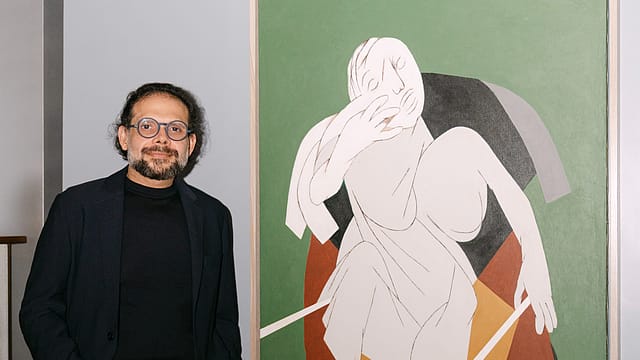
Tyeb Mehta was the anti-thesis of a prolific artist. He eschewed volume for intensity, producing only about 200 paintings in his lifetime which have gained immeasurably in value with time. In 2002, he painted The Rickshaw Puller—returning to a figure that recurred on his canvas several times. It was in the same year that his triptych Celebration fetched $300,000 at a Christie's auction setting a record for the highest-priced painting by an Indian artist; it was also less than less than a decade before his death in 2009. In the 2002 acrylic-on-canvas rendition, Mehta’s rickshaw puller is a lone figure—characteristic of the artist’s work—whose existence seems compressed into his vehicle. The striking green backdrop of the only heightens the sense of anguish.
This month, the painting went under the hammer for ₹69.1 crore. It marks a global record for the late artist as well as a shining start for Volte Una, a new single-lot auction platform that put up Mehta’s work as its debut offering. In the weeks preceding the auction, which took place on October 11, Tushar Jiwarajka—founder of Volte Art Projects and the mind behind Volte Una—presented Mehta’s painting in an intimate format to select collectors. “This is the whole concept—that the rarest works you don’t find easily deserve their own space. They deserve their own focus and standing,” he told Open during a preview of The Rickshaw-Puller in Delhi.

Zeroing In on ECI
09 Oct 2026 - Vol 05 | Issue 41
Constitutional legitimacy versus political opportunism

Having worked as a gallerist and private dealer for close to two decades, Jiwarajka finds joy in the pursuit of bringing a work of art to a collector who will cherish it. Having identified a “pipeline of interesting works” he envisioned Volte Una as a platform that would give masterpieces their rightful spotlight. At multi-lot auctions, the sheer number of objects can eclipse their individual worth. A rare, valuable work of art may end up being given the same significance and a collector’s time as a work of far lesser value. “I felt that it’s important that the right price-discovery happens for masterpieces,” Jiwarajka notes. “Let the people who actually want to buy these decide—and may the best person win the work rather than negotiating from an asking price.” Although Volte Una has employed an auction format, its focus on a single work of art sets it apart and Jiwarajka seeks to make his impact through word-of-mouth and personal relationships.
Mehta’s painting has been a fitting work for such a venture. It was first acquired by art collector Amrita Jhaveri in the same year Mehta painted it, from an exhibition hosted by Vadehra Art Gallery in Mumbai. It was later acquired by a Delhi-based private collector through Saffronart who later resold it in 2021 to a US-based collector. Its well-documented provenance makes it valuable but its rarity is equally important. Mehta’s works are nowhere as ubiquitous as artists such as MF Husain or SH Raza. They have also been exhibited on a handful of occasions—such as earlier this year, when the Kiran Nadar Museum of Art (KNMA) in Delhi presented Tyeb Mehta: Bearing Weight (with the lightness of being) to mark his centenary year. “In the last five years, there has not been a single major acrylic by Mehta that has come out in the market,” Jiwarajka says, while observing that it was only “after he moved from oil to acrylics in 1985 that Mehta really hit his stride” as an artist. All these factors combined make The Rickshaw-Puller an exception work of art, worthy of exclusive attention in a booming, competitive market.
The Indian art market has evolved by leaps and bounds during Jiwarajka’s career. “What has been great that that art is now firmly established as a real asset-class,” he says. “There’s more depth in the market than ever before.” The value of Indian art, particularly those by the Modernists are on the rise, though Jiwarajka observes that their value is still significantly lower than what Western or Chinese markets where it is not uncommon for art to cross the $100 million mark at auctions and private. In comparison, only two works by Indian painters have fetched more than $10 million dollar in sales—Raja Ravi Varma’s Yashoda and Krishna (1890s) acquired by businessman Cyrus Poonawalla for $17.9 million at a Saffronart exhibition this year and MF Husain’s Untitled (Gram Yatra) (1954) purchased by prominent art collector Kiran Nadar for $13.8 million at a Christie’s, New York auction in 2025.
A single-lot auction format like Volte Una can potentially present the work of Indian masters in a manner that highlights their value. The record set by Mehta’s work points to this direction. Next, Jiwarajka is planning the auction of a rare MF Husain from the Herwitz Collection in November. It is accepting application to consign major works and one-lot at a time.
Jiwarajka does not intent to limit Volte Una’s format only to art. “This is a platform for Indian masterpieces. It could be in any form and could be linked to India in different ways,” he says. It could be a rare Rolls Royce that once belonged to a maharaja, a “fabulous Mughal emperor’s necklace or a miniature painting”. The focus is also on the valuable and the rare, and what will be deemed desirable for the most serious and discerning collectors. It could even be a “really interesting piece of real estate” he says, smiling at the possibilities. It is exactly in line with how Jiwarajka maps his own entrepreneurial journey and the future of Volte Una. “When I started Volte 18 years ago, I didn’t know where I’d go,” he says. “Every business has its own journey. I am happy to see where this leads.”