The Transmission of the Guru
The iPhone’s delivery of news is instant and spans all corners of the Earth. In 1974, that was not the case for the man who would eventually be responsible for creating the phone.
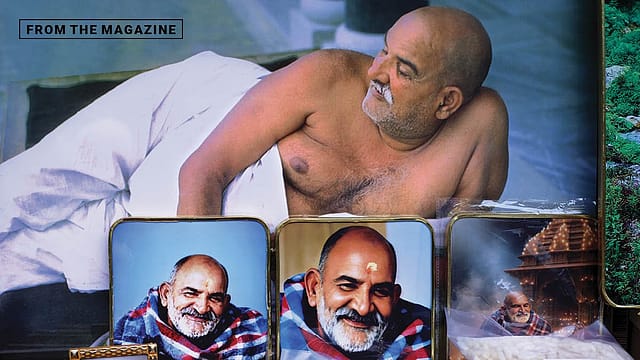
Steve Jobs, long before founding Apple, all of 19 and deeply interested in what was termed Eastern philosophy, left his job at Atari to find himself a guru. He had heard about a saint named Neem Karoli Baba who lived in the Himalayas. When Jobs arrived in Delhi, he promptly got dysentery losing 18 kilos in a week. He went to the Kumbh Mela in Haridwar and a few days later, reached the foothills of the Himalayas, only to find that Neem Karoli Baba had been dead for over a year-and-a-half. Jobs hadn’t bothered to check before setting out from the US.
He rented a room, slept on the floor while a family helped him recuperate. “There was a copy there of Autobiography of a Yogi in English that a previous traveller had left, and I read it several times because there was not a lot to do, and I walked around from village to village and recovered from my dysentery,” he is quoted saying in his biography, Jobs, by Walter Isaacson. There were other Westerners there. Isaacson names Larry Brilliant, “an epidemiologist who was working to eradicate smallpox and who later ran Google’s philanthropic arm and the Skoll Foundation.” Many more would follow in the coming decades, like Facebook founder Mark Zuckerberg, and Google cofounder Larry Page.

Zeroing In on ECI
09 Oct 2026 - Vol 05 | Issue 41
Constitutional legitimacy versus political opportunism
In how Jobs learnt about Neem Karoli Baba, you can trace the globalisation of Indian gurus. He was told by a friend, who himself got to know of the Baba from a man named Ram Dass, formerly a psychologist who had been fired from Harvard University. He would write a book called Be Here Now in 1971 about his spiritual journey in India and being with Neem Karoli Baba. He gave lectures that brought many in the US into contact with Indian spirituality. He didn’t make Americans interested only in Neem Karoli Baba. He went to 10-day retreats of Vipassana, a form of Buddhist meditation, that were being conducted by a businessman-turned-meditation teacher, SN Goenka. His retellings of those contributed to popularising the meditation. Western seekers were moving from guru to guru, spiritual practice to spiritual practice, and taking it back home to get an ever-increasing number of adherents. There was the 20-minute meditation of Mahesh Yogi. In 1968, the Beatles came and spent time in his ashram in Rishikesh. There was the cult of Rajneesh, an exceptional orator preaching non-restraint while progressing to a higher reality. There was Swami Chinmayananda, who went into the Himalayas to learn Advaita Vedanta, and then returned to teach about incorporating it into the modern world. There was BKS Iyengar, who was making Yoga popular across the world. He published Light on Yoga, a classic whose foreword was written by the violinist Yehudi Menuhin. They all began to get scale in the 1960s.
It wasn’t a new phenomenon. As far back as 1893, Swami Vivekananda had gone to the US and done a tour, the highlight of which was an address to the World’s Parliament of Religions in Chicago. The Ramakrishna Mission he set up continues to be a pillar of the Indian religious edifice today. One of the early Westerners to come searching for Indian spirituality was Paul Brunton. In 1934, he wrote a book on it which ended with a moment of rapture he experienced at the ashram of Ramana Maharshi in the presence of the guru. What changed in the 1960s and ’70s was the ever-increasing reach of mass media like television. Travel was easier. More people were literate enough to read books and there was economic surplus to not be caged by work. One of the key factors was a change in the US immigration law in 1965 that removed a limit of 100 Indians per year. More could now settle in the country. Gurus began to go to the US and directly speak about their traditions and practices. They became one more of the many globalisations taking place. It is in that context that Neem Karoli Baba, who had no organisation and did not move beyond the confines of the Himalayas, became a lodestone at the other end of the world.
The mechanism through which this was distilled was the power of stories. In the absence of an institution, they did all the work. In 1979, Dass brought out a book, Miracle of Love, which collected the experiences of followers of Neem Karoli Baba. Almost everyone had a story and almost everyone came to him after hearing a story about him. Many are in this vein: “Maharajji could give you a whole teaching just in a glance. You’d be sitting there, going through some incredible suffering in your mind. He would just look at you and your whole being would change. I don’t know if he was actually doing anything or whether it was just the way he looked at you, but you knew that the universe was right and that you were taken care of. At other times, you’d be going off on some mental tangent, when with just the slightest glance from Maharajji, you would be totally demolished.”
The teachings were bare basics, unlike many of his contemporary gurus, with structured philosophies and organisations. Word-of-mouth has been a traditional and powerful lever in India when it comes to religion. Anecdotes about Neem Karoli Baba moved without hurry, first locally, then nationally and then globally. It is the same phenomenon that has happened with the movie Hanuman Ansh. It came with no bang and after a few weeks, touched an invisible chord and has since become a blockbuster with no marketing. The stories had begun to travel again.