The changing look of Indian calendars
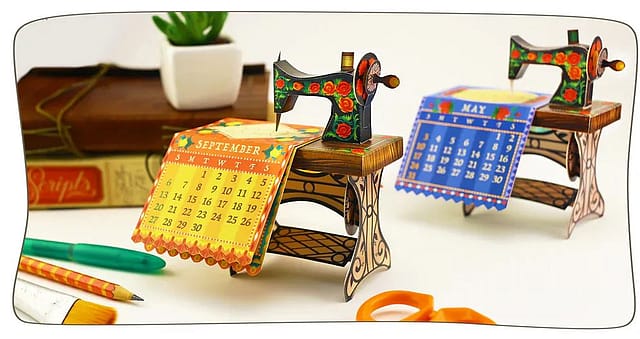
As one year makes way for another, an array of posts advertising calendars for 2026 fill up social media feeds. A calendar by Twillo Story, a “creative wellness and self care brand”, is designed as monthly date cards, perched on a wooden stand, each featuring a pastel-hued illustration and inspiring messages. Sustainable calendars are made of bamboo and plantable seed paper. At Sky Goodies, the homegrown paper craft brand which has gathered a loyal fan following over the years, calendars come in all shapes and sizes. Calendars come in the shape of mini toasters, sewing machines, typewriters and grand pianos—these are sold as kits to be cut and folded into the final three-dimensional designs, adding a DIY-twist to the project.
These are different expressions of the calendar from the highly saturated, colourful images that dominated mass-produced calendar art in the country for decades and became a singular form of visual culture. Going beyond its basic function, calendars i reflected faith and belief, as much as taste. They became a showcase of popular culture, and a commercial tool as much as a creative enterprise. India has its own traditions of astronomical almanacs, the Panchangam (also known as the Panchanga), the Kaalnirnay or the Panjika, which remain in use especially to determine religious occasions and festivities. When the Śaka calendar was chosen as India’s national, civil calendar in 1957, it was the culmination of half a decade of work by the Calendar Reform Committee (under the Council of Scientific and Industrial Research) headed by Meghnad Saha and studying 30 different calendars in use across the country. With different regions marking their new year during different months, timekeeping in the country is also a multicultural phenomenon.

Survival Instinct
22 May 2026 - Vol 04 | Issue 72
India navigates global economic turmoil with austerity and smart diplomacy

The popularity of wall calendars can be traced back to the late 19th and early 20th centuries when the rise of lithographic printing technologies brought a new visual aesthetic to calendar art in India. Raja Ravi Varma’s lithographs of goddesses and mythological figures came to be used on calendars, and the artist is sometimes called the father of Indian calendar art. Religious and mythological images became central to the iconography of Indian art, as printing studios in the country began to produce calendars featuring gods and goddesses, episodes from epics such as the Ramayan and Mahabharat or even spiritual leaders. Artists came to known for their work on calendars such as Kondiah Raju, whose paintings were much sought-after across printing presses in Sivakasi, or Yogendra Rastogi who worked out of Meerut.
Looming over the bold typography, these images stood out on walls in all their highly saturated colours. The bright, kitschy aesthetic came to dominate the visual language of mass-manufactured calendars in India. In Gods in the Bazaar: The Economies of Indian Calendar Art, Kajri Jain writes of their sheer abundance and variety: “While the majority depict Hindu deities, there are also images from India's many other religious, including Islam, Christianity, and Buddhism, which are often placed for worship in personal shrines. There are movie stars, chubby babies, and seductive women; patriotic figures and personifications of the nation; animals, landscapes, and cityscapes, all in vivid, saturated colors often further embellished with gold dust, sequins, glitter, or flowers.” Calendars came to be adapted to specific regional beliefs and seasons. In Bengal, the Gregorian calendar (from January to December) is as common as calendars made for the Bengali calendar year beginning in April. Images of Jesus Christ holding up his hand in blessings, or baby Jesus cradled in his mother, Mary’s arms are common in calendars.
Artists also painted national leaders and milestones from India’s struggle for independence. An anonymous calendar for 1946-47, in the DAG collection, depicts Netaji Subhash Chandra Bose with the Rani of Jhansi regiment marching to “Chalo Delhi” while Mahatma Ganchi and Jawaharlal Nehru gaze from an inset image framed by the sun. Another, by the artist Sobha Singh, titled When the Goal was in Sight” dated to 1946 depicted the Shimla Conference. Meanwhile, BR Ambedkar and Dalit leaders featured on Dalit-Bahujan calendars, which K. Kalyani links to anti-caste consciousness in the paper, “Resistance in Popular Visuals and Iconography: A Study of Dalit-Bahujan Calendar Art in North India”. Kalyani writes: “The ‘visual rhetoric’ of anti-caste sentiments and Bahujan identity was invoked through rejecting those calendars that portrayed Hindu Gods and Goddesses and instead substituting it with Bahujan Nayaks.”
If national leaders and deities continue to capture the imagination of calendar artists and public alike in the decades post independence, so did new forms of popular culture. Actors and actresses began to appear on calendars, often sponsored by brands and commercial enterprises. If a Lux calendar from 1954 featured the likes of Suraiya, Meena Kumari, Kamini Kaushal and Shashikala, later decades saw Neetu Singh (for a Signal Light matchbox calendar), Kimi Katkar and Sonu Walia appearing on calendars. Their appearances became more stylised and glamorous, as photographers like Dabboo Ratnani made Bollywood-themed calendars featuring a bevy of stars each year. In 2020, bringing together two different eras of calendar art, photographer G Venket created a limited-edition calendar to featuring South Indian film stars such as Khushbu Sundar and Shruti Hassan among others dressed up as women from Raja Ravi Varma’s most iconic paintings.
However, the biggest inflection point for calendars may have come in the last decade or two. A calendar is no longer a necessity when one only needs to tap open their calendar apps to see dates from the past, present and future. In this new market, aesthetics play a bigger role in the choices upwardly mobile, young Indian make. “Calendar in a new middle class home is an exhibitionist item and this explains the reluctance of the new middle class to display old-fashioned calendars in the public domains of their homes,” writes Anirban Mukherjee in ‘The Changing Vogue of Calendar Art Among the Middle Class in Urban India’ (2020), highlighting research that old-fashioned-devotional calendars often end up in prayer rooms. Quirky, design-forward calendars, messages of positive affirmation, art-inspired prints and illustrations turn calendar into decor objects while the dates and days seem to blend into the background.
But storytelling remains a running thread and a dose of vintage appeal can still prove to be a winner. In Sky Goodies’ lineup of calendars, the Be Good design, features painted images and resolutions. A woman, decked up in a sari and jewellery, kisses a frog while the text makes a case for believing in magic; a young boy hugs his cat and dog with the affirmation that “I will love my family.” Or take the I See Desi-gn (ISD) tear-a-day calendar from the design label mubhi, depicts India-inspired art in bold colour, English and Hindi text, historical trivia and factoids and upcoming events. If Sky Goodies finds inspiration in the bygone 'Good Habits' charts of India (which have become memeworthy in recent years), mubhi takes cue from old Tamil tear-a-day calendars. Both understand that times may have changed what a calendar represents, but the very act of choosing to have it is a nod to nostalgia.