“The Biennale Has a Long, Sustained Afterlife,” says Bose Krishnamachari
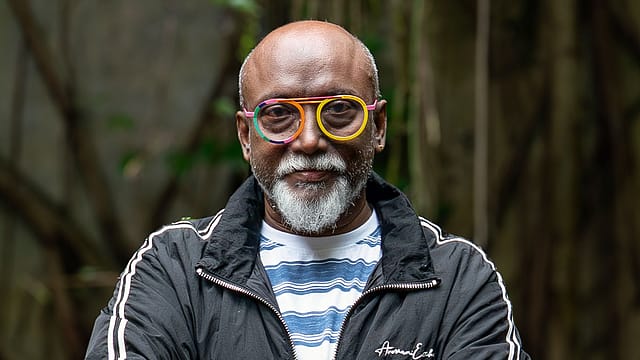
The 2025 edition of the Biennale is spread across an unusually large number of venues. What did it allow artists to do that wasn’t possible earlier?
When the curator was selected—Nikhil Chopra was chosen by a five-member jury—I was part of that jury along with members from the Foundation and the organisation. One of the things we made clear to the jurors was that we wanted an artist-curator, and ideally an Indian curator. If not, then someone who could still move fluidly within this context.
When the proposals came in, what stood out in Nikhil’s proposal was its emphasis on working on site—on workshops, on processes, on spaces that would be discovered and activated rather than predetermined. He wanted to bring his own team from HH Art Spaces. Initially, we were hesitant. But he insisted—and eventually we agreed—because the proposal demanded trust in process.
What we loved was the idea that the Biennale wouldn’t be fully predictable. That art-making would unfold here, on site, in conversation with the city, its labour, its materials. That requires a very different geography—one that extends beyond conventional exhibition spaces.
Performance seems very central to this edition. Was that a deliberate emphasis?
It’s not simply because Nikhil is a performance artist—though he is. He’s also an incredible painter. He began as a painter and moved into performance, and I’ve followed his practice closely for many years. I was one of his early collectors.

India's Action Hero
27 Mar 2026 - Vol 04 | Issue 64
Riding the Dhurandhar Wave
Performance, for us, is not a category—it’s a way of working. It’s about presence, temporality, and engagement. It fits very naturally with this idea of process-driven art. And yes, friendship plays a role here too—the “friendship economy” you may have heard about. It’s not about curatorial cleverness. It’s about trust in making, and in the people you work with.
There also seems to be a shift away from star power toward collectivity, even though there are many internationally recognised artists.
Collectivity has always been central to KMB, especially in its early years. Many of the artists selected are deeply socially committed. Take Ibrahim Mahama, for example—his work is inseparable from ideas of community, care, and shared labour. This edition is very much about care, love, and sharing spaces with others.
When we started the Biennale, people didn’t even know what a Biennale was. Today, it has given confidence to an entire generation—across architecture, design, art, and beyond. Many of the people working here as volunteers are highly educated, but they are also learning through practice, through freedom, through exposure.
You have often spoken about giving back. How does that philosophy shape the Biennale’s approach to artists, especially local practitioners?
I don’t believe in schools—Bombay school, Bengal school, Kerala school. I believe in diversity. But I also believe in opportunity. Wherever I have worked, I’ve tried to give back.
My career began in Bombay. My first curatorial work was in 1987. Giving back to society is essential. That’s why we invite artists who want to understand the local culture, the social structure, academia—who can think and practice at the same time.
The Biennale is temporary, yes. But it has a long, sustainable afterlife. It opens doors. It sends people in new directions. That, for me, is its greatest achievement.

This edition appears to have posed unique logistical challenges—local fabrication, multiple performances, talks, and coordination across labour systems. How have you managed that complexity?
We create a bit of chaos—and then we try to make order from it. That’s how it works.
We have strong teams at the Foundation who understand local labour policies and systems. We work very closely with political and labour unions. You have to understand how this system works—once you do, people support you fully, whether it’s a large-scale work or a small one.
There’s also mutual learning. We learn from local labour practices; they learn new technologies and methods. Slowly, a shared understanding develops.
Is a local craft economy emerging around the Biennale?
Yes, very much so. We have conducted over a hundred workshops through our education programmes. We are trying to develop our own standards—artistically, structurally, even in how we think about branding.
It’s not about importing models. It’s about building something rooted here.
How has your own role evolved over the years—as founder and president of the Biennale?
Titles don’t matter to me. Whether I’m president or just a friend of the organisation, I remain a worker. As Karl Marx said, man is a maker. I believe in making—not just imagining. Imagination is always faster than life. But how you give it form—that’s what matters. I keep working. That is my celebration.
When audiences walk through this Biennale, across its many venues, what do you hope they will notice and take back home with them?
Recently, a gallery director told me she had goosebumps—that this was one of the most powerful experiences she had seen. There are many such moments.
What matters to me is that people—especially students and young practitioners—get opportunities. India has so many art institutions, most government-run, and many students never get exposure to original practices. Here, they meet artists, collaborate, observe, learn. Those moments stay with them.
I travelled the world to gain knowledge. Now, young people can encounter great artists in their own city. That is powerful. If that learning, that momentum, carries forward—even after these three months—then we have done something meaningful.