The Banarasi Shikargah’s New Textile Trails
A snow leopard is an elusive sight, even in its habitat, an animal camouflaged in the Himalayan terrains of snow and stone. But to see it leaping on the length of a Banarasi sari is a rarer wonder—a figure unknown to the textile tradition’s vocabulary. It is one of the stories that Tilfi, the clothing label founded in 2016 by Aditi Chand, Udit Khanna and Ujjwal Khanna, is now bringing to the handloom stories of the Banarasi Shikargah.
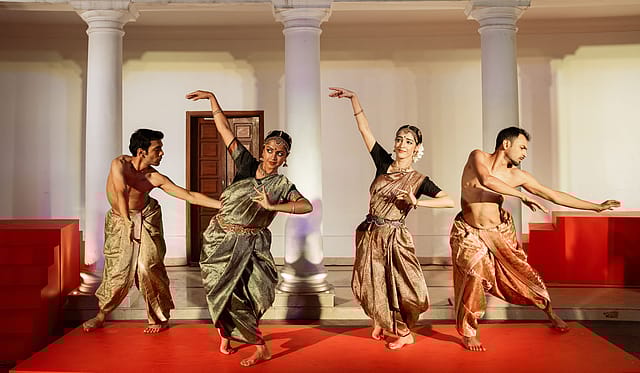
In a recent exhibition in Delhi, titled ‘Heritage in Motion’, Tilfi showcased its new textiles and other design interventions through an experiential mix of textile displays and performance art. Among a mix of the brand’s various design interventions, including linen and Pashmina Banarasi and ready-to-wear, Shikargah stood out with main character energy. It wasn’t only the line of saris draped on mannequins and displayed in a gallery setting. Shikargah scenery also shone on the brass repoussé works, a recent extension from the brand incorporating another longstanding craft from Varanasi. A line of textiles showcased new design explorations while a Bharatnatyam recital, choreographed by Keelaka Dance Company with creative direction by Howareyoufeeling.studio, translated the theme into performance.

Losing Memory
16 Oct 2026 - Vol 05 | Issue 42
The making of a medical and social emergency
The Shikargarh design grammar draws its name from the Persian-origin word shikārgāh, used to describe a royal hunting ground which served as sites for elaborate hunting games. Banarasi Shikargah saris and textiles depict scenes of such hunting escapades, with humans, flora and fauna woven in exceptional detail. Think of it as a painterly scene unfolding on a canvas of cloth. As conversations around handlooms and textile arts have gained greater attention over the last few years, with artisanal communities and textile-led enterprises gaining market visibility, demand for the Shikargah’s elaborate gilded scenery has also risen.

Chand, co-founder and CEO of Tilfi, observes that Shikargah is one of the most figurative designs within Banarasi’s diverse repertoire. The brand has offered Shikargah design from its early days, when it began as a fashion-forward textile label rooted in Varanasi’s weaving traditions. But over the last year or so, Chand and the Tilfi team have turned their lens on building the Shikargah’s aesthetics for a contemporary market. The Banarasi, a GI-tagged handloom, remains one of the most popular textiles in the countries favoured for weddings and special occasion. New homegrown labels and design interventions have elevated the expertise of the region’s weavers and brought new products to the market. “Our love for Shikargah, apart from its visual appeal, also stems from the fact that it is a tradition followed by a certain artisanal community. To keep their practice alive, it make sense to keep bringing new inspirations and language which work with what they were already familiar with,” she says. “We don’t want to make a drastic departure from what the Banarasi is or what it stands for. New intervention doesn’t have to be alien to artisans, but build on their existing skills.”
Archival designs offered inspirations for Tilfi’s original designs. “As we had to confidence to push boundaries, we started looking at ways to reframe the conversation around Shikargah,” she says. “We thought if we could look at a more contemplative expression rooted in an observation of nature, the symbolism of animals and how can those qualities be transferred to the wearer who finally drapes the textiles.”
These ideas also engage make the weaving tradition part of a contemporary milieu where hunting has made way for conservation. The big cats and animals which were once game on the textiles are reimagined as protagonists. Deer and tigers seem to chase each other across the border of one sari, while peacocks perch among densely-woven zari foliage. Tiger peek from behind tall grasslands while a lion occupies a corner of a sari usually occupied by paisley and floral motifs. Like the snow leopard, the panther is another new addition to the woven vocabulary. “Our team enjoys starting with an idea and choosing the right technique to translate it on to textiles,” says Chand, highlighting the use of meenakari and zari vasket to evoke the animals’ depth and movement.
Tilfi works with close to 2000 artisans, and Chand notes that these contemporary practices lead to cumulative growth for crafts communities as they seek sustained livelihoods. “It is not so much about revival, as much as giving artisans the right patronage,” she adds. “The weavers, their skills and this ecosystem have always existed. We are privileged to have them.” As the brand’s tryst with the Shikargah continue, Chand to turn attention to similar interventions for other techniques and designs from brass works to the Jamdanis woven by Banarasi artisans, a textile she counts among her personal favourites.