Steve Jobs came looking for him, Mark Zuckerberg followed: The Neem Karoli Baba story behind Hanuman Ansh
Picture a small ashram tucked into the Kumaon hills.
There are no corporate headquarters here. No glass towers. No Silicon Valley pitch decks. Just a temple, devotees and the memory of a spiritual teacher whom followers called Maharaj-ji.
And yet, decades after his death, his name keeps turning up in some rather unexpected places.
Steve Jobs came looking for him. Mark Zuckerberg later visited the same ashram. Hollywood actor Julia Roberts has spoken about being drawn to his photograph. And an American psychologist named Richard Alpert would leave India with a new name — Ram Dass — and a spiritual journey that would introduce millions of Western readers to the world around his guru.

Zeroing In on ECI
09 Oct 2026 - Vol 05 | Issue 41
Constitutional legitimacy versus political opportunism
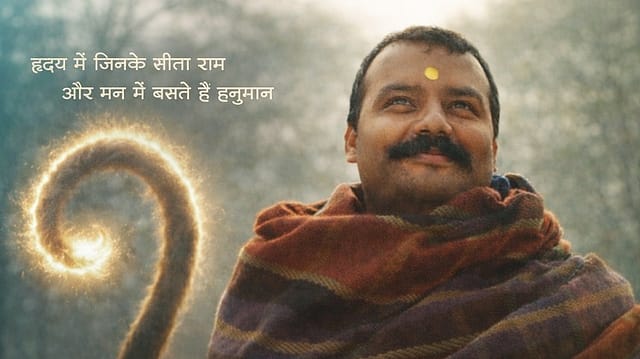
Now, Neem Karoli Baba is back in the spotlight through Hanuman Ansh, Vishal Chaturvedi’s devotional drama about his life.
The film, released on August 7, has become an unlikely box-office story. Made on a reported budget of around ₹2 crore, it crossed ₹50 crore in India after opening to just ₹10 lakh, according to The Indian Express. On September 2, Chaturvedi also confirmed that work on a sequel has begun.
But who exactly was the man at the centre of this story?
Who was Neem Karoli Baba?
Neem Karoli Baba, also known as Maharaj-ji or Neeb Karori Baba, was a Hindu spiritual teacher and a devoted follower of Lord Hanuman.
His birth name is generally given as Lakshman Narayan Sharma, and he was born around 1900 in Akbarpur, Uttar Pradesh. Accounts of his early life vary, and even his devotees have often described his biography as difficult to pin down.
He spent periods of his life as a wandering sadhu before returning to family life and later embarking again on a spiritual path.
He died in Vrindavan on September 11, 1973.
What survived him was not a conventional body of philosophical writing but a vast collection of stories, memories and teachings preserved by devotees.
At their centre were ideas that sound remarkably simple: love, compassion, devotion and seva, or selfless service.
Why is Kainchi Dham so important to Neem Karoli Baba?
If Neem Karoli Baba has a geographical home in popular memory, it is Kainchi Dham.
Located in Uttarakhand near Nainital, the ashram became closely associated with Baba during the later years of his life and eventually became a pilgrimage centre for his followers.
But Kainchi Dham's story did not end with his death.
It travelled.
And one of the people who helped carry it much further was a young American psychologist.
How did Ram Dass take Neem Karoli Baba's teachings to the West?
Before he became Ram Dass, he was Richard Alpert — a Harvard psychologist who had been involved in research into psychedelic drugs alongside Timothy Leary.
In 1967, Alpert travelled to India.
There he met Neem Karoli Baba, an encounter that transformed the direction of his life. Baba gave him the name Ram Dass, meaning "servant of God", according to the Ram Dass organisation.
Ram Dass eventually became one of the most influential Western teachers of Indian spirituality.
Then came Be Here Now in 1971.
The book blended autobiography, spiritual instruction, meditation and Indian philosophy, and became a counterculture classic. The Ram Dass foundation says it introduced meditation, yoga and Eastern spirituality to millions of Western readers.
That is arguably the most important bridge between Neem Karoli Baba's Himalayan ashram and the Western spiritual imagination.
The guru himself did not travel to America.
His stories did.
Did Steve Jobs actually meet Neem Karoli Baba?
No — and this is an important distinction.
Steve Jobs travelled to India in 1974, hoping to meet Neem Karoli Baba. But there was a problem: Baba had died the previous year.
Jobs therefore never met him.
He did, however, visit Kainchi Dham during his time in India. The Indian Express, citing Jobs's 1985 interview with Playboy, notes that Jobs later spoke about the profound effect his Indian experience had on his perspective.
So the popular shorthand that “Neem Karoli Baba influenced Steve Jobs” needs a little unpacking.
There was no guru-disciple relationship between the two.
It was instead a spiritual trail that Jobs deliberately followed — one that led him to India and to an ashram whose central figure had already passed away.
Why did Mark Zuckerberg visit Kainchi Dham?
More than four decades after Jobs's Indian journey, another technology giant arrived at the same spiritual destination.
Mark Zuckerberg visited Kainchi Dham during a difficult period for Facebook.
Zuckerberg had reportedly been advised by Jobs to visit the temple. Zuckerberg later spoke about the India trip and how it helped him reconnect with Facebook's original purpose.
The story is striking because the connection between the two tech entrepreneurs runs through the same place.
Jobs went searching for answers in India.
Years later, Zuckerberg was sent there by Jobs.
And at the centre of both stories sits an ashram associated with a guru who had died decades earlier.
What is Julia Roberts' connection with Neem Karoli Baba?
Julia Roberts' connection is different.
She did not travel to Kainchi Dham to meet Neem Karoli Baba.
Instead, she has spoken about being drawn to his photograph.
In an interview with ABC News' George Stephanopoulos, Roberts explained that she became interested in Hinduism after seeing a picture of Neem Karoli Baba, despite knowing little about him at the time.
That makes her story another unusual chapter in Baba's global afterlife: someone who never met him, and encountered him only through an image, nevertheless felt a powerful connection to his spiritual legacy.
What did Neem Karoli Baba actually teach?
Strip away the celebrity names, the stories of miracles and the mythology that has grown around him, and the teachings associated with Neem Karoli Baba are surprisingly straightforward.
Love.
Serve.
Remember God.
Ram Dass's writings about his guru repeatedly return to service, compassion and devotion. The Ram Dass organisation describes karma yoga, or spiritual practice through selfless service, as one of the paths Maharaj-ji encouraged among his devotees.
His devotees also preserved teachings around seeing the divine in others and accepting people beyond divisions of religion and social status.
That simplicity may be part of the reason his legacy travelled so well.
You did not need to be a monk to understand it.
You could be a student, a musician, a technology entrepreneur — or simply someone looking for a different way to live.
What is Hanuman Ansh about?
Hanuman Ansh takes that spiritual journey back to its Indian roots.
Directed and written by Vishal Chaturvedi, the film follows Lakshman Das from childhood and spiritual awakening to his transformation into the man devotees would come to know as Neem Karoli Baba.
The story centres on his devotion to Lord Hanuman and the ideas of love, compassion and selfless service that became central to his spiritual identity.
Chandan Anand and Shobhinaw Satyaa lead the cast, with Satyaa portraying Neem Karoli Baba.
Interestingly, Satyaa was not originally meant to play the lead. He was working as a second assistant director when the original actor fell ill. Director Chaturvedi then reportedly auditioned him for five hours before casting him in the role.
Why has Hanuman Ansh suddenly become a box-office surprise?
This is where the story gets even more unexpected.
A film about a spiritual teacher who died more than five decades ago opened quietly, with around ₹10 lakh on its first day.
Instead of disappearing, it grew.
By September 1, The Indian Express reported that the film had crossed the ₹50 crore mark in India, riding on word of mouth. The director said his team travelled from theatre to theatre as bigger releases threatened to push the film out of screens.
On September 2, the film's unexpected run produced another update: Chaturvedi confirmed that a sequel is in the works.
Kangana Ranaut has also praised the film, describing the experience in spiritual rather than conventional cinematic terms.
And suddenly, the story of Neem Karoli Baba is no longer confined to old photographs, devotees and an ashram in the Kumaon hills.
It is playing on cinema screens across India.
How did a quiet guru become a global spiritual figure?
Perhaps that is the real story behind Neem Karoli Baba.
He did not build a global technology company.
He did not write a bestselling business book.
He did not travel the world giving motivational talks.
Instead, a chain of people carried his influence outward.
A young American psychologist met him and became Ram Dass.
Ram Dass wrote Be Here Now.
Western seekers followed those stories back to India.
Steve Jobs came looking for Baba, even though he arrived too late to meet him.
Mark Zuckerberg later visited the same spiritual centre.
Julia Roberts encountered his photograph and spoke of the pull she felt towards it.
And now a ₹2-crore film about the guru has crossed ₹50 crore and spawned plans for a sequel.
The journey from Kainchi Dham to Silicon Valley, Hollywood and finally the Indian box office is an unlikely one.
But perhaps that is exactly what makes Neem Karoli Baba's story endure.
The man himself remained in India.
The idea of him travelled.
(With inputs from yMedia and agencies)