Menswear makes the first move on the opening day of Lakme Fashion Week x FDCI
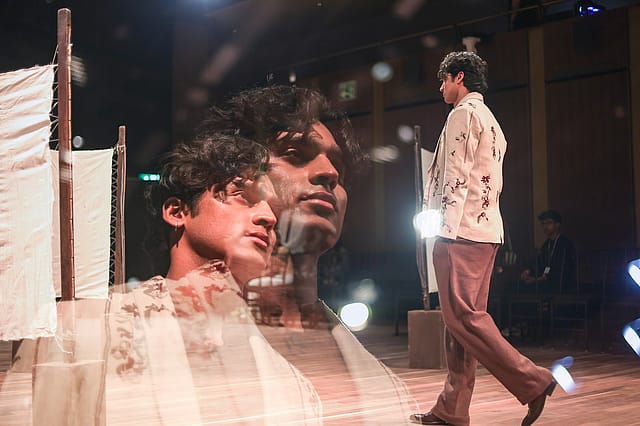
The latest edition of Lakmē Fashion Week x FDCI (LFW x FDCI) began on March 19 with a switcheroo. Conventionally, barring an occasional opening night spectacle, LFW x FDCI begins with the Gen Next show—a longstanding launchpad for emerging designers. This year, as guests arrived at Jio World Convention Centre in Mumbai (where the event is ongoing until March 22), the calendar for the four-day event began with a menswear show, ‘The Boys Club’. Sunil Sethi, a natty dresser himself and president of FDCI, which presented the show, described it as an “homage to the man who likes to experiment innovatively.”
It was an unusual choice but hardly an odd one. Men’s fashion, once considered niche, is now one of the hottest categories in the segment—no longer concealed in the shadow of womenswear. In a gradual shift, that is both cultural and sartorial, men have come to be not only willing to invest in fashion but find their own expression of style. In response, the market has stepped up, across price points and brands, with a staggering variety of designs to choose from. ‘The Boys Club’ was an attempt to showcase this array in the category of designerwear with four distinct labels.
The Abandoned Kejriwal
01 May 2026 - Vol 04 | Issue 69
Brain drain from AAP leaves Arvind Kejriwal politically isolated
Countrymade, helmed by designer Sushant Abrol, opened the showcase with a collection inspired by cenotaphs. Abrol’s designs often emerge from sombre muses, with references to war and memory recurring across collections, which he upends with his emphasis on exceptional tailoring and eye for detail. Everything from the colour and surface treatment to the embroidered motifs and architectural details reiterates the story behind the collection. Abrol may still be young in the business of fashion but few designers have his clarity and his incredible ability to distil an inspiration into tactile features on the garments.

Architecture also inspired the collection that followed Abrol, ‘The Blueprint’ by Dhruv Vaish which translated the geometry of urban planning into clothing which stood out for its tailoring and understated elegance. Sahil Aneja’s collection, ‘Strata’, was less successful—the cheeky illustrations on some garments recalled the designer’s signatures but the textures and cuts needed more attention. Continuing with the range on the runway, Vivek Karunakan closed the show with ‘The Thangam’ a collection celebrating the significance of gold in South Indian cultures. The veshti was the collection’s hero—a traditional garment Karunakaran has adopted in recent seasons as leitmotif—presented with occasionwear tailoring, handlooms and a generous dose of shine. ‘The Boys Club’ was evidently curated to showcase design diversity, but this proved to be its Achilles’ heel as well; with four dramatically different collections, the curation and flow of the show lacked coherence.
But menswear continued to find success through the day, appearing across multiple shows. Abraham and Thakore’s show, ‘Sari’torial’, hosted around a dancing fountain in the outdoors explored how tailoring can transform the sari, an unstitched garment revered in Indian sartorial culture. It was a playful collection which challenged the vocabulary that designers David Abraham and Rakesh Thakore are known for but also remained true to their strengths. The show was in collaboration with the lifestyle brand L’Atelier 1664 (owned by Carlsberg Group) which added a serving of bright blue to the collection—incorporating branded elements into fashion is art in itself but the colour punctuated Abraham & Thakore’s iconic monochromatic palette with relative ease. The inspiration of the show would naturally bring saris to mind, and thus womenswear, but there were an equal number of male models in the show. It has only been a few years since Abraham and Thakore have ventured actively into menswear, but they have highlighted their early success in the category and the desire to build on it.
One of the most anticipated fixtures of the day was entirely menswear—Kartik Research’s show, helmed by Kartik Kumra, the 2025 Fashion Trust Arabia winner for Guest Country (India). Spread across two spaces, the show brought Kartik Research’s clothing to Indian runways for the first time following its major international success, including shows in Paris and a store in New York. To those familiar with Indian crafts, the designs will spark familiarity—the use of khadi, hand-knitting, handblock prints, zardosi and embroidery, incorporated into shirts, jackets and trousers, even denim. Translating the country’s artisanal skills into contemporary clothing has been one of the great successes of Indian fashion. A number of designers have dedicated their practices to working with craftspeople and reimagining the possibilities of handlooms and crafts techniques. Kartik Research’s practice continues in this trajectory, rooted in Indian textiles traditions yet layered and styled with dexterity for transcontinental appeal and with a youthful energy.
Other Highlights
Clothing label Chola swapped a fashion show for a theatrical performance that showcased founder and designer Sohaya Mishra’s longstanding interest in exploring he dynamics between cloth and movement
At AK-OK by Anamika Khanna, a quartet of ‘flower girls’ grabbed attention. The women sat inside floral installations perched high up on the walls of the show venue
The opening day, refreshingly, offered little by way of showstoppers. Siddharth opened Vivek Karunakaran’s segment in The Boys Club, speaking to the audience as he walked down the runway.