Kochi Muziris Biennale: What Stayed After the Biennale
During my recent visit to the ongoing Kochi Muziris Biennale, I wrote a cryptic social media post – I don’t remember the art but I remember the spaces. Several wrote to me saying that it wasn’t as cryptic as I had intended it to be. I had perhaps announced though unintentionally that very few artworks stayed with me after the first viewing. In some cases, I didn’t remember what I had seen but I could recall where I had seen them. I had forgotten the artwork but the spaces endured in my imagination – a balcony overlooking the ocean, a window left askew, spice and coir godowns repurposed for showing art. For those familiar with the biennale will know what I mean. Kochi Muziris Biennale has turned Fort Kochi and Mattancherry areas into an ever-evolving exhibition arena. Some of these spaces are so magnificent in their decrepit beauty that I couldn’t help wondering – what is the art here? The location or what it contains? Needless to say, that space adds a new layer, often a new context to our viewing of the art being displayed. The range of reactions that the physical space could evoke was largely lacking in the artworks or so I thought but it could be a personal limitation too. Irrespective, there are a few that I will fondly cherish:
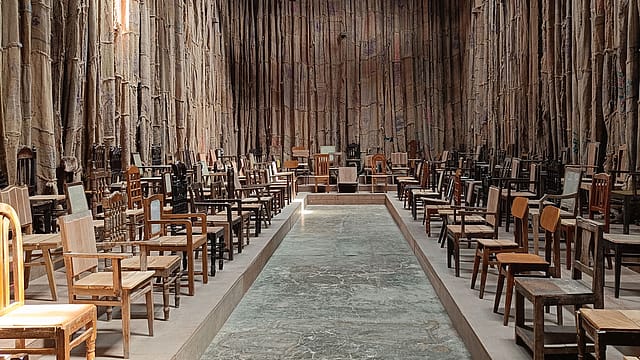
Ghanaian artist Ibrahaim Mahama’s installation consisting of rickety chairs and used jute sacks is one of the most discussed artworks at this edition of the biennale. Mahama recently topped ArtReview’s list of most powerful individuals in the world of art. His work is a testament to colonization, histories of migration and exploitation of labour amongst a host of other pressing issues especially relevant in post-colonial nations. You enter a room where a large number of chairs of different shapes and sizes are arranged in unison akin to a performance. The walls are draped with jute sacks. Mahama has clarified in several interviews that jute sacks are regularly used to pack and transport cocoa in his native Ghana and become a signature presence in many of his large-scale installations. This installation can be interpreted in various ways but it also invites silent contemplation on the histories of exploitation which characterizes the human race. Mahama’s use of the mundane wooden chair is particularly remarkable. Pick a chair you like, sit as you please. And think? The installation is compelling in its ability to reflect on the present as well as remind us of our shared murky past.

The Modi Years
02 Oct 2026 - Vol 05 | Issue 40
A Nation Rebuilt
For the lack of a better word, I found Smitha M Babu’s paintings hypnotic. They capture her lived experiences along the Ashtamudi Lake in Kollam and her observations of individuals associated with coir making in the region. In her canvases, women carry on with their lives often engaging in domestic chores, playing games, exercising the right to leisure. Their working-class identity is paramount. On first viewing, these paintings appear to offer glimpses of daily life but there is so much more happening when you look close such as the landscape which anchors the individuals and almost becomes an extension of their being. The presence of political insignia is unmissable, perhaps reflecting micro histories of the region and the artist’s own ideological leanings. The paintings exude a sense of intimacy even to a viewer like yours truly who doesn’t know the region or the individuals shown on canvas. It is done in such an unobtrusive way. At a time when art world vocabulary and imagination is dominated by normative resistance, Smitha Babu’s paintings stage a quiet defiance by presenting life as it is.

Sujith SN is a much-admired contemporary painter from Kerala. I have known his work for a while yet his paintings at the biennale took me by surprise. Is it landscape painting? Should it be called that? Is this another way of doing botanical art? You can’t look away from the terrific green wilderness depicted on the canvas but that’s certainly not the sole intention of this work. It is stunning to look at which also pulls you towards the canvas when you notice a long white wall with a colonial style entrance. A lush green tropical forest looms large behind the manmade structure. Is beauty a mirage then? What does it indicate? Is it historical? The painting becomes a teacher. It nudges you to look closely and reflect on the tension between the white and the green. It resists an easy resolution which is the gift of art.
Edam is a special exhibition featuring several contemporary artists from Kerala and the diaspora curated by Aishwarya Suresh and KM Madhusudhanan. Spread across three venues, it comprises an array of very interesting works by a group of diverse artists. This exhibition is also an indication of current art practices in the state and the Malayali diaspora. But why single it out for a special mention? I feel one of the major highlights of the biennale since inception has been a constant showcase of art and artists from Kerala where the biennale is held. This is a very important intervention made by the biennale where you see the local alongside artists from all over the globe. It is such a great way to foster conversations amongst artists and art practices. Also to understand if their concerns overlap. For non-Malayalis like myself, these avenues are educative to understand and identify contemporary practitioners and their practice. Edam does that with elan showcasing a range of practices, one very different from the other. It also features paintings by Tom Vattakuzhy, a highly sought after artist, a master of observational detail and capturing private moments and if I may say so, one of our finest contemporary painters.
Kochi Muziris Biennale offered another opportunity to view Gieve Patel’s iconic painting which I had first seen at an exhibition in Mumbai when the painter-poet was alive. Its magnetism remains intact. Its sparseness is a statement in itself. Its homage to privacy is endearing. Very few paintings have been able to depict longing or intimacy this way. Showing so little yet generating maximum impact. Almost turning it sacred.