Inside the first showcase of contemporary Indian art at Russia’s State Hermitage Museum
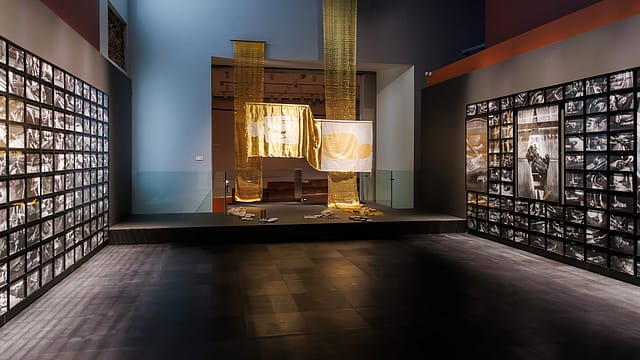
Artist Lakshmi Madhavan first visited St Petersburg’s State Hermitage Museum in 2017. “I remember wandering through its halls completely in awe of the art, the architecture, the scale, and the sheer weight of history that the museum holds. I distinctly remember wondering what it would feel like if one day I could show my own work in a place like this,” she tells Open. Almost a decade later, Madhavan’s own works are on display at the iconic address, as part of Sediments of Becoming: Fossilised Present, Summoned Pasts, an exhibition curated by Tunty Chauhan—founder of the Delhi-based Threshold Art Gallery—along with Marina Schulz.
Open to the public since June 4, this marks the first time the Hermitage Museum—home to the largest collection of paintings in the world—is hosting an exhibition of contemporary Indian art in its 260-year history. Among 11 Indian artists hand-picked to present their works at the exhibition, Madhavan is showcasing her work, Looming Bodies, which was recently also exhibited at the Kochi-Muziris Biennale and emerges from the artist’s longstanding engagement with the Kasavu weaving community of Balaramapuram in Kerala. Assembling textiles, photographs, archival wage books, weaving artefacts and sound, the work features more than 20,000 photographs capturing the movements, postures, hands and feet, and gestures of weavers along with materials and records from the loom.
Rise of the Pivotal Power
18 Sep 2026 - Vol 05 | Issue 38
The BRICS declaration is a strategic victory for Modi

“What interests me is the idea that bodies themselves can function as living archives. Knowledge is not only preserved in museums or books; it is transmitted through gesture, repetition, muscle memory, and labour,” Madhavan adds. “The Hermitage is a place where centuries of history and culture are carefully held and shared across generations. To bring a contemporary work rooted in the living traditions of a weaving community in Kerala into that context creates a meaningful dialogue between institutional archives and embodied archives—between what museums preserve and what communities continue to carry within their daily lives.”
For Chauhan, who travelled to Russia for the exhibition’s opening along with several of the artists, Sediments of Becoming is both providence and the culmination of a longstanding relationship with art collectors Ekaterina and Andrey Terebenin. Chauhan recalls how, years earlier, a cancelled meeting in Delhi brought Andrey Terebenin to a nearby gallery—it happened to be Threshold and marked the beginning of a long engagement. The Terebenins have been acquiring Indian art and textiles for some years, engaging with local artists and artisans; when the couple decided to showcase their collections of Indian art and textiles in Russia a few years ago, in an exhibition titled India Reflections, they invited Chauhan to curate it.
From India Reflections to Sediments of Becoming, Chauhan has pushed her curatorial engagement further. “What’s important about the exhibition are the voices of artists carrying the language of a civilisation to its present,” says Chauhan, describing the practices of the chosen artists as “cultural archaeology”. The idea emerged from a perspective of India—described by Andrey Terebenin in his exhibition statement as a “dense, layered palimpsest, in which language, customs, and beliefs mingled without ever fully displacing one another.” “The intention was to show the depth of this civilisation where artists become the narrators,” Chauhan adds. “It is something that has stood the test of time and something that is constantly resonating. It’s not dug out from the past, but a living, recursive moment which is constantly evolving.” The exhibition focuses on mid-career artists that Chauhan felt “would carry the present to the future and would resonate with the audiences” and she brought together names not only represented by Threshold but several others from across the country, each with distinct artistic practices.
One can thus see Ravindra Reddy’s Kali sculpture, a large head resplendent in blue, in dialogue with visual artist Pushpamala N’s work Kali. Meanwhile The Saga of Nandanar, a triptych by V Ramesh, brings into the spotlight the story of Nandanar—a 7th-8th-century Dalit bonded agricultural labourer who went on to become a revered saint. Gargi Raina brings a different moment in time from the region to her canvas—memories of her family’s experience with Partition and its aftereffects. Pressing fragments of Persian text (from her grandfather) against glass and surgical instruments, with remnants of other images, the artist explores “the shared experience of displacement, erasure, and the violence of borders drawn arbitrarily across land and culture”—subjects that remain as contemporary and urgent today as they did in the past. Another exhibition, Constructing the memory of a room, culminated from Raina’s 2001 visit to Lahore where her family lived before the Partition.
Debashish Mukherjee’s work, The Culture Flux, is rooted in the artist’s visit to Ladakh and its monasteries, reflecting on the gradual dissolution of centuries-old heritage in the face of rapid urbanisation. The disappearance of the old also occupies Sumakshi Singh, known for her architectural installations created with the most delicate threadwork, who is presenting Ascent, a suspended indigo-blue spiral staircase exploring the idea of home as “anchor and illusion” in a changing world.
Singh was earlier part of a residency, organised by Threshold with support from the Terebenins. Another artist who was part of the initiative is Anindita Bhattacharya who is also showcasing her works at Sediments of Becoming. Over multiple visits to St Petersburg, Moscow and the village of Palekh, Bhattacharya dived into Russian icon painting, the folk Palekh art form, popular imagery and art produced during the Soviet era, as well as Indian paintings in the Hermitage collection. “What interested me most was observing how visual traditions survive periods of political and ideological rupture—how images adapt when patronage shifts, belief systems change, or power restructures cultural life,” she says. “I became particularly interested in how sacred visual languages sometimes move into the secular, how inherited forms begin to reflect the political realities of their time, and how, in some contexts, visual cultures quietly resist while in others they adapt in order to survive.”
The site of the exhibition, and its larger setting, certainly played influenced on the artistic choices. Performance artist Maya Krishna Rao conceived Horse, Woman, a work specifically for Sediments of Becoming, exploring how the “performer’s body in a museum could be seen as a fluid artefact in itself, the body as a museum, as a repository, a regenerator, and maker of new stories.” The fragments in Manjunath Kamath’s Altered Sentences may also bring to mind images from Russian paintings and folk art, or the gilded details one encounters at monuments like the Hermitage.
Another exhibiting artist, Afrah Shafique turned to the relations between India and the USSR during the Cold War, creating a space of cultural exchange. If Hindi films discovered an audience among the Soviets, Russian circus acts and ballets found popularity in Indian cities as did illustrated Soviet children’s books and fairy tales. Shafique’s work, Nobody Knows For Certain, is “an archive of these books” and an examination of that moment in history. “Using fiction, documentary and fantasy to move back and forth between the USSR and India through different moments in the 20th century that have been featured in these children’s books, I explore the radical reframing of social order, the evolution of archetypes, the individual within the collective, the dance between fantasy and industry, the allure of the promised land and how stories carry forward, leak, morph and change themselves, the world and its people in a way that nobody knows for certain,” the artist writes in her statement.
In her curatorial note, Marina Schulz, Head of the Contemporary Art Department, State Hermitage Museum, observes that the works were deliberately presented in dialogue with frescoes, decorative arts, graphic prints and icons from the collections of the museum and other major Russian institutions. “The juxtaposition is not intended to embellish the exhibition or to lend additional authority to contemporary works, but to provide historical context and illuminate the artistic traditions upon which Indian artists draw; and ultimately to reveal parallels, connections and unexpected affinities that allow even the most complex conceptual frameworks to be grasped intuitively,” she adds.
The showcase in Russia adds another milestone to the growing opportunities for contemporary Indian artists in the global ecosystem, from the upcoming Art Basel Hong Kong to the ongoing Venice Biennale where India has returned after a gap of seven years. Russia marks a new destination, and the historic venue has left its own imprint on the participating artists. Bhattacharya describes St Petersburg as “a city suspended between multiple temporalities”, where imperial history, revolution, memory, beauty, and rupture seem to coexist. “Spending time here also made me think more deeply about the politics of preservation: what gets remembered, what changes form in order to survive, and how cultural memory continues to evolve through moments of upheaval,” she says. “To be able to present work in that context feels both humbling and deeply generative.”
(‘Sediments of Becoming: Fossilised Present, Summoned Pasts’ will be on view at State Hermitage Museum, St Petersburg till October 4.)