In Jaipur’s City Palace Museum, a new gallery displays the history of statecraft
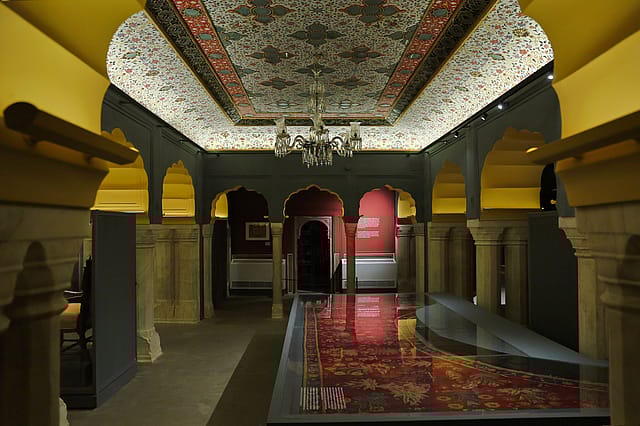
The Anand Mandir (Abode of Bliss) is one of the oldest royal apartments of the City Palace, Jaipur, once serving as a private chamber for rulers to meet with their advisors and discuss matters of importance for the kingdom. In this space now lies a shield dating back to the late 18th century, made for Maharaja Sawai Pratap Singh. Shila Mata, a revered deity in the region, occupies the centre of the shield protecting the king who is depicted beneath her, mounted on a horse. Scenes of hunting surround this central image, rendered in painted lacquer, ground mother of pearl and gold dust. Crafted by Jaipur’s court painters and leatherworkers, the shield is one of the main exhibits of the Power and Diplomacy, newly opened to the public.
A permanent exhibition reimagining the sileh khana (arms and armour gallery), the Power and Diplomacy exhibition is curated to present a history of power dynamics in Jaipur’s royal family over three centuries, adding to the City Palace Museum’s growing list of cultural attractions. Sawai Padmanabh Singh, who serves as Chairman of the museum, notes that while many of the recent initiatives have celebrates artistic and architectural legacy, this gallery presents a narrative of power dynamics—negotiated “politically, ceremonially, intellectually, and even emotionally,” over three centuries. “Over the past several decades, the previous iteration of the gallery, the Arms and Armoury Gallery, has been one of the most popular spaces at the Museum. With our new curation, we’re hoping to build on this, and deliver an even more nuanced perspective of these objects,” he says. “Many of the objects, maps, thrones, ceremonial arms, manuscripts, are pieces we have had in our collections but had previously not been contextualised in relation to one another. We wanted the narrative of the exhibition to follow Jaipur’s historic development; rather than choosing objects solely for their aesthetics, we asked what role it played in the foundation, and development, of the city.”
Survival Instinct
22 May 2026 - Vol 04 | Issue 72
India navigates global economic turmoil with austerity and smart diplomacy

Spread across four zones, the exhibits displays artefacts from a period beginning at around 1727 to the present day. A zone titled ‘The Making of a Maharaja’ presents how princes were educated and trained to assume their future royal duties while ‘The Jaipur Throne’ explores material culture that symbolised kingship. ‘Courtly Connections’ reveals the diplomatic ties between Jaipur and other courts. There is for instance a map of Agra created for Maharaja Sawai Jai Singh and a manuscript by the Mughal princess Jahanara containing instances of Jaipur’s cultural exchange with the Mughals. Embroidered textiles and a host of maps and manuscripts bring to the present glimpses of bygone courtly life, diplomatic affairs and the inner lives of members of the royal family. A helmet on display is shaped like a turban, likely made for a Mughal prince for hunting or a royal parade. An abundance of arms are exhibited across the gallery, sourced from not only Rajasthan but across the country including Bengal, Gujarat and the Deccan, along with talismans and objects for personal protection.
Singh hopes that the gallery will inform visitors not merely of the authority wielded by kings, but the quieter codes of strategy, allyship, negotiation and governance that sustained their rule through different periods of history. “If visitors leave with a deeper appreciation for the complexities of rule, the craft and knowledge systems of the court, and the continuity of ideas across centuries, then the gallery has achieved its purpose,” he says. If the exhibits once served as emblems of power and diplomacy, the gallery named after these ideals now becomes a symbolic space of its own. The role of royalty in India and their influence may have transformed but they continue to be custodians of heritage and tradition—the City Palace Museum and an array of other cultural initiatives testifies to the sense of responsibility with which the Jaipur royal family assumes this role. The expression of power today, says Singh, lies in knowledge-sharing and collaboration, and the ability to forge lasting “cultural, social, and global exchanges. “As someone responsible for preserving this heritage, I see diplomacy in the way we engage with scholars, creators, conservationists, and the wider public,” he says. “Power lies in preserving our traditions while remaining open to new ideas.”