How Arpita Akhanda Transforms Memories and Family Histories into Art
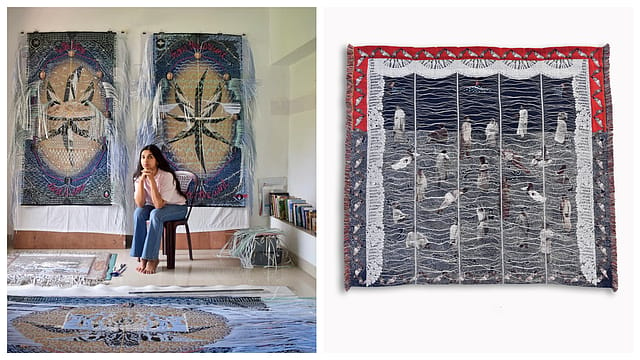
In 2018, a year after she had received an MFA in Painting from Kala Bhavana, Visva-Bharati, Arpita Akhanda embarked on a journey. The Cuttack-born, Santiniketan-based artist travelled to Bangladesh, piecing together an itinerary from her paternal grandfather’s archives. That year marked the beginning of an exercise in memory collecting—and interpreting—that has anchored Akhanda’s multidisciplinary artistic practice for close to a decade. Over the past few years, her work has been showcased from Kolkata to Kyoto and from New Delhi to London and Berlin. A recipient of the 2025 Sovereign Asian Art Prize, among other accolades, Akhanda’s new works are now on display at Emami Art in Kolkata. Titled Under the Moon Across Many Waters, the exhibition spans a variety of mediums and techniques from paper weaving, photography and drawing to performance, video and installation—all anchored in a study of memory. The artist speaks to Open on her artistic approach, longstanding practices, new interventions and bringing the past and present together on her canvas.

Under the Moon Across Many Waters is dedicated to the act of remembering: “in understanding how we remember or want to remember”. What sparked your interest in memory—and the gaps that exist in it?
Look Who's Talking Regime Change
23 Oct 2026 - Vol 05 | Issue 43
It was not a singular event that sparked my interest in memory, but rather a continuous experience of growing up with certain objects, particularly family albums containing photographs from before and after Partition, alongside inherited memories of the idea of home. These objects and stories shaped my understanding of how memory travels across generations, long after the places and people associated with it have gone.
If I have to identify a moment when this interest began to take a more tangible form in my artistic practice, it would be in 2018, when I travelled to Bangladesh, following the diary entries and photographs preserved in my paternal grandfather’s archive. I used these as landmarks to trace the places where he was born and grew up. Finding those places transformed memory into evidence and became a point of departure for my practice. It made me think about the relationship between what is remembered, and what can be retrieved, where past and present meets.
As I began working with these archives, I encountered gaps in the material available to me. Some memories had left very few physical traces. I began to wonder whether this absence was a consequence of the family’s repeated changes of address, of living in rented spaces where objects and documents were lost over time, or of certain events never being recorded because they were not considered important enough. Often, survival took precedence over documentation. Gender, too, played a significant role in determining whose experiences were recorded and how.
I became increasingly aware of how gendered family archives can be. My paternal grandfather was an artist who had access to a camera and meticulously documented his life through photographs, diary entries and poems. His archive left behind physical traces through which I could connect people, places and events. My paternal grandmother’s archive, however, existed differently. It lived in oral histories, textiles and conversations during overnight stays. Her memories were transmitted through stories, gestures and acts of making rather than through a formally documented record. This difference made me question what constitutes an archive and whose ways of remembering are recognized as historical evidence.
Only recently did I learn more about my maternal grandfather’s history and his displacement from what is now Bangladesh during Partition. This discovery also made me reflect on how histories can remain unknown within a family for generations. Sometimes, information is not passed on because family members are unaware of it; at other times, there may be a reluctance to revisit painful experiences, or silence itself may become a form of defence.
The gaps can also emerge from the age of the person sharing a memory, the gradual fading of recollection, or the fact that different people remember and narrate the same event differently. Each retelling carries its own perspective, emphasis and omissions, producing multiple iterations of what might appear to be a single history.
Over time, I have come to understand these gaps not simply as distortions or failures of memory, but as part of the language through which memory operates. They reveal the circumstances in which something could be remembered, recorded, transmitted or withheld. This is why I am interested not only in memory itself, but also in the process of remembering: how it works, what shapes it, and what it allows us to access. For me, the process cannot be separated from the thing it produces. The act of remembering is as significant as the memory that eventually takes form.
How do you approach objects such as family photographs, letters, travelogues and heirlooms in your practice—and consequently this exhibition—and translate them from personal objects to motifs and inspiration in the wider grammar of an artistic practice?
I approach these materials in different ways. I begin by placing them in the context of larger institutional archives to understand how larger historical events have affected personal histories. I then categorize the materials chronologically, which helps me understand the different layers of memory I am working with. From there, I try to gather as many memories and physical materials as I can access. When physical traces are missing, I sometimes reconstruct the memories through staged photography.
My choice of medium depends on the kind of memory I am trying to work with. I work across different mediums, and I feel that the context of a memory often determines how it wants to be expressed. Sometimes this process is intuitive; at other times, it comes from the need to find a language that can communicate what these materials bring to the surface.
In my paper weaving, I use the process as a metaphor, bringing together the warp of past/ my personal or family archive and the weft of the present/ institutional archive together. Through weaving, these different strands come together and enter into a conversation. The resulting image is often fragmented, pixelated and partially obscured, reflecting the gaps and uncertainties in the narratives I am trying to reconstruct.
The warp and weft do not simply come together to form a woven image. They also carry patterns that I derive from different sources, depending on the memories I am working with. For instance, when a memory has a sonic presence, I convert audio recordings made during my field visits into graphic drawings that can then be woven into the work. Some patterns emerge from larger institutional archives, such as the cartographic language of wind barbs, while others come from my personal archive, such as my grandmother's crochet work.
For me, patterns are more than ornament. They carry traces of different histories and become a way of bringing these histories into the present. Depending on the journey of a particular memory, I translate my archival research into patterns, allowing different materials, histories and ways of remembering to come together within the weave.
In the series, Carry, Borrow, Sow, the boat becomes a “kind of junction and compass indicating the cardinal directions and windward currents”. What led you to this image, and what does the boat make possible within the exhibition?
For me, the boat becomes a metaphor for the body in transit. And with transit comes the need for directions. This is where the boat also begins to function as a compass, navigating not only the journey but also the narrative. It becomes a carrier of water, wind and land, as well as of the past, present and future.
I think this image brings together my grandparents’ memories of their migration journey by boat and my own journeys by boat to trace their home. The boat connects these two journeys across time, one carried through inherited memories and the other through my attempt to locate and understand those memories.
From Carry, Borrow, Sow, the boat also moves into When the Curtain Falls, where it becomes a stage or platform on which the narrative unfolds. At the same time, it remains suspended in a state of stillness, holding the idea of in-betweenness. For me, the boat is not just a means of moving from one place to another; it is also a space where different times, memories and histories meet.
31 Days is made using archival pigment on bamboo paper with tatebaku. I was particularly drawn to the pixelation in the work. What interests you in bringing together the tactile and the digital?
Pixelation is inherent to the language of paper weaving. In my paper weavings, the paper is cut into strips of approximately 0.5cm in width, making the pixels clearly visible. For me, this pixelation, along with the idea of hide and seek or layering, becomes a way of narrating memories, particularly when I am trying to trace narratives that have been lost or remain incomplete.
The digital presence in my work comes mainly through photography and the digital editing I use to compose the images. Beyond this, I do not use digital technology as a medium. The patterns that appear pixelated are first drawn by hand on graph paper, with each square measuring 0.5 × 0.5 cm and then woven.
In a world of high-resolution images, where there is an attempt to make pixels dissolve and become invisible, I deliberately retain them. I think this also derives from the context of the work. A pixel is a basic building block of an image, but it can also be understood as a fragment of a larger whole. In 31 Days, fragment as a unit and concept connect to the physical experience from which the work emerged from.
It took thirty-one days for the wounds on my thumbs to heal after my performance 360 Minutes of Requiem, during which I attempted to untie 360 feet of barbed wire by hand over 360 minutes on which the work is based. The wire gradually cut into my thumbs, and I temporarily lost my fingerprints. Over the following month, the wound slowly heal and my fingerprints reappear. It felt as if I was witnessing the body reconstruct a pattern that had momentarily disappeared, a kind of biological remembering.
I began to see a connection between this process and pixelation: as the wounds gradually healed, the patterns of my fingerprints re-emerged. It was almost as if the fragmented, pixelated surface of the skin was being reconstructed into a recognisable pattern. At the same time, the individual pieces of barbed wire that I untied during the performance can also be understood as fragments that later became the patterns used to weave the work.
The pixelation connects the fragments of the wound, the re-emerging fingerprints, and the pieces of barbed wire, bringing them together through the process of weaving.
You have also incorporated jacquard weaving into your works for the first time. What made you work with the technique and what has it lent to your practice?
Working with Jacquard weaving was a gradual but natural progression from my paper weaving. Before this, I had also worked with handloom weaving during my residency at Hampi Art Labs in 2024. For this particular series, I wanted to work with tapestry, where the photographic elements could be woven directly into the textile. Digital Jacquard weaving at EE Exclusives in the Netherlands gave me the opportunity to explore how the language of photography could translate into textile.
The entire series, When the Curtain Falls which is a series offive works, is conceived as a theatrical sequence, and I wanted the works to have the physical presence of a curtain or a stage backdrop. Textile felt like a natural medium for this.
It was a wonderful learning process, as it was my first time understanding the technical aspects of weaving in such detail. I learnt how different weaving techniques and bindings could be used to create different textures and effects, depending on the context of the work. For instance, the crochet pattern at the top of one of the works needed to be woven in a way that gave it a sense of relief, almost like actual crochet. Similarly, I used the floats in weave to create the gold traces of the water bodies, giving them a different surface quality.
I am extremely grateful to Robin at EE Exclusives for working so closely with me throughout the process and helping me realize these works. I learnt a great deal from this experience, and I hope to continue exploring Jacquard weaving in my practice.
So much of the exhibition is drawn from memory, and the object that embody it. It is defined by what is available as well as what is absent. Referring to any of the works in the exhibition, could you tell me about how you choose what to preserve and what (gaps) to fill?
I think rather than filling the gaps, I am more interested in understanding them. This understanding might lead to an attempt to bridge a gap, or it might not. For me, what matters is acknowledging their presence and understanding what has led to them.
One of the ways I have tried to approach these gaps is through staged photography, where I dress up as characters from the past to narrate their stories. But gaps exist at multiple levels. Sometimes there is a lack of material evidence; sometimes a story has never been told, or has been forgotten, or has been deliberately left out of the family narrative. Each of these absences is adopted through different approach.
One work I would like to speak about in this context is Anemoia I. The series began with an image from my maternal family archive. It shows my maternal grandfather standing in the middle, with two unidentified men or boys on either side. This was one of the earliest photographs of my grandfather that my maternal uncle had. He shared it with me and asked if I could remove the two unidentified figures so that he could print a portrait of his father to display at home.
His request made me think about how we constantly edit, erase, omit and add narratives within family archives. I was reminded of a passage I had come across in the book My Mother’s Stories, Framing Portraits Binding Albums: “The act of eraser through an alteration of the original photograph is to validate the family dynamics to ‘construct a new memory’.”
This made me question what happens when we alter an archival image to make it fit the memory we want to preserve. What happens to the people who are removed, and what does their absence do to the story the photograph tells? The title Anemoia refers to a sense of nostalgia for a place or time one has never experienced. For me, it also connects to my attempt to know my maternal grandfather and a history I have inherited but never directly experienced.
In Anemoia I, the weft carries the background of the original photograph, gradually overlapping the two unidentified figures across the triptych until they disappear, leaving only a trace of their presence. However, their disappearance depends on the direction from which you encounter the work. Moving from left to right, the figures gradually disappear; moving in the opposite direction, they reappear. I wanted the act of erasure to remain visible as a process rather than become a final, irreversible decision. The work allows the figures to move between presence and absence, making us aware that what we choose to preserve is also connected to what we choose to leave out.
My maternal grandfather's history has come to me through archival photographs, conversations and refugee board certificates, but there are still many gaps. I continue to piece together what I can from these fragments, without necessarily being able to arrive at a complete picture. Perhaps this is also why I am reluctant to think of the gaps as something that must always be filled. Sometimes, understanding how and why something is missing is as important as recovering what has been lost.
What do you think art can offer us that history perhaps cannot?
I think art is more porous, empathetic and accommodating. It allows different voices and perspectives to exist together without necessarily having to discard one in favour of another. While history works towards constructing an account of the past through evidence, records and interpretation, art can stay with the ambiguities, contradictions and gaps that may not always find a place within a historical narrative.
Art allows time to exist not only in a linear manner, but as an entangled web where the past, present and future constantly overlap and inform each other. For me, this possibility of holding different experiences, sometimes even conflicting ones, together without necessarily resolving them is something art can offer and history cannot.
How has your notion of home evolved as your have travelled, researched and worked on this exhibition?
I think home for me are the archival materials I have been researching for this exhibition. Through the process of making, I find a temporary sense of belonging within them. The work becomes a place I can inhabit, even when the home I am looking for may no longer exist in the same way, or may never have been a place I experienced myself.
But this sense of residing is never permanent. Once a work is complete, I find myself moving towards the next one, carrying something from the previous work with me while looking for another place to reside. I think of these works as individual chapters in a book I am writing to understand what it means to remember home across time, geographies and generations. Perhaps, for me, home is not a fixed place I am trying to return to, but something I keep discovering and reconstructing through the process of making work.
This exhibition is the culmination of several years of work and research. As an artist, when did you feel that your work had accumulated into a body of work that was ready to be showcased?
I look at these works as part of a continuous journey, where one memory leads to another, often giving me a clue about what I need to research next. It has been almost eight years of research and documentation, and I don't think there was one particular moment when I felt that the body of work was complete. Rather, I began to feel that the exhibition could bring together these different strands of the journey.
There was also a sense of wanting to pay homage to the memories I had been gathering over all these years, and to the people and stories that have shaped my understanding of home, displacement and belonging. Over time, staged photography became an important language in my practice, particularly when I encountered gaps in the family archive and needed to find a way to approach or reconstruct what was missing.
This is where the large tapestry When the Curtain Falls comes in. It brings together many of these memories and threads of research that I have been carrying for years. In a way, the exhibition allows these works to come together, not as the end of the journey, but as a moment to look back at what has accumulated so far before moving towards what might emerge next.
Has creating these works, and working towards the exhibition, opened any questions or ideas you would like to explore further in your practice?
Yes, there is still a lot of research to be done. I have only recently encountered my maternal grandfather’s archive, and I feel the need to spend more time with it and understand his journey. I would also like to look more closely at my paternal grandmother’s journey. Ideally, I would like to return to Barishal and Faridpur in Bangladesh to continue researching their histories and the places they came from. There are still many gaps, and I feel that each new discovery opens up another set of questions.
But perhaps the most important question that has emerged from this exhibition is: where do I go from here, when the curtain has fallen?