Faith Multiplier
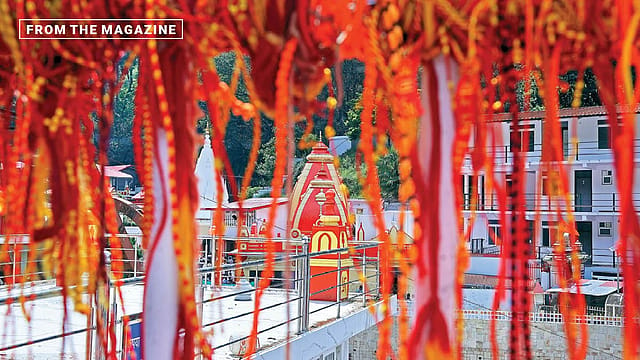
The road from Bhowali to Kainchi Dham has always been slow: 17km of hill highway from Nainital, the last stretch narrowing to a single lane as it climbs through a pine forest above the Kosi River. What’s changed this season is a little extra traffic: alongside the buses full of longtime devotees making a trip they’ve made for years, there are now a few more people than usual who have found their way here for the first time, surprisingly, through cinema.
Our own journey starts much before Kainchi Dham though, at Hanuman Garhi, around 20km from Kainchi Dham on a hillside above Nainital. It is here, and not at the Neem Karoli Ashram everyone heads to, that Lakshman Narayan Sharma, the man the world would eventually know as Neem Karoli Baba, first came. He had been drifting in and out of Nainital through the 1940s, and by the turn of the following decade, had settled on this particular hill, a patch of ground that had served as a graveyard for children and was, for exactly that reason, avoided by everyone who lived nearby. With a handful of devotees, he cleared it, built a small hut, and set up a modest idol of Hanuman. What grew out of that hut is the temple that stands there today, more than 10 years before Kainchi Dham came into being.

Zeroing In on ECI
09 Oct 2026 - Vol 05 | Issue 41
Constitutional legitimacy versus political opportunism
At the Hanuman Garhi temple, a few pairs of shoes sit near the entrance on a rack. Inside, the space is sparsely crowded, people moving around quietly with folded hands and silent prayers on their lips, a sevadar occasionally waving down a phone camera—photography or videography isn’t allowed on either premise, though people try anyway before being told, gently, to put it away.
MP Singh, who now manages the temple, has been coming since 1997, decades after Baba died. So, whatever he felt on his first visit came from the place, rather than the man. He still tells it plainly. “When my friends and I first reached the temple, we were wearing shoes,” he says. “People shouted at us, and I felt a bit negative at first. But something about being there made me want to go back in properly. I was very young then; I could not understand it fully.” He says he understands it a little better now. “Maharajji is my father,” he says, plainly, the way a person states a fact rather than making a claim. “This place feels like home for many devotees. This is not just belief; it becomes a way of life.”

Ritika Negi, 29, hadn’t even known Hanuman Garhi and Kainchi Dham were two separate places until a few weeks ago. “I watched the film Hanuman Ansh with my cousins in Dehradun and none of us had heard of this place before that,” she says. “We didn’t even know Hanuman Garhi existed separately from Kainchi Dham until someone told us. So we said, let’s do both while we are here.”
The story began at Hanuman Garhi in 1950, but it would be another decade before Baba turned his attention to Kainchi Dham. Baba and a Kainchi village resident named Poornanand set their sights on a stretch of forest where two earlier ascetics had once known to have performed yagnas, and in 1962, they sought and got formal permission to clear it, raising a platform on land leased from the forest department. The ashram itself was completed and opened in June 1964, more than a decade after Hanuman Garhi’s own quiet beginnings. Smaller shrines to Lakshmi Narayan, Durga and Ram Darbar have been added to the complex since, along with a temple built in Baba’s memory after his death, and residents of the ashram are still expected to attend the daily aarti.
By the time the road reaches the ashram gate, the crowd has thickened into something closer to a fair than a queue, people milling around the complex rather than filing through, buying prasad off nearby shops, sitting on the compound wall in the thin mountain sun. Most of the crowd is young, sneakers and jeans, though older devotees are scattered through it too, sitting further inside the shade on the cool stone slabs, in no hurry to move.
In the crowd waiting outside, you find people, some of whom have driven from afar to get to the ashram. Ketan Bhatt, 34, is standing near the gate with his parents, having made the trip from Ahmedabad. “We drove 11 hours because my mother wanted to come before the crowds got worse,” he says. “The film had nothing to do with it for her.”
A little further along, Hardik has driven 26 hours from Rajkot. “I drove here as my father used to talk about this place when I was a child, and I always said I’d come one day. This year, I just stopped waiting for a better time.”
Not everyone in this story is standing in a queue.
Rajesh Pandey, 41, from Rudrapur, turns up mid-conversation, stepping into the ashram manager Pradip Sah’s office for some unrelated business while we are still talking. “Someone in my family was very unwell a few years ago,” he says. “We came here, prayed, and things started to get better after that. I can’t explain it any other way, so I don’t try.”
Shravika and Shreya, two students from Noida in their early 20s, first came across Baba’s photograph in a photo studio in Delhi NCR. “I asked about him at the studio, and then again at home,” Shravika says. “My mother explained it to me very well, and since then I have been thinking about coming here.” Shreya’s own path in was secondhand too: a friend whose brother had come here worried about his job and left; he told her, feeling something shift. “After that, something changed,” she says. “I started understanding more about Baba and felt I should come here too.” Their trip had been delayed more than once. “Our plan kept getting postponed, sometimes because of rain, sometimes for other reasons,” Shravika says, “but eventually, we made it.” Neither describes the decision as entirely her own. “It feels like Babaji calls you here,” Shreya says. “Who comes here without getting a call?” Asked what she’d hoped to find, Shravika only half-answers. “I just wanted to come here,” she says. “There is a wish, but I can’t say it.”
Meenakshi Rawat, 58, a retired schoolteacher from Haldwani, is part of the queue of people neatly filing their way through the designated path on the ashram premises. “I’ve been putting this off for two years,” she says. “My daughter watched the film and kept sending me clips on WhatsApp until I finally said, ‘Fine, let’s go together next month.’ Then she got busy with work, and I came alone instead.”
Akash Kumar, 26, has come the farthest from anyone in this crowd, all the way from Ranchi, though he says the trip wasn’t really planned. “My friends had been here before. They kept telling me I should come whenever I got the chance,” he says. “So when I did get the chance, I came.”
Down in Nainital town, on the way between Hanuman Garhi and the ashram, the recently released film is filling seats at a rapid pace. Gautam Sharma, the assistant manager at New Capitol Cinema, where Hanuman Ansh has been running to mostly packed halls for weeks now, more so on weekends, says, “There are 218 seats in our hall, and almost every show is full,” he says. “The crowd here is mixed—children, old people, young people, families.” He’s seen grown men weep at the film’s more emotional turns, whole halls calling out “Jai Shree Ram” as the credits roll. “Almost everyone in this region knows about Babaji now,” he says. “People from Nainital also go to Kainchi Dham. It has become a common destination.” He’s made the drive up himself, twice now, and has watched the crowd there change in that time too. “A year ago, the crowd was normal when I visited,” he says. “When I went there, I felt something was happening. It is a different kind of place with a different energy.”
Pradip Sah, the senior trustee and head of the Neem Karoli Ashram, has watched the numbers behind all these stories grow for years, long before any film entered the picture. “For the past three years, the crowds have been rising steadily,” he says. “On normal days, 8,000 to 10,000 people come, but on weekends, it crosses 30,000.” His own connection to the place goes back decades further than his current job. “I have been coming here since childhood, with my mother,” he says. “Even after moving away for work, I kept returning. Now, I am here in service.” He remembers a line Baba himself is said to have used, long before any of this. “Baba had said long ago that a time would come when people would come like ants,” Sah says. “Today, you can see that happening with your own eyes.” Where they come from, he adds, is its own small geography lesson. “People are coming from everywhere, Gujarat, Rajasthan, Bengaluru, South India, even from abroad,” he says. “They are not coming for a place. They are coming for Baba.”
Sah or Singh will describe the man himself if you ask, though neither gives you a straight answer. “He is not the end,” Singh says. “He is the beginning, the middle and the end.” Even now, the scale of it resists belief, Singh says. “In 1973, it is said that many of his leelas were seen by people,” he says. “Even today, people find it difficult to believe the scale of his influence.” Baba, married off young before he renounced family life for good, left behind almost no written teaching of his own, mostly instructions passed down secondhand: “feed people, tell the truth, don’t perform your devotion for an audience.”
What have remained, though, are stories. Water that became ghee when supplies for a feast ran short. A train that would not move again once he’d been made to leave it without a ticket, and started only when he was asked back on board. Devotees describe him, too, as a figure who appeared differently to different people, so that two accounts of the same encounter might describe two different men. His name comes up outside religious circles too.
Steve Jobs was 19 in 1974, fresh out of a job and inspired by an American spiritual teacher’s writing on Eastern philosophy, when he and a friend travelled to Kainchi Dham hoping to meet the guru; Baba had died the previous September, so Jobs sat with sadhus and wandered the ashrams of northern India instead, in a trip he later described as formative. Decades on, Mark Zuckerberg has said Jobs personally told him to visit Kainchi Dham during a rough patch at Facebook, an advice Zuckerberg apparently took. Virat Kohli is the third name that surfaces most often here; none of the three are “devotees” in any conventional sense, all three now attached to the story of this place, regardless. Sah has his own theory on the Jobs connection anyway, involving an apple, a bite, and a logo, offered with a straight face. It doesn’t hold up against Apple’s own account of its design, but it gets told all the same.
The gates at Kainchi Dham close at 8PM every evening. But you can still hear the bells after that, carried down the hill to whoever is still on the road. By 6AM the next morning, before the gates open again, people are already waiting outside. On a weekend, more than 30,000 of them will pass through by evening. A film hasn’t changed any of that. What it may have changed is who’s standing in that line before six, and why. Nobody at the gate asks. Maybe the answer doesn’t really matter.