Asha Thadani explores the lives of India’s nomadic and denotified communities through the prism of their labour
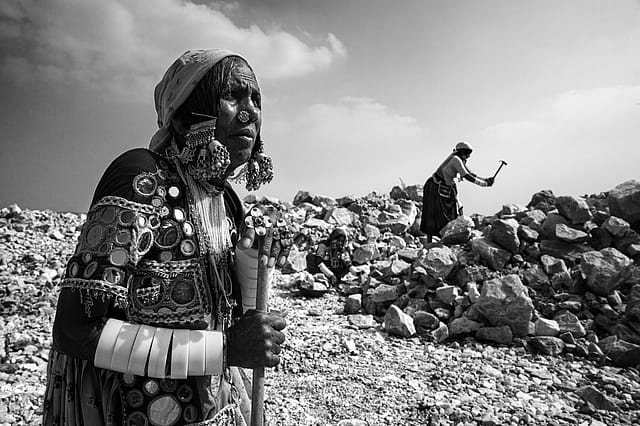
Two women from the Banjara community stand in the frame, surrounded by rocks and rubble. One of them gazes into the distance, the other in the background hammers her way through her task—her tools dwarfed by the enormous landscape around her.
Yet, what tends to draw the eyes first are the women’s dress and adornments—mirrorwork decking their clothes, jewellery gleaming through grayscale on their ears, noses and fingers, chunky white bangles covering their arms. For these women, and the community they belong to, attire and adornment is their identity. It is also veritable armour in a life shaped by hardships and misconceptions about who they are.

This is one of photographer Asha Thadani’s images, now on display at the I to Eye: Shades of Humanity exhibition in National Gallery of Modern Art (NGMA) Bengaluru).
Curated by Amrutha R, Deputy Curator NGMA Bengaluru, there are 127 photographs on view encompassing 16 communities, most of which are denotified and nomadic groups. For the Bengaluru-based Thadani, this has been a project undertaken over several years, travelling across the country and living with the communities with the aim to make photographs that offer more than a perfunctory glimpse of their lives. The Nachaniya, young boys from the Musahar and Nat communities of Bihar who perform the Launda Naach, are lensed in amid preparations for a performance, smoking but also sometimes during household errands such as cooking—expanding the gender roles and expectations these performers inherently resists. The story of the Sapera community, also known as the Kalbeliya is a story of a change—when the Wildlife Protection Act 1772 outlawed their ancient occupation of handling snakes (but also treating snake bites and catching them), they turned to training greyhounds to race and perform. Yet, the memories of snakes and their symbolism persist.

I.N.D.I.A. Falling
12 Jun 2026 - Vol 04 | Issue 75
The Unravelling of an Alliance
The assemblage of image, rendered in Thadani’s signature grayscale, is anchored by her quest to explore who these communities are through what they do. “I saw photography’s identity crisis for what it was the moment I claimed it as my career: a battle for legitimacy. Because there's no academic barrier to entry, it lacks the built-in status of ‘cerebral’ careers defined by degrees or licenses. Often dismissed as the mere ‘magic’ of a button-click, photography is frequently relegated to hobby status,” says the photographer. “This forced me to look at how we value and label work within a hierarchy.”
Thadani’s response to this is a challenge she poses to herself—to be a photographer who doesn’t simply click a photograph but “earns” them. “I view the photograph as a manufactured product, built through deliberate assembly rather than luck. While many categorise creative work as "yellow collar," my practice is blue collar in spirit—a philosophy that bridges the gap between my process and the workers I document—for whom work is the primary scaffolding of dignity and identity. Especially when the response to ‘So, what do you do?’, is perceived as shorthand for our virtues.”
Stories of work and labour thread together the different communities framed for the exhibition, from the salt farmers of Kutch to the Gadiya Lohar of Madhya Pradesh, a nomadic community known for its skills with ironworks whose traditional livelihood and lifestyle is declining in the face of modernisation. In the coal mines of Jharia, Jharkhand, the exhausting labour of adults and children contributes to the nation, but leaves them vulnerable for life. Within the Mala community of Telangana, young girls are dedicated to the deities as Joginis, a dvine calling that nonetheless leaves them homeless and worse, subject to trafficking.
(I to Eye: Shades of Humanity is on view at NGMA Bengaluru till April 12, 2026)