‘Women-led Businesses Should Be Seen as Active Drivers of Trade, Investment and Innovation’: Avarna Jain
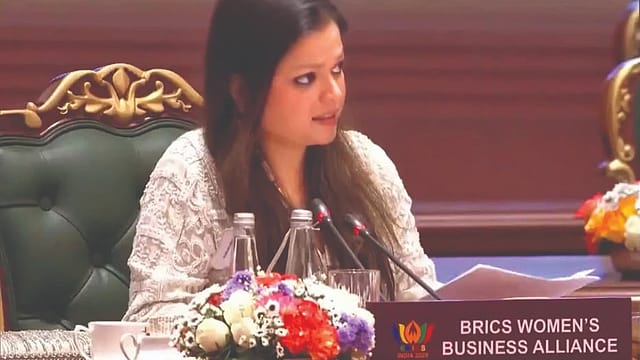
Trade between BRICS countries crossed the $1 trillion mark in 2025 and now accounts for nearly 26 per cent of global trade. What in your opinion should be done to increase trade flows in this important geo-economic bloc?
BRICS economies have large, diverse, and complementary markets—the opportunity is to connect those strengths more effectively. Women-led businesses should be seen as active drivers of trade, investment, and innovation, not simply beneficiaries of economic programmes.
The biggest barriers remain access to finance, market information, business networks, distribution channels, finding credible partners, and understanding regulations in new markets. BRICS cooperation can help address these barriers by creating stronger business-to-business connections, market linkages, and investment partnerships.
The focus needs to move beyond networking—from introductions to partnerships, dialogue to transactions, and connections to measurable economic outcomes. We need to create stronger pathways for women entrepreneurs to find customers, suppliers, investors, technology partners, and new markets across BRICS.
The Modi Years
02 Oct 2026 - Vol 05 | Issue 40
A Nation Rebuilt
Ultimately, the objective should be to make it easier for women-led businesses to scale and participate in regional and global value chains.
The BRICS Women’s Business Alliance (WBA) is an important initiative in the grouping. What role can this play to boost women-led growth in BRICS nations?
The WBA’s role is to act as a bridge between women entrepreneurs, capital, markets, technology, knowledge, and networks. The mandate has evolved significantly—from economic empowerment to women-led economic growth, business ties, trade, investment, entrepreneurship, technology, capital, and market access.
The focus should not simply be on increasing women’s participation in business but on enabling women to start, grow, scale and lead. There is a very strong case to build a living network of women across borders, where relationships translate into enterprise and experience into leadership.
The diversity of BRICS economies is an advantage here. Countries can learn from one another and adapt successful models rather than each economy having to develop solutions independently.
Knowledge exchange is an important part of this. Under India’s chairship, the WBA has brought out a dedicated knowledge paper on India’s Digital Public Infrastructure (DPI) alongside six other BRICS-wide knowledge papers and compendiums.
The next phase needs to be about action and measurable outcomes—finance, markets, digital inclusion, skills, cross-border business, and mentorship.
What has been the experience of the WBA so far? Is cooperation among women business leaders in these countries growing? What can be done to increase opportunities for women entrepreneurs in BRICS countries?
One of the biggest strengths of the WBA is the diversity of its economies, experiences, and priorities. That diversity creates an opportunity for shared learning and practical cooperation.
The WBA has evolved considerably over the past six years. When leaders first welcomed the establishment of the WBA in the Moscow Declaration of 2020, it was framed as a platform for women’s economic empowerment. New Delhi in 2021 saw that mandate grow into business ties, trade, and investment. Beijing in 2022 connected it explicitly to BRICS economic cooperation and innovation. Johannesburg in 2023 broadened it further to capital, technology, land, and market access. Kazan in 2024 saw leaders commend concrete instruments—a digital platform, an Entrepreneurship Forum, a Startups Contest.
Last year, in Rio de Janeiro, leaders recognised the WBA’s work in addressing structural barriers to credit, education, healthcare and climate-smart agriculture.
In six years, in the words of successive heads of state themselves, the WBA has moved from being welcomed as an idea to being recognised as infrastructure.
During India’s chairship, the Women-Led Development Summit brought together women leaders, entrepreneurs, policymakers, investors, and innovators from across BRICS.
The six Working Groups have also created platforms for cooperation across Creative Industries, Healthcare, Inclusive Economy, Tourism, Innovative Development, and Food Security & Environmental Safety.
The next opportunity is to make these connections more commercially meaningful—turning discussions and relationships into partnerships, investment, market access, and business opportunities.
The real measure of cooperation should ultimately be what businesses are able to do because these connections exist.
Are there any new initiatives being planned under the aegis of the BRICS WBA on women-led startups?
The BRICS WBA Women’s Startup Awards are an important initiative under India’s chairship. The response has been very encouraging—more than 550 applications have been received from women-led startups across the BRICS ecosystem.
The awards followed a three-tier assessment process, supported by Shiv Nadar University and the BRICS India Secretariat, followed by evaluation by an international jury.
The significance of these awards goes beyond recognition. They bring visibility to promising women-led businesses, creating opportunities to connect with investors, opening potential markets, and creating partnerships across BRICS.
The larger ambition is to ensure that today’s promising startups become tomorrow’s global enterprises.
The next step should therefore be to build stronger pathways from recognition to market access, investment, and cross-border growth.
More broadly, the ecosystem women entrepreneurs need is one that brings together capital, technology, skills, markets, and mentorship.
The care economy is an important initiative of the BRICS WBA, and the importance of this sector is only going to increase in the coming years. Are there initiatives in the works to help the group garner a greater share of business in this sector globally?
Absolutely. We see the care economy not only as a social imperative but also as a significant economic and business opportunity for BRICS.
Our Care Economy Report identifies the growing demand across childcare, eldercare, nursing, home-based care, and care technology. As populations age, families become more urbanised, and women’s workforce participation grows, demand for organised, high-quality care services will only increase.
The first step is to create the ecosystem that allows this sector to scale. Through the BRICS VALUES Framework, we have identified priorities around investment in care infrastructure, formalisation and protection of care work, universal access, standards, and skilling. These can help transform care from largely informal and unpaid work into a more structured economic sector.
For the BRICS WBA, the next opportunity is to build on this through greater cross-country collaboration—connecting women-led care enterprises with capital, technology, skills, and markets across BRICS. There is considerable potential for new business models in areas such as care technology, assisted living, childcare, home healthcare, and professional care services.
Ultimately, our ambition should be to ensure that BRICS countries are not simply responding to the growing global care economy but building enterprises, capabilities and solutions that allow us to play a significant role in shaping it.