Will the Kurds spearhead Iran’s Balkanization as the war spreads?
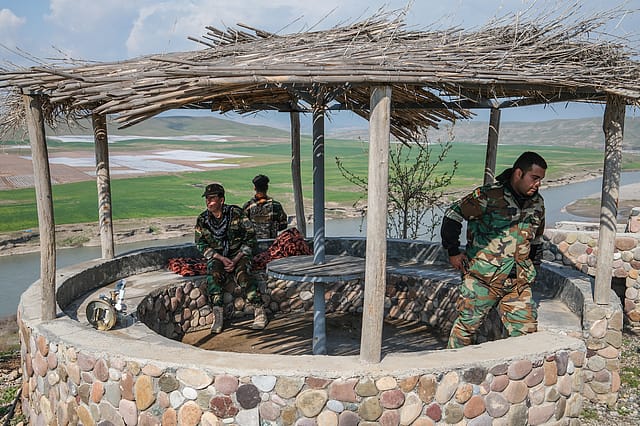
The ongoing US Israeli air campaign against Iran blew the lid off a country that was already disintegrating from within. This disintegration was best understood by persons right on the ground at the Iraq-Iran border. These people are the Kurds of Iran. They knew what was going to happen and on 22 February 2026 they acted in unison in the interests of the Kurdish nation by forming the Coalition of Political Forces of Iranian Kurdistan (CPFIK), a unified alliance of major Kurdish opposition groups. The coalition's stated mission is to overthrow the Islamic Republic of Iran and secure the right to self-determination for the Kurdish people. It operates primarily from bases in Iraqi Kurdistan. The coalition brings together several prominent Iranian Kurdish political and militant organizations:
Democratic Party of Iranian Kurdistan (PDKI): The oldest and most established group, led by Mustafa Hijri.
Kurdistan Free Life Party (PJAK): An armed group and ideological offshoot of the Turkish PKK, known for its significant percentage of female fighters (HPJ).
Kurdistan Freedom Party (PAK): This is pro-US and led by Hussein Yazdanpanah, and has a history of high-visibility operations with international support.
Komala Workers of Kurdistan (KWK): One of the traditional leftist Kurdish factions.
Khabat Organization of Iranian Kurdistan (KOIK): A nationalist and Islamic-oriented Kurdish group led by Baba Sheikh Hosseini.

Zeroing In on ECI
09 Oct 2026 - Vol 05 | Issue 41
Constitutional legitimacy versus political opportunism
On 5 March, Iran struck multiple Kurdish bases in Iraqi Kurdistan with three separate ballistic missile attacks. The IRGC released a statement saying it had targeted positions on the ground, where separatist groups were operating, who intended to enter Iran from its western borders and if they made any move against Iran's territorial integrity, it would crush them.
But here is where the military calculus gets interesting. Those same border outposts that the IRGC would normally use to repel a Kurdish incursion have been systematically degraded by Israeli air strikes. This is not an accident. This is architecture. The Israeli Air Force has been bombing Iranian military and police positions specifically along the border with Iraq in what multiple sources describe as a deliberate effort to strip away the defensive infrastructure that would otherwise stop Kurdish fighters from crossing into Iran.
How will this look militarily?
The terrain along the Iraq Iran border has seen some of the most brutal fighting country on earth. The Zagros mountains do not forgive mistakes. They have been the graveyard of conventional armies since the time of Alexander the Great. You cannot move tanks through these mountains efficiently. You cannot establish clean supply lines. You cannot call in close air support the way you would in a flat desert theatre.
What you can do, if you are trained for it, and these Kurdish groups are, is use that terrain as a weapon itself. Small unit infiltration, ambushes, hit and run tactics that bleed an opponent slowly rather than defeat them decisively. This is exactly the kind of warfare that the IRGC fears most in this environment, because it is exactly the kind of warfare that conventional military doctrine struggles to counter.
The CIA and the Mossad have been quietly backing these factions for months. Not openly, not through official channels, but through the kind of shadow infrastructure that intelligence agencies build when they want plausible deniability and maximum operational flexibility. The idea, according to sources familiar with the discussions, originated not in Langley, but in Jerusalem. Israeli Prime Minister Benjamin Netanyahu and the Mossad conceived the concept of using Iranian Kurdish militias as a ground element, a force capable of penetrating deep into Western Iran at exactly the moment when the regime's attention, resources, and command structure would be maximally degraded by air strikes.
The Mossad reportedly promised these Kurdish factions something they have not been offered in living memory. Not just weapons and air support, but a political commitment; a promise of backing for a Kurdish autonomous region inside a post-regime Iran, if and when the Islamic Republic falls.
However, sources indicate that the present thinking in Jerusalem is that Kurdish forces are most likely to play an auxiliary role rather than a decisive conventional one. Not a blitzkrieg. The terrain and force structure do not support that. But sustained disruption, reconnaissance for US and Israeli air strikes, seizure of specific border crossings, and the psychological and political signal of armed Kurdish fighters physically holding ground inside Iran. These are all achievable objectives.
And the psychological dimension may be the most powerful of all. Inside Iran right now, the Kurdish population has been in a state of rolling civil unrest since before the current war even started. The 2025-26 Iranian protests swept through Kurdish provinces with particular intensity. By the time the US Israeli air campaign began, the Kurdish regions of Iran were not a quiet backwater waiting to be stirred. They were already stirred. The fire was already burning. What the external operation does is pour accelerant on flames that were already lit from within.
The new Ayatollah in charge of Iran, Mojtaba Khamenei knows this. Days before Mojtaba’s anointment, on 3 March, as the bombs were still falling, Iranian President Pezeshkian, officially devolved power to 31 provincial governors all of whom have IRGC backgrounds. The centralized authority that has been Tehran’s hallmark for decades was formally fragmented as part of Ali Khamenei’s legacy to autonomously sub-divide the war, so as to protect it from a wayward “centre.”
Paradoxically, this opens opportunities for local Kurdish commanders who know their terrain, their population, and their enemy in ways that a provincial governor appointed from Tehran never will. On 2 March 2026, the newly formed CPFIK, issued its first joint statement. They called on Iranian armed forces stationed in Kurdish areas, IRGC troops, police, military conscripts, to separate themselves from what they called the remnants of the Islamic Republic. They told those forces the regime is collapsing and urged them to step away from it.
Two days later, on 4 March, the PJAK faction called on the people of Iranian Kurdistan to form local governance committees and self-defence committees. They told civilians to protect public institutions and service facilities. These groups are not just preparing to fight. They are preparing to govern. They are laying the groundwork for a parallel civilian administration in a territory they intend to control. That is not the behaviour of a group planning a raid. That is the behaviour of a group planning an occupation.
When asked by Reuters whether he would support Kurdish fighters crossing the border, Trump said it would be wonderful and that he would be all for it. The US President publicly said he would support Kurdish fighters invading Iran.
However, the situation is not that simple. Iraq's national security adviser Qasim al-Araji stated publicly that Iraq will not allow groups to infiltrate or cross the Iranian border to carry out attacks from Iraqi territory. The Iraqi prime minister and the president of the Kurdistan Regional Government, Nirvan Barzani, also agreed that Iraqi territory must not be used as a launching point for attacks against neighbouring countries.
Turkey is also watching closely. It fears that any autonomous Kurdish region inside Iran could inspire Kurdish groups in Turkey, especially the Kurdistan Workers Party (PKK). Turkey has fought the PKK for four decades and would not easily accept a Kurdish proto state emerging on Iran's western border particularly after the forced dissolution and disbandment of the PKK in May 2025.
Another complication is internal Kurdish divisions amidst groups who have different ideologies and histories of rivalry. Maintaining unity during a real military campaign could be extremely difficult.
CIA assessments have also stated that Iranian Kurdish groups do not have the military resources to overthrow the Iranian government on their own. They would require sustained air support, intelligence sharing, and political backing. There is also a demographic complication. Regions like West Azerbaijan contain large Azeri populations who may not welcome Kurdish fighters. If tensions erupt there, the situation could evolve into a civil war inside an already unstable conflict.
Despite all these complications, the current moment is unprecedented. A sustained US Israeli air campaign is degrading Iranian infrastructure while Kurdish factions are unifying with outside support and preparing for possible military action. According to Kurdish sources, on 6 March their forces were already inside Iran and waiting for the right moment to begin operations. If that statement is accurate, the next week could determine whether this becomes a major new front in the conflict.
The Kurdish population inside Iran, estimated between seven and ten million people, has waited for decades for such an opportunity. Iranian authorities, meanwhile, are attempting to maintain control while facing air strikes, internal protests, and the possibility of insurgent infiltration along the western border.
Iranian state media calls the Kurdish plan an Israeli American plot. Notwithstanding that, it is clearly emerging that Kurdish groups have entered a coordinated operational phase. The Islamic Republic of Iran was born while fighting a Kurdish uprising. It can be argued that if the current conflict escalates, the same Kurdish question could again play a decisive role in its future.
What happens in the coming days could reshape not only Iran but the broader geopolitical balance across Iraq, Turkey, Israel, and the wider Middle East. The situation remains fluid, and the next developments could emerge suddenly from events on the ground in the mountains along the Iran-Iraq border.