Will a Reluctant Pakistan be Drawn into the Iran war?
On 9 September 2025, Israel launched airstrikes on the Leqtaifiya district of Doha, the capital of Qatar. These strikes targeted Hamas leadership as it met to discuss a US ceasefire proposal. The attack killed Hamas members, Qatari security forces, and civilians. This was a first-time attack by Israel on a GCC (Gulf Cooperation Council) member.
The GCC's collective defense mechanism suddenly felt hollow. The US, which had long been the security guarantor of the Gulf, seemed distracted, unpredictable, and increasingly unwilling to write blank checks for Middle East security.
MBS (Saudi Crown Prince Mohammed bin Salman), who had spent years trying to modernize his kingdom and reduce its dependence on Washington, decided to act. He was going to find a new security partner—one that was nuclear-armed, one that was Muslim, one that owed Saudi Arabia a historic debt.

Zeroing In on ECI
09 Oct 2026 - Vol 05 | Issue 41
Constitutional legitimacy versus political opportunism
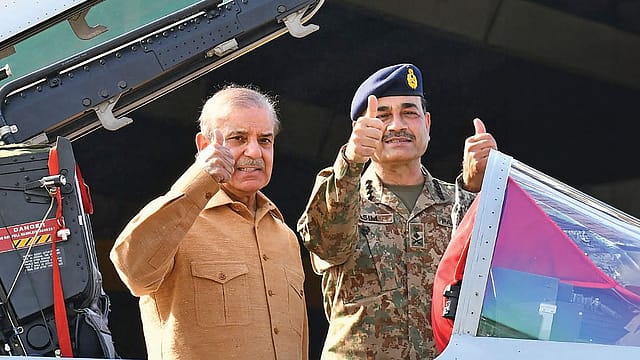
Days later, on 17 September 2025, in the Al-Yamamah palace in Riyadh, two men sat across from each other and signed a piece of paper. On one side was MBS, the de facto ruler of Saudi Arabia, the world's largest oil exporter. On the other side was Pakistani Prime Minister Shahbaz Sharif. Standing beside him was Pakistan's army chief, Field Marshal Asim Munir. The document they signed was called the (SMDA) Strategic Mutual Defense Agreement, and its core clause was twelve words long.
Any aggression against either country shall be considered an aggression against both.
On 28 February 2026, the United States and Israel launched a surprise joint attack on Iran. they killed Iran's Supreme Leader, Ayatollah Ali Khamenei. The Middle East had not seen a moment like this since the assassination of Archduke Franz Ferdinand of Austria which triggered WWI. In Saudi Arabia, air defense systems went into overdrive as Iranian ballistic missiles screamed towards Riyadh. Four missiles were intercepted in a single night. Then three more targeted the Prince Sultan Air Base, which houses thousands of American troops and serves as one of the most strategically important military facilities in the entire region. One strike near Al-Kharj, less than 100 km from Riyadh, was not fully intercepted. Two people were killed, 12 were injured
On 2 March 2026, a key oil refinery in Ras Tanura, Saudi Arabia owned by Aramco was attacked by an Iranian drone. The attack caused very minor damage; however, the refinery halted operations out of security concerns and Riyadh began working on creating alternate routes for crude oil exports.
On 3 March 2026, Pakistani Foreign Minister Mohammed Ishaq Dar walked up to a microphone and said something that sent shock waves through every capital from Washington to Beijing. He said he had personally warned Tehran not to strike Saudi Arabia. The Iranian response was fascinating. Foreign Minister Araghchi did not dismiss it. He did not laugh it off. He asked for guarantees. Specifically, he wanted assurances that Saudi soil would not be used to launch attacks against Iran.
Iran took the SMDA seriously enough to calibrate its strikes. It took it seriously enough to send its ambassador to Saudi Arabia with a public statement appreciating Riyadh's pledge not to allow its territory to be used against the Islamic Republic.
Then came 7 March 2026. Field Marshal Asim Munir, Pakistan's army chief, flew to Riyadh. Saudi Arabia had just formally, officially, publicly invoked the SMDA. For the first time since the pact was signed, it was being activated in a live conflict, and Pakistan's most powerful military officer was sitting in the room when it happened. There was a reason.
The near-total halt of tanker traffic in the Strait of Hormuz has triggered what economists are now calling the most severe energy supply disruption since the 1973 oil crisis. It has hurt Saudi oil exports and the Kingdom’s revenue stream. Brent crude oil price is kissing $114 per barrel. Further, the Fertilizer Institute reported that nearly 50% of global urea and sulphur exports and 20% of global liquefied natural gas transit through Hormuz. When fertilizer supply collapses, food production follows. The UN World Food Programme has already issued warnings about long-term increases in global food prices.
And then something remarkable happened.
The Pakistan-flagged oil tanker MT Karachi successfully passed through the Strait of Hormuz on 15 March 2026, with Iranian approval, transporting crude oil from Abu Dhabi to Pakistan with its tracking systems fully active. Amid regional conflict and disruptions, the tanker with its transponder functioning took an unusual route close to the Iranian coast, signifying a negotiated safe passage for specific shipments. It was a stunning piece of diplomatic manoeuvring. Pakistan was simultaneously invoking a defense pact with Saudi Arabia and negotiating safe passage with Iran.
On 18 March 2026, after Israeli strikes on Iran’s South Pars offshore gas field and surrounding infrastructure, Tehran faced a choice. It could strike back at Israel directly, risking overwhelming retaliation from both Tel Aviv and Washington, or it could do something far more surgical—and far more devastating. They could go after the one thing the entire Western world cares about more than any military base or political border: energy supply.
And that is exactly what Iran did.
Iran’s attacks on Qatar’s Ras Laffan LNG complex, on UAE energy terminals, and on Saudi refining infrastructure were not random acts of vengeance. They were a coordinated message. The message was simple: the cost of confronting Iran is not measured in soldiers. It is measured in dollars per barrel. It is measured in LNG tanker rates. It is measured in the electricity bills of German factories, Japanese households, and American families trying to fill their gas tanks.
On 21 March as the war began to escalate to unanticipated dimensions, President Trump gave Iran just 48 hours to fully reopen the Strait of Hormuz or he threatened to obliterate its power plants, starting with the biggest one first. He posted it on Truth Social. He signed it with his name. The clock was now running. The deadline is today 23 March.
Iran has said explicitly that if the US attacks its critical infrastructure, it will destroy every allied energy facility within missile range. Power plants qualify. The response to their destruction would not be negotiation. It would be the activation of every remaining missile, drone, and proxy capability Iran possesses, from the IRGC’s nightly launches to the Houthi blockade of Bab El-Mandeb. The message from Tehran was crystal clear. Your cities are not safe. Your oil fields are not safe. Your airports are not safe. And your American protectors cannot stop everything.
Pakistan, a nuclear-armed nation of 240 million people just got pulled into the most volatile conflict of the 21st century, whether it wanted to be or not. This is where Pakistan's impossible position begins.
For Pakistan, the economic stakes of this conflict are not abstract. Pakistan imports 85% of its crude oil through the Strait of Hormuz. As of early March 2026, Pakistan had approximately 28 days of fuel reserves remaining. Two crude tankers bound for Pakistan were stranded in the strait, unable to move. In this crisis, Pakistan cannot stay afloat without Saudi kindness.
Pakistan was not just being pulled into this war as a defense treaty partner. Pakistan was being squeezed economically with every passing hour that the strait remained closed.
The Pakistan-Saudi SMDA was not supposed to be tested like this. When it was signed in September 2025, Pakistan's military planners almost certainly believed they had many years before the strategic environment would force a real decision. The China-brokered Saudi-Iran rapprochement had reduced tensions. The Gulf states were diversifying their security relationships gradually.
The question that every strategic analyst is now asking is not whether Pakistan will use nuclear weapons. The question is what Pakistan does under Saudi pressure in the next 72 hours, the next 7 days, the next month?
Alternatively, does Iran believe the Chinese will pull back the Pakistani’s from yielding to Saudi pressure?
As the war continues to escalate and Saudi Arabia's territory continues to be struck by Iranian missiles, will Pakistan deploy additional military personnel to the kingdom? Will it provide intelligence sharing with the Saudi air defense network? Will it send missile defense systems to Saudi Arabia? Does it publicly announce that any strike that kills Pakistani soldiers on Saudi soil will be treated as an attack on Pakistan itself? Will it be forced to engage in nuclear brinkmanship with Iran?
Each of those steps, taken in isolation, seems manageable. Taken together, they draw Pakistan inexorably into a war it desperately wants to avoid. What is happening is a historic shift in the security architecture of the entire Muslim world pitting Muslim against Muslim. The United States' seven-decade dominance as the ultimate guarantor of Gulf security is being visibly tested, visibly found wanting, and visibly supplemented by a new set of arrangements that involve nuclear-armed Pakistan, a newly assertive Saudi Arabia, and a China that is watching all of it carefully from the sidelines.
The real story behind the Pakistan nuclear umbrella over Saudi Arabia is not whether Islamabad will push a button, but whether the shadow of that button is enough to hold the Middle East together while it tears itself apart?
And orchestrating the play is MBS.
The answers to those tests will shape the Middle East, South Asia, and global security for decades to come. It will not only test the extremely close Sino-Pak military and economic relationship but it will reveal the emerging Iran war related contradictions in it as well. How does the SMDA co-exist with the Chinese position on Iran?
And right now, in war rooms somewhere in Islamabad and Beijing, both China and Pakistan's senior most military and civilian leaders are trying to think through the answers to these without triggering the one outcome that nobody wants.
A conflict that begins with ballistic missiles over Riyadh and ends somewhere that no country on earth has planned for and no diplomat on earth knows how to stop.
What is New Delhi thinking?