Why A Tibetan Activist Set Himself On Fire
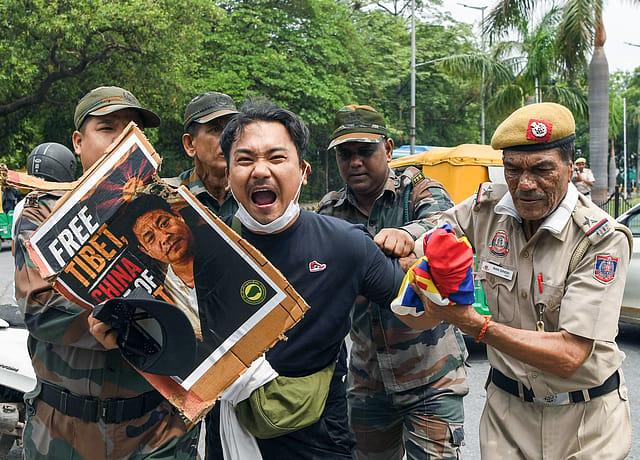
On July 2, Lobga Rangzen walked to a traffic median across from the entrance to the United Nations headquarters in New York, planted a Tibetan national flag on a post, and set himself on fire. As the flames engulfed him, he shouted: "Free Tibet! China out of Tibet!" He was 52. He was also my friend.
His protest had happened the day after China's new Ethnic Unity Law had entered into force -- legislation that Tibetans, Uyghurs, and Southern Mongolians understand as the codification of forced assimilation. He had chosen the place too. Not a battlefield, and not the Chinese embassy, but the building where the flags of nations fly together as a symbol of the world order.
Look Who's Talking Regime Change
23 Oct 2026 - Vol 05 | Issue 43
Rangzen was born in eastern Tibet, fled into exile in India, and eventually settled in the United States, where he gave more than two decades to advocacy for his country: raising awareness internationally, speaking for those inside Tibet whose voices have been silenced, and keeping alive the aspiration for a free Tibet.
His flames were not flames of hatred. They were born of love for his people and of a final appeal to the conscience of humanity. From a Buddhist perspective, one who gives their life for the welfare of others, free of hatred and of any intention to harm, acts in the spirit of the bodhisattva — the aspiration to seek liberation in order to help all beings overcome suffering.
More than 170 Tibetans have chosen self-immolation as an act of political protest and an urgent appeal to the conscience of the international community. Each sought, in their own way, to draw attention to what Tibetans are enduring and to call for justice, freedom, and dignity. With Rangzen, that appeal reached the very gates of the United Nations itself.
Since the People's Republic of China took control of Tibet by military force in the 1950s, Tibetans have endured decades of unbroken political repression: massacres, police brutality, the suppression of religious and cultural life, and policies that first cast nomads and farmers as backward second-class citizens and later evicted them in the thousands from their ancestral and sacred lands. Monasteries are surveilled and silenced in a systematic effort to extinguish Tibet's distinct national identity.

The former political prisoner Labrang Jigme has described being threatened at gunpoint by police in custody. "This gun was made specifically for people like you, Tibetans," he says the officer told him. "If we kill you and throw your body away into the garbage, no one will ever know, and there will not be a single person who will stand up for you." Freedom House ranks Tibet among the least free places on earth.
It was against this backdrop, and against Beijing's growing capacity to shape how Tibet is discussed within the UN and other international bodies, that Rangzen made his final stand.
The flames compelled a response. At the UN noon briefing, the spokesperson called the death "absolutely tragic" and offered condolences, noting that UN security officers had been the first to reach him with fire extinguishers. Pressed by a journalist to name the man and say where he was from, he did not say Rangzen was Tibetan. He did not even mention Tibet. He did not acknowledge the words Lobga Rangzen had spoken as he burned.
Rangzen's act was an unmistakable rejection of exactly that erasure — of Chinese rule over Tibet, and of any framing that reduces Tibetans to one more ethnic minority within China. More striking was the spokesperson's characterisation of Tibetans as a "minority", language that reflects Beijing's narrative. Whether or not one shares Rangzen's political vision, the clarity of his intention cannot be dismissed. His final words, the national flag he carried, and the site he deliberately chose all conveyed the same message.
His action posed a question to the institution in front of which he stood, founded on a promise still unfulfilled for Tibet: to uphold human rights, to defend the equal dignity of all peoples, to protect those whose voices are drowned out by the power of states. And it posed a question to the rest of us. When peaceful appeals go unanswered for generations, what is left to a people who are never heard?
History has repeatedly shown that extraordinary acts of self-sacrifice can awaken public conscience, shift government policy, and at times hasten the collapse of oppressive systems. Thích Quảng Đức's flames in Saigon altered international perception of the war in Vietnam. The Czech student Jan Palach stirred the spirit of an occupied nation. The flame of Tunisian street vendor Mohamed Bouazizi triggered the downfall of a regime and ignited the Arab Spring. The force of such moral awakening often outlives the individual.
Rangzen's flame renewed global attention to Tibet and rekindled the spirit of the Tibetan people, inspiring renewed determination in their struggle for freedom. History is rarely written at the moment. The significance of such acts often becomes visible only years or generations later. What is undeniably true is that he forced the world to confront a question it has long preferred to avoid.
His sacrifice was never an invitation to others to follow the same path. As his friend, I can say with conviction that he did not wish to become another name on a growing list. He carried a larger hope: that his would be the last, and that it would compel the world to uphold its own principles and find the courage to end the suffering endured by Tibetans, Uyghurs, Southern Mongolians, Hong Kongers, and all those living under China's totalitarianism.
His testament, though, was directed above all at Tibetans. He believed that Tibet's future rests ultimately in their hands, and that everything Tibetans suffer — the abuses and the existential threat to their identity — flows from China's occupation of their country. The lasting solution, he held, lies in the restoration of Tibet's independence. He urged Tibetans to remain united and steadfast in that struggle, never to surrender their national identity, and to continue with courage, wisdom, and determination until Tibet's future can be decided freely by Tibetans themselves.
Tibetans have heard what the United Nations said of the first man to confront its principles in flames beside the Snow Lion flag. Whether the world heard him is less certain. How Tibetans answer this moment, and how they choose to remember it, remains an unwritten chapter.