The Manila Moment: The ASEAN Summit frames India’s stakes in the Indo-Pacific
The 49th ASEAN Summit, scheduled to take place in Manila on November 16-18, will assume significance well beyond the customary diplomatic calendar of Southeast Asia. Hosted under Philippine chairmanship and guided by the theme ‘Navigating Our Future, Together’, the summit comes at a moment when ASEAN is confronting an increasingly complex regional environment marked by intensifying great-power competition, maritime contestation, economic uncertainty and persistent challenges to regional cohesion.
The agenda reflects the breadth of challenges confronting the organisation. Among the principal priorities are efforts to advance the ASEAN Digital Economy Framework Agreement (DEFA), potentially the world’s first binding regionwide agreement on the digital economy; negotiations towards a Code of Conduct in the South China Sea; and cooperation on food and energy security, artificial intelligence (AI) governance, inclusive growth and maritime security. Myanmar’s implementation of the Five-Point Consensus will also remain an important test of ASEAN’s institutional credibility.
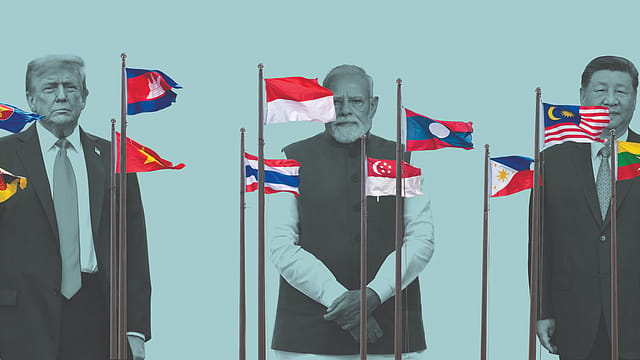
The summit’s significance will be amplified by the participation of leaders from ASEAN member states, alongside dialogue partners and other major powers. Prime Minister Narendra Modi, US President Donald Trump and other international leaders are expected to participate in the associated meetings, including the East Asia Summit (EAS). Potential Quad engagements and a Manila Dialogue on the South China Sea could further underscore the strategic importance of the gathering.
For New Delhi, ASEAN is not simply an important regional economic grouping; it is a central pillar of India’s Act East Policy and its broader Indo-Pacific vision. India’s Comprehensive Strategic Partnership with ASEAN reflects a recognition that the future of the Indo-Pacific will be shaped by the ability of Southeast Asian states to preserve their strategic autonomy and maintain an inclusive regional order.
The Manila summit offers India an opportunity to reinforce its commitment to ASEAN centrality at a time when the organisation faces growing pressure from competing geopolitical interests. The South China Sea remains a particularly consequential arena in this regard. India’s support for freedom of navigation, respect for international law, and the United Nations Convention on the Law of the Sea (UNCLOS) is consistent with its wider commitment to a rules-based Indo-Pacific. The ASEAN Outlook on the Indo-Pacific provides an important framework for converging these interests without requiring the region to organise itself around competing military blocs.
The East Asia Summit will be especially relevant. As a forum bringing together the US, China, India, Japan, Australia and other regional stakeholders, it remains one of the few platforms capable of sustaining strategic dialogue across geopolitical divides. For India, strengthening ASEAN-led mechanisms is also a way of advancing a multipolar regional order in which Southeast Asian countries retain agency rather than becoming passive arenas of great-power competition.
Maritime cooperation is likely to emerge as a central pillar of India’s engagement with ASEAN in 2026, with the ASEAN-India Year of Maritime Cooperation providing an opportunity to translate diplomatic commitments into tangible outcomes. The second ASEAN-India Maritime Exercise (AIME), hosted with the Philippines, alongside India's engagement with the ASEAN Defence Ministers’ Meeting-Plus (ADMM-Plus) and its co-chairmanship of the Experts’ Working Group on Counter-Terrorism, reflects the expanding scope of this partnership. New Delhi’s priorities extend beyond naval exercises to maritime domain awareness, intelligence-sharing, capacity-building, humanitarian assistance, disaster response and the blue economy. India’s counter-terrorism expertise and operational experience also offer practical value to regional partners. The larger challenge, however, will be to institutionalise this cooperation through greater interoperability, technological collaboration and sustained capacity-building, while initiatives such as the proposed India-ASEAN Youth Bridge could broaden the partnership beyond traditional security frameworks.
The economic dimension of India-ASEAN relations presents a more complicated picture. While bilateral trade is estimated at approximately $128 billion in 2025-26, the widening trade deficit highlights persistent structural imbalances. The review of the ASEAN-India Trade in Goods Agreement (AITIGA) is therefore a priority for New Delhi, which seeks more equitable market access, stricter rules of origin and safeguards against transhipment. A major breakthrough at the Manila summit, however, appears unlikely, with negotiations expected to extend into 2027. At the same time, the proposed ASEAN Digital Economy Framework Agreement (DEFA) offers opportunities for India to leverage its digital public infrastructure (DPI), fintech capabilities and technology ecosystem to deepen cooperation in digital trade, AI and innovation. The implementation of the ASEAN-India Plan of Action (2026-2030) will further be critical to strengthening supply-chain resilience, connectivity and people-to-people ties. Ultimately, the sustainability of the economic partnership will depend on reconciling India’s concerns over trade asymmetries with the broader imperative of deeper regional economic integration.
India’s participation in the Manila summit as a key dialogue partner carries wider strategic significance, with Modi’s attendance at the 23rd ASEAN-India Summit and the East Asia Summit reaffirming Delhi’s commitment to ASEAN centrality, the Act East Policy and an inclusive Indo-Pacific. India’s approach emphasises practical cooperation, respect for strategic autonomy and regional capacity-building rather than geopolitical containment. This is particularly relevant to partners such as the Philippines, Vietnam and Indonesia, with whom India shares converging interests in maritime security, defence cooperation and adherence to international maritime norms. Deeper defence-industrial partnerships, maritime domain awareness and technology transfers could lend greater substance to these ties, while India’s engagement through ADMM-Plus, joint exercises and counter-terrorism initiatives provides an institutional foundation. Coordination with the Quad on maritime security, resilient supply chains and connectivity offers further opportunities, although New Delhi will need to ensure that such engagement complements, rather than undermines, ASEAN’s preference for strategic inclusivity and autonomy.
For India, the challenge will be to translate its expanding engagement with the ASEAN grouping into tangible and sustainable outcomes, whether through deeper maritime cooperation, or greater collaboration in connectivity and the digital economy
The 49th ASEAN Summit will convene amid considerable strategic uncertainty, with South China Sea tensions, the continuing crisis in Myanmar, intensifying US-China competition and regional food and energy vulnerabilities testing ASEAN’s cohesion and relevance. For India, the challenge will be to translate its expanding engagement with the grouping into tangible and sustainable outcomes, whether through deeper maritime cooperation, a more balanced AITIGA framework or greater collaboration in connectivity and the digital economy. The Manila summit thus offers Delhi an opportunity to consolidate its position as a consequential Indo-Pacific stakeholder while reinforcing an ASEAN that remains cohesive, strategically autonomous and central to the regional security architecture. Ultimately, India’s engagement with ASEAN goes beyond strengthening economic and diplomatic ties with Southeast Asia; it is integral to securing its strategic access to the eastern neighbourhood, shaping a favourable maritime balance and advancing a multipolar Indo-Pacific without the constraints of formal alliance structures. The summit’s real significance will lie not in the declarations it produces but in the extent to which shared strategic interests translate into sustained cooperation.