Whose War, Whose China? Why Xi’s WWII Remarks Have Reopened the Taiwan Debate
The war ended in 1945. The battle over who gets to claim its victory continues.
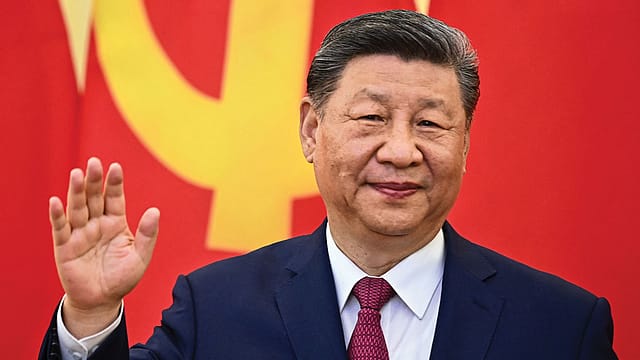
At a White House state dinner on September 24, Chinese President Xi Jinping recalled Chinese and American people fighting together against Japanese aggression. It sounded like a bridge between two modern rivals. But it also raised an awkward question: which China was America’s wartime ally?
The answer leads to Chiang Kai-shek, Mao Zedong, a government that retreated to Taiwan and competing readings of the documents that shaped post-war Asia. Here is why a reference to an old war carries such contemporary political weight.
WHAT EXACTLY DID XI SAY?
According to China’s Foreign Ministry account, Xi said Chinese and American people had stood “shoulder to shoulder” against Japanese militarist aggressors more than eight decades ago. He placed that cooperation within a longer story of exchanges between the two countries, using history to argue for better relations today.
Look Who's Talking Regime Change
23 Oct 2026 - Vol 05 | Issue 43
The wording matters. Xi referred to the two peoples. He did not explicitly say that the People’s Republic of China was America’s wartime ally. That distinction is essential to understanding the criticism fairly.
SO, WHICH CHINA FOUGHT ALONGSIDE AMERICA?
The Republic of China, led by Chiang Kai-shek’s Nationalist government. The People’s Republic of China—the state Xi leads—was established by Mao on October 1, 1949, four years after Japan’s surrender.
The US State Department’s historical record identifies Chiang’s Nationalist government as America’s wartime ally. After the Communists won the civil war on the mainland, Chiang and his forces retreated to Taiwan, where the Republic of China continued.
WHY DOES LEAVING OUT THAT NAME MATTER?
Because the Republic of China is central to the dispute over Taiwan’s political identity.
The ANI report, citing The Epoch Times, attributes the criticism to analysts including Shen Ming-shih of Taiwan’s Institute for National Defense and Security Research. Shen argues that Beijing’s narrative obscures the ROC’s wartime role while claiming its historical legitimacy.
That is an interpretation of Xi’s political messaging, rather than proof of his private intentions. But the underlying issue is concrete: the government that represented China during the war and the government that rules mainland China today are not the same.
DID THE COMMUNISTS FIGHT JAPAN TOO?
Yes. Erasing their contribution would produce another selective history. Communist forces conducted guerrilla warfare against Japan. Nationalist forces carried the principal conventional war effort, under immense military and economic pressure.
In a National WWII Museum interview, historian Richard B. Frank argues that Communist guerrilla achievements were real but exaggerated in influential accounts, while the Nationalists’ contribution was substantially understated. The wartime picture also included bitter rivalry between the two Chinese camps. Their cooperation against Japan never eliminated the struggle for power between them.
IS XI’S STATEMENT HISTORICALLY WRONG?
The statement that Chinese and American people fought together is historically defensible. The argument concerns how that shared history is framed and who disappears from the telling.
Beijing sees the PRC as the successor government of a continuing Chinese state. Under that interpretation, China’s wartime achievements form part of the national history it represents.
Taipei rejects the leap from that historical inheritance to Beijing’s authority over Taiwan. The disagreement becomes sharper when remembrance of wartime cooperation is used to support present-day territorial claims.
HOW HAS BEIJING ANSWERED THE CRITICISM?
Forcefully. Reuters reported on September 30 that China’s Taiwan Affairs Office accused Taiwan’s ruling Democratic Progressive Party of distorting history and “desecrating the martyrs”.
Spokeswoman Zhang Han also acknowledged that Kuomintang forces fought on the main battlefield, while describing Communist operations behind enemy lines. Beijing’s position was that victory belonged to the entire Chinese nation and should be commemorated on both sides of the Taiwan Strait.
HOW DOES A WAR AGAINST JAPAN BECOME AN ARGUMENT ABOUT TAIWAN?
Through the wartime promises about what would happen to territories under Japanese control.
Japan ruled Taiwan from 1895 to 1945. The 1943 Cairo Declaration said Taiwan—then commonly called Formosa—and the Pescadores should be restored to the Republic of China. The 1945 Potsdam Proclamation required the Cairo terms to be carried out. The ROC assumed administration of Taiwan after Japan’s surrender.
Beijing’s argument connects those events to 1949: Taiwan was restored to China; the PRC subsequently replaced the ROC as China’s government; therefore, Taiwan belongs to the PRC.
Taiwan rejects that conclusion. Its Foreign Ministry stresses that the PRC has never governed the island. The historical dispute turns on what changed in 1949—and what Beijing is entitled to inherit.
DID THE POST-WAR DOCUMENTS SETTLE EVERYTHING?
They did not produce an interpretation accepted by all sides.
The Cairo wording specifically referred to the Republic of China. Later, under the 1951 San Francisco Peace Treaty, Japan renounced its rights to Taiwan and the Pescadores. Taiwan’s Foreign Ministry emphasises that the treaty did not transfer Taiwan to the PRC.
Beijing rejects the San Francisco treaty as illegal and invalid, pointing out that the PRC did not participate in its preparation or signing.
These documents are therefore part of the argument itself. Quoting one without explaining the competing interpretations can make a contested claim sound universally settled.
WHERE DOES JAPAN FIT INTO TODAY’S DISPUTE?
Japan is both the former colonial ruler of Taiwan and a target of Beijing’s warnings about a revival of militarism.
This use of wartime memory predates Xi’s latest dinner remarks. Reuters reported in November 2025 that, during a China–Japan dispute over Taiwan, the Communist Party’s People’s Daily urged Washington to restrain Japan and invoked their common wartime enemy. That provides a documented example of old alliances being deployed in current diplomacy.
Japan’s formal language is more carefully drawn. Its 1972 joint communiqué recognises the PRC government as China’s sole legal government. On Beijing’s claim to Taiwan, it says Japan “fully understands and respects” the Chinese position.
Those are different formulations. Treating them as interchangeable strips out a distinction the document itself preserves.
DID THE UN ALREADY DECIDE THAT TAIWAN BELONGS TO BEIJING?
Resolution 2758, adopted in 1971, settled who represented China at the United Nations. It recognised the PRC’s representatives and removed Chiang Kai-shek’s representatives.
Beijing treats the resolution as affirming its one-China principle. Taiwan’s Foreign Ministry argues that the text does not mention Taiwan and cannot establish PRC sovereignty over it.
The distinction is consequential: deciding who occupies China’s UN seat and expressly determining sovereignty over Taiwan are different questions. Their relationship remains fiercely contested.
WHERE DOES THAT LEAVE THE UNITED STATES?
With diplomatic language designed to manage a disagreement that never disappeared.
When Washington established relations with Beijing in 1979, it recognised the PRC government as China’s sole legal government and acknowledged the Chinese position that Taiwan was part of China. It also retained unofficial relations with Taiwan.
The Taiwan Relations Act subsequently provided a framework for those ties, including defensive arms. The US State Department’s historical account records both parts of this arrangement.
Acknowledging Beijing’s position should not be casually rewritten as adopting every element of Beijing’s sovereignty claim.
WHAT IS REALLY AT STAKE IN THIS BATTLE OVER HISTORY?
The political authority that comes with claiming it.
Beijing presents a continuous national story: resistance to Japan, recovery of lost territory and an unfinished mission of reunification. Taiwan challenges the claim that this history gives the PRC authority over an island it has never ruled.
Xi’s reference to wartime friendship can therefore serve two purposes: recalling genuine cooperation with America and reinforcing Beijing’s account of China’s continuity. That second reading is the analytical link between the historical record and today’s dispute.
The fighting ended in 1945. Who gets to speak for its legacy remains part of the struggle over Taiwan’s future.
With inputs from ANI & agencies