When the Cyclone Hit Fiji, Sivendra Michael Couldn’t Reach His Daughter
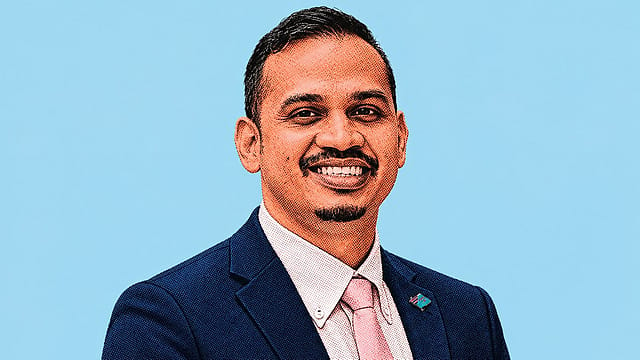
Sivendra Michael tried the evacuation centres. Their emergency lines were busy. He was a university student in New Zealand. His three-year-old daughter was in Fiji, Cyclone Winston had struck, and the telephone network had gone down. He was following the news and trying to get on the next flight home. In an essay for VICE the following year, he remembered “praying to see them all alive”.
His daughter had clung to her mother and grandmother through the storm. Michael learned that afterwards. What he knew from the New Zealand end of the line was how little a father could do from there. Winston destroyed homes his family had lived in.
Ten years later, in Antalya, Türkiye, Michael had a different responsibility to people waiting for news from Fiji. He was the country’s chief climate negotiator and was speaking on behalf of the Pacific Small Island Developing States. His delegation had worked until five in the morning. An earlier draft of the COP31 summit agreement had omitted language on moving away from fossil fuels. Countries had already agreed to that in a previous round. Michael was being asked to go home and explain why they had to argue for it all over again.

The Wealth Issue 2026
06 Nov 2026 - Vol 05 | Issue 45
Portraits of Dreamers and Doers under 35
“We will be standing our ground, knowing that we cannot go back home and tell our people that we accepted a weak outcome,” he told Repeka Nasiko of The Fiji Times.
On November 22, the summit ended without an overarching agreement. Fiji’s climate minister, Lynda Tabuya, spoke openly of how exhausting it was to come back year after year and see so little movement. Michael told Reuters why he still wanted the countries in the room. They had made commitments to one another. Where else could Fiji call them back, ask what they had done and expect an answer?

By then, Michael had a particularly good reason to care whether a promise made at one summit survived the next. He was a year old when Pacific island countries first sought international help for climate losses. At 32, he got to negotiate on the issue himself. In Antalya, he arrived with a request to the fund that had eventually emerged. Fiji wanted $20 million to help communities move when staying home became too dangerous. Michael also had firm views about whose hands the money should pass through.
What his parents knew about floods
Michael grew up in Fiji’s Ba Province. His parents ran an automotive business. A serious flood or cyclone was roughly an annual occurrence in his childhood, he recalled in a 2019 University of Auckland interview. By the time he gave that interview, he reckoned his community faced about three such events a year. Ba had flooded four times in 2018 alone. Three of those floods came in April.
That April is worth pausing over. A business owner who gets through one flood can reasonably hope to put the proceeds of reopening towards repairs. What can the family draw on when the water comes back twice in the same month? Michael had seen his parents work their way through repeated disasters. Later, when he had an economics degree and a choice of subjects for a doctorate, he chose the owners of small businesses in Ba. “My PhD is very personal,” he said.
At 29, he put a career overseeing development projects on hold. A doctoral scholarship allowed him to study at Auckland, where he lived in university accommodation with his young daughter. He was a single parent. In the university’s account of those years, his supervisors, Andreas Neef and Jesse Grayman, are two of the people he credits with making the work possible. There is also a photograph of Michael back in Ba. He is pointing to the height the floodwater reached.
The business owners who took part in his research gave him another way to measure a flood. Consider the cost of a water pump. After a bad flood, the authorities could cordon off damaged parts of town for up to three days. When owners got back into their premises, some had to hire a pump, buy cleaning supplies and pay people to help. Money was going out before a single customer could come in. Owners told the researchers they often used personal savings to get going again.
In a chapter drawing on his doctoral work, Michael and his co-authors recorded what became of businesses that did reopen. Owners described difficulty raising money to expand or carry a different line of goods. A shop could be trading again, its owner back behind the counter, while the next few years of the family’s plans had quietly got smaller. An economist who grew up around his parents’ business had found a consequence that anyone taking a quick look down a reopened street could easily miss.
The people who came for the hotel guests
Winston was the cyclone that cut Michael off from his daughter. In his own account, the experience that first brought home the severity of climate change came two years earlier, during a 2014 visit to Kiribati and Tuvalu. He recalled waking one morning to hotel staff calling on guests to leave. When he got out of bed, the water reached his knees. His belongings were floating in the room.
He managed to push the door open. Local people were waiting to take the guests to an evacuation centre. Among the people making their way through the water, he remembered mothers carrying babies. The detail that gives the episode its force is who had come for whom. Michael was a Pacific islander who knew floods. That morning he was also a visitor who needed somebody else to show him the way out.
When he began doing climate advocacy, one of his jobs was to give people with that kind of local knowledge a larger audience. Through a project called Valuing Voices, young Fijians planted mangroves, built seawalls and challenged decisions about energy. Art and social media gave them ways to reach people who might otherwise hear little from communities such as his. Michael had complained about how rarely the damage in Ba drew coverage. He had also found how little research there was on its businesses. In one part of his working life he helped people tell those stories. In another he went back and asked the questions himself.
In 2017 he went to the UN climate summit in Germany as a member of a youth delegation. He showed delegates videos about the Pacific. Five years later, at the summit in Egypt, he could speak for Fiji in formal negotiations. By then he had earned his doctorate. He belonged to the first cohort of a programme that trained young negotiators, 60 people from 27 countries. At 32, he had something to say about the adjective in his new title.
“I’m listed as a youth negotiator because of my age. But I’m as capable a negotiator as anyone else,” he told Laurie Goering of the Thomson Reuters Foundation.
One of his briefs in Egypt was loss and damage. The Pacific had been raising it since 1991. An entire generation had gone from infancy to negotiating age while governments discussed who should help pay for harms that countries could no longer avoid. Michael had spent some of those years finding out who actually paid in Ba. Often it was whoever had enough left in a savings account to hire the pump.
Who gets the money to move a village?
In Antalya, Michael appeared at the Moana Blue Pacific Pavilion in his capacity as Fiji’s permanent secretary for environment and climate change. The session concerned the movement of people whose homes had become unsafe. His country had submitted its $20 million relocation proposal to the international loss and damage fund. He wanted the money to go directly to the Fijian government.
Fiji already had a trust fund for community relocation. A levy on tourism activities had helped capitalise it. New Zealand and Australia had contributed. Domestic levies could only go so far, Michael explained, but Fiji had already done the work of setting up a way to receive and spend the money. Why pay another agency to stand between the international fund and the country responsible for the move? “We have proven concepts, proven solutions, and we are asking for direct budget access,” he said. The $20 million was a request. Fiji was still asking.
At the same summit, Fiji set out how it proposed to decide whether a community needed to move in the first place. Its Cabinet had endorsed 43 communities for assessment. For the people who live in those places, the distinction between assessment and relocation carries the weight of everything they own. Some communities might be able to stay on ancestral land with better protection. For others, officials would have to work through the risks with residents, establish their consent and plan a move. A sum of money can pay for new buildings. It cannot settle the question of who gets to decide when a family leaves its land.
That was the work under way while diplomats argued over the summit text. It also helps explain the limits of Michael’s patience. Fiji was already assessing where people could safely live. In the negotiations, the Pacific delegation was reading a draft that had lost language on the fuels driving global warming. There were disagreements over finance and the treatment of the 1.5°C temperature limit. Some of the ground the islands had to defend was ground they understood everyone had accepted.
There were other Pacific answers to that frustration. Tuvalu’s climate minister, Maina Talia, spoke of bringing together countries willing to act together without waiting for everyone. Michael’s concern was what would happen to the promises made by countries whose cooperation was harder to secure. Smaller groups could choose their company. Fiji still needed a place where it could put a question to all the governments that had signed up.
The young man who went to Germany in 2017 had films to show delegates and a question about the world they would leave their children. The official who went to Antalya knew the name of the fund, how much Fiji was requesting and where he wanted the money sent. He could point to 43 communities whose residents would have to decide, with their government, whether they could stay. Before the summit broke up, he asked Pacific islanders to keep their negotiators in their prayers. Then he told them what his delegation was still prepared to do at five in the morning. They would hold their ground.