What 2025’s Newest Words Say About How We Communicate

Every December, the dictionaries pull their little stunt. They each hold up a single term like a biopsy slide and announce that this, this syllabic smear, is what we have been doing all year. In 2025, the sample is especially revealing in how thoroughly it bypasses traditional media altogether, arriving instead from TikTok, AI dashboards and group chats typed with one thumb while the other doomscrolls on a crowded ride home.
Oxford picks “rage bait”, Cambridge goes with “parasocial”, Collins chooses “vibe coding”. Dictionary.com does the linguistically perverse thing and crowns a number—“6–7”—as its Word of the Year. Seen together, this cluster reads like a manifesto about how we now communicate: angry, asymmetrical, machine-assisted, and permanently half-aware that we are performing even our reactions.
Let’s start with rage bait. It’s not just an update on “clickbait”. It’s an admission that anger has become the platform’s most reliable fuel. The audience has learned to name the trick, but they still click, comment, quote-tweet. They just do it with a small semantic flinch now, an inner subtitle that says: I know what this is doing to me.
If rage bait is about what we are shown, bloomscrolling is about how we try—sometimes awkwardly, sometimes earnestly—to survive it. First mocked as a saccharine Pinterest word, bloomscrolling has been adopted by wellness writers and psychologists as the designated antidote to doomscrolling: intentionally shaping one’s feed toward images and ideas that don’t spike the heart rate or hollow out the afternoon. Where doomscrolling casts you as casualty, bloomscrolling casts you as caretaker, tender of flowers. It has an air of private discipline about it: if the platforms won’t recalibrate themselves, we will at least try to recalibrate what we look at.
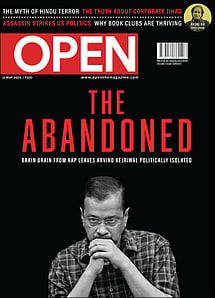
The Abandoned Kejriwal
01 May 2026 - Vol 04 | Issue 69
Brain drain from AAP leaves Arvind Kejriwal politically isolated
This is a recurring pattern in 2025’s lingo: for every diagnosis of a warped environment, there is a small counter-practice. Rage bait paired with bloomscrolling. Brain rot with digital detox. As experience speeds up, language becomes our way of briefly steadying ourselves.
Then there is parasocial, the term that finally crossed from academic footnotes into everyday speech. In 2025, it is the most economical way to describe one-sided intimacy with YouTubers, streamers, pop stars, podcasters, and increasingly, with AI companions trained to sound attentive. It has become the most precise word we have for connection without reciprocity. To “follow” is no longer neutral. It is to invest emotionally in someone who may never meaningfully look back.
If language is a kind of cultural imaging, “parasocial” lights up the circuits of a society fluent in proximity but starved of mutual presence. We talk to more voices than ever. But we are touched by fewer hands.
The youngest speakers of the internet, meanwhile, are busy inventing a language of strategic vagueness. “6–7” does not describe so much as deflect. How was the day? Six-seven. How do you feel about the future? Six-seven. It is not indifference so much as refusal to over-explain. In a world where adults narrate everything the number operates like a blackout curtain drawn halfway down. “6-7” is a word, a number, a shrug and it became Google’s most-searched slang term in 2025. A chant embedded in a rap track, briefly tethered to a basketball star’s height, then liberated entirely by a viral clip of a schoolboy shouting it with a hand gesture in a gym somewhere. From there it spread the way only contemporary slang can, through repetition stripped of context, a meme divorced from its source and made portable.
A close cousin to this is the so-called “Gen Z stare”: the blank, unblinking look that has ignited a thousand workplace debates. To older generations it reads as insolence or vacancy. To those who use it, it often functions as a pause, a small withdrawal of performance. If older workers perfected the polite smile as survival strategy, younger ones have perfected neutrality.
On the more theatrical end is “aura farming”, the craft of appearing unbothered so consistently that it begins to look like authenticity: the precisely casual walk, the studied lack of urgency. The joke, of course, is that it takes repetition and editing to look this unedited. The most telling phrase of the year’s self-conscious cool, it imagines charisma not as an accident of personality but as a resource one can slowly accrue through repetition and display. Borrowed from gaming culture, where farming means accumulating points through steady, almost tedious labour, the term quietly reveals how performative ease has itself become work.
One level up from personal aura sits “broligarchy”, the unserious word now tasked with describing very serious concentrations of power. It compresses a whole political unease into a single cartoon syllable: the sense that a small fraternity of technology-era men exerts disproportionate influence over markets, media and governance. The humour inside the word does not cancel the anxiety. If anything, it makes it speakable.
Running through all of this is the absorption of AI language into daily speech. “Vibe coding” , or coding by intuition, by prompt, by feel, feels flippant until you realise it reflects a real shift in how work is done. People describe what they want and models draft the skeleton, with humans only correcting the joints.
The newest lingo of 2025 is a record of the pressure points of our society. Attention versus agency in rage bait and bloomscrolling. Connection versus distance in parasociality and the Gen Z stare. Aura farming and broligarchy, at opposite ends of the same ladder of status. Expression versus automation in vibe coding.
The striking thing is how self-aware this vocabulary is. These are not innocent slang terms that grow wild and unnoticed. They are born already watching themselves being used. There is, undeniably, a subdued melancholy running through these terms. The words give shape to sensations that would otherwise remain blurry. They allow people to point, together, at pressures they feel even if they cannot yet change them.
What these words suggest is not that communication has thinned, but that it has become densely layered. Every utterance now carries, inside it, an awareness of being processed—of visibility being scored, of tone being evaluated, of unseen audiences.