US Will Fail In Regime Change Operation In Iran: Jeffrey Sachs
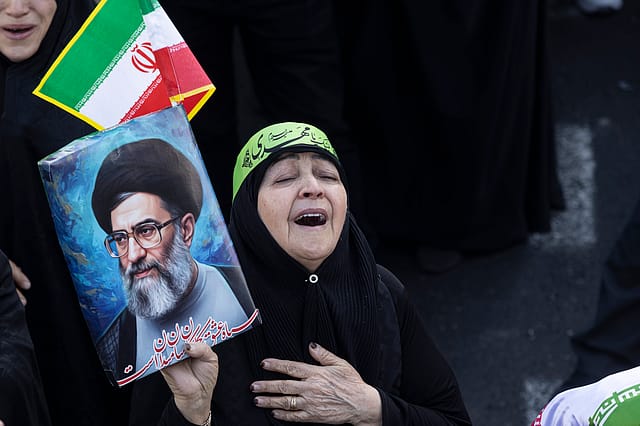
At a time when television studios are busy redrawing the map of the Middle East and speculating about a new balance of power, economist and public intellectual Jeffrey D. Sachs is blunt: Washington’s attempt to engineer regime change in Iran is unlikely to succeed.
Sachs, a professor at Columbia University and one of the West’s most persistent critics of interventionist (forever) wars, told Open that the objective of the Donald Trump administration is clear. “The US aim, indeed, is to overthrow Iran, install a puppet state or compliant government, and thereby also to add pressure on China and Russia. This is very unlikely to succeed,” he said.
His remarks come amid sweeping claims by some analysts that the coordinated assault launched by Israel and the United States on February 28- codenamed Operation Roaring Lion by Israel and Operation Epic Fury by the US-could reshape geopolitics. With Iran weakened, they argue, Russia would face heightened vulnerability, given its shared maritime boundary with Iran in the Caspian Sea and the expanded presence of NATO forces in the region. China, in turn, would worry about the security of its energy lifelines.
The joint Israeli-US strikes have so far killed Iran’s supreme leader Ali Khamenei, former President Mahmoud Ahmadinejad, several senior officials and members of Khamenei’s family. Civilian casualties included more than 150 children in an attack on a girls’ school in Minab in southern Iran.
For Sachs, however, the historical memory of Iran complicates any grand design from Washington. Iran, he points out, is a nation of more than 90 million people, defined by a vast and rugged geography and a deep resistance to foreign domination. “Iran has no interest in being colonised by the US and Israel,” he told Open.
He invoked the precedent most frequently cited in such discussions: the 1953 coup orchestrated by the CIA and MI6 to overthrow Prime Minister Mohammad Mossadegh. The operation, known as Operation Ajax, followed Mossadegh’s decision to nationalise Iran’s British-controlled oil industry. The coup helped centralise power under the Shah of Iran who put in place a police state aligned with Western strategic and business interests until the Islamic Revolution of 1979.
“That episode is remembered in Iran with profound disfavour,” Sachs said. “It is most unlikely to be repeated.” He added that Iran is likely to receive support from China, Russia and other countries in the coming weeks and months, complicating any external attempt to impose political change.
Sachs, a former director of Columbia’s Earth Institute and adviser to three UN Secretaries-General, has long argued that American foreign policy has been captured by militarism and special interests linked to

Losing Memory
16 Oct 2026 - Vol 05 | Issue 42
The making of a medical and social emergency
Israel. Of Jewish origin, he has been sharply critical of what he calls the undue influence of the Israel lobby on Washington’s strategic decisions, maintaining that US foreign policy should serve American constitutional principles rather than external agendas.
In a previous interview with Open, Sachs said the US has carried out, overtly or covertly, scores of regime-change operations since the end of World War II. Citing Lindsey O’Rourke’s Covert Regime Change, 1947–1989, he noted that 70 such operations are documented in the Cold War period alone. “Since then, there have been dozens more-coups, wars, colour revolutions-both overt and covert,” he said, listing countries from Serbia and Afghanistan to Libya, Syria, Ukraine and Venezuela. A comprehensive accounting, he suggested, could approach 100 attempts, though much of the record remains secret or contested.
In a recent conversation with Norwegian academic and political commentator Glenn Diesen, Sachs went further. “We are in an order led by a military state which doesn’t obey the US Constitution,” he said, describing interventions such as that in oil-rich Venezuela as part of a pattern of illegality.
For Sachs, the lesson of 1953 is not that regime change is a reliable instrument of policy, but that its consequences endure because Iran remembers it.
And memory, in geopolitics, can be more powerful than missiles amidst Trump’s expectation that Iranians will throng the streets and demand a regime change in a massive popular unrest.
As the war entered the fourth day on March 3, analysts like Sachs and others point out that neither Trump nor Netanyahu were ever interested in securing a nuke pact with Iran. Their argument is that Trump is the one who, in the first place, scrapped Obama's deal with Iran over nukes. And this latest coordinated invasion of Iran took place amidst the Oman-brokered US-Iran talks in which, according to Oman’s foreign minister, Tehran had agreed to “zero stockpiling” of enriched uranium. In fact, Oman was thrilled at the prospects of a major breakthrough in the talks and said they were close to deal better than Obama’s.
Iran, which has now rejected fresh American overtures for negotiations after the assassination of Khamenei, has expanded the scope of the war by targeting various sites in Israel and American bases in the region besides other areas in Saudi Arabia and a few other countries and by closing the crucial Strait of Hormuz to international navigation. Saudi Arabia’s Ras Tanura oil refinery, one of the largest in the world, came under an Iranian drone attack on March 2, forcing it to be temporarily shut down.