US-Iran Hormuz Ping-Pong Continues. Now Tehran Wants India at the Table
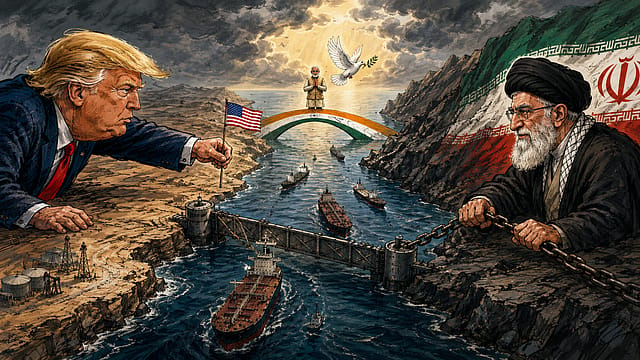
Donald Trump says America controls it. Iran says the claim is false.
Tankers continue to squeeze through it while Washington and Tehran cannot even agree on whether the Strait of Hormuz is open, closed or waiting for a deal.
Now, Iran has sent three messages from Mumbai: the strait remains under Tehran’s control, negotiations with the United States are still possible if Washington meets its commitments, and India can help bring the two adversaries back towards an agreement.
Saeid Reza Mosayeb Motlagh, Iran’s Consul General in Mumbai, rejected Trump’s repeated assertions that the US had taken control of the strategic waterway connecting the Persian Gulf with the Gulf of Oman.
“The Strait of Hormuz is completely under Iran’s control,” Motlagh said, calling the American president’s claim “false”.
The Modi Years
02 Oct 2026 - Vol 05 | Issue 40
A Nation Rebuilt
Trump has argued that the US naval blockade has given Washington “total control” of Hormuz. He has claimed that American forces destroyed much of Iran’s naval and missile capability, cleared the waterway and kept oil moving through it. He has also backed the provocative idea of declaring the strait American territory.
“I think it’s a great idea,” Trump told reporters. “We have total control over the Strait.”
Tehran sees a very different picture. Motlagh said Iran could fully reopen the waterway only after the US fulfilled its commitments and accepted Tehran’s conditions under a 14-point memorandum reached in June.
“Iran can reopen the Strait of Hormuz once the United States fulfils its commitments and Iran’s conditions are fully accepted,” he said.
Those demands reportedly include lifting the blockade, releasing frozen Iranian assets, easing oil sanctions, ending threats and halting military operations.
Iranian Parliament Speaker Mohammad Bagher Ghalibaf has taken an equally hard line, saying the strait will remain closed until Washington implements the agreement.
“Until America’s commitments in the memorandum of understanding, including lifting the blockade, releasing frozen assets, lifting oil sanctions, ending threats and military operations on all fronts, and other conditions to which America committed, are implemented, the Strait will not be opened,” Ghalibaf said.
ONE STRAIT, TWO VERSIONS
The physical movement of ships tells a murkier story than either capital admits.
Shipping through Hormuz remained severely restricted, with only nine commodity vessels recorded crossing the strait on Tuesday and the same number on Wednesday, according to Kpler vessel-tracking data cited by Reuters.
The data may not capture every transit because some vessels could be sailing with their tracking systems switched off. But the numbers suggest a waterway functioning far below normal levels rather than one operating freely under uncontested American or Iranian command.
That ambiguity is precisely what makes Hormuz so dangerous.
The strait is among the world’s most important energy chokepoints, carrying roughly a fifth of global oil supplies in normal conditions. Any disruption can hit freight costs, insurance premiums, energy prices and economies far beyond West Asia.
Motlagh said any arrangement governing the waterway must protect Iran while preventing harm to countries along the southern shores of the Persian Gulf and the Gulf of Oman.
His statement attempted to frame Tehran’s position as a regional-security demand rather than simply a claim of territorial power. But Iran’s insistence that it alone can decide when the strait fully reopens collides directly with Washington’s claim that American military force has already broken Tehran’s hold over it.
MEDIATORS CARRY MESSAGES AS DIRECT DIALOGUE STALLS
The two countries are just as divided over diplomacy.
Motlagh dismissed reports of direct or back-channel negotiations “in the conventional sense”, but acknowledged that intermediaries were carrying messages and attempting to create space for dialogue.
“There is not, in the conventional sense of the word, a direct negotiation between Iran and the United States,” he said. “However, intermediary countries and those engaged in mediation are trying, by conveying messages between the two countries and facilitating communication and dialogue, to find a peaceful solution and keep the region away from war.”
Iran, he insisted, remains prepared to negotiate.
“Iran has always stated that it is prepared for negotiations and dialogue,” Motlagh said.
But Tehran no longer treats Washington’s willingness to talk as evidence that a settlement is near. Motlagh accused the US of entering negotiations when they served American interests and using dialogue as cover for renewed military action.
“The United States has declared itself ready for talks whenever it has served its interests, using negotiations as a pretext for launching renewed attacks and another war,” he said.
For negotiations to become meaningful, Motlagh said, Washington must halt military aggression and destabilising activity across the region. He accused the US of expanding its military presence even while publicly discussing diplomacy.
Trump, meanwhile, has offered conflicting signals. He has suggested that talks could resume “maybe at some point”, while insisting that Iran cannot be allowed to possess a nuclear weapon.
“Right now I think the situation is so good,” Trump said when asked about reopening negotiations.
Washington’s pressure campaign has continued to intensify. Trump has threatened sweeping economic consequences for countries and entities supporting Tehran, promising what he described as unprecedented economic isolation. Reuters reported that the threat came amid contradictory messages from American officials over whether negotiations were continuing.
Iran’s position is equally layered: it says it wants dialogue, denies that direct negotiations are underway and ties progress to conditions Washington has shown little inclination to accept.
Both sides are keeping the door unlocked. Neither appears ready to walk through it.
ENTER INDIA: CAN NEW DELHI BREAK THE HORMUZ DEADLOCK?
It is into this stalemate that Iran has invited India.
Motlagh described India as a “great” and “peace-loving” country capable of helping create the conditions for an agreement between Tehran and Washington.
“India can also play a role in this regard,” he said. “As a leading country committed to peace, India can help create conditions that enable these two countries to reach an agreement.”
Such an agreement, he argued, could bring “peace, stability and harmony” to the wider region.
The proposal is diplomatically flattering, but it would place New Delhi in a difficult position.
India has long maintained relations with Iran while deepening strategic, defence and economic ties with the US. It also has enormous stakes in the stability of West Asia, from energy security and trade routes to the safety of millions of Indians living and working across the Gulf.
New Delhi has consistently called for conflicts to be resolved through dialogue and diplomacy. Prime Minister Narendra Modi reiterated that position during his recent visit to Australia, saying negotiations offered the only path to resolving ongoing wars.
But mediation requires more than a reputation for strategic balance. It requires both sides to accept the messenger, trust the process and show some willingness to retreat from maximalist positions.
There is little public indication that Washington has invited India into the negotiations. Motlagh’s remarks reflect Tehran’s interest in widening the circle of intermediaries, rather than the emergence of a formal Indian mediation effort.
Even so, the invitation matters.
It shows that Iran is attempting to separate its refusal to bend from a refusal to talk. Tehran wants to present itself as the side that remains open to diplomacy while placing responsibility for the stalemate on Washington.
THE BATTLE BEYOND THE WATER
The fight over Hormuz is now operating on three levels.
At sea, the US and Iran both claim control while commercial ships navigate the risks between them.
At the negotiating table, neither side admits that meaningful talks are underway, even as intermediaries continue carrying messages.
Across the wider diplomatic map, Iran is searching for countries capable of narrowing the distance. India has now been publicly named as one of them.
The danger lies in the gap between those layers.
Trump says the strait is open and under American control. Iran says it will decide when the waterway opens. Shipping data suggests neither description fully captures the reality.
Motlagh says Tehran wants negotiations. He also insists that Washington must first satisfy conditions ranging from sanctions relief and frozen assets to an end to military pressure. The US is escalating economic threats instead.
India may be able to carry a message across that divide. First, Washington and Tehran will have to agree that there is still a bridge worth crossing.
(With inputs from ANI)