Balochistan’s Enforced Disappearances Mount With Over 2,700 Cases Since 2011
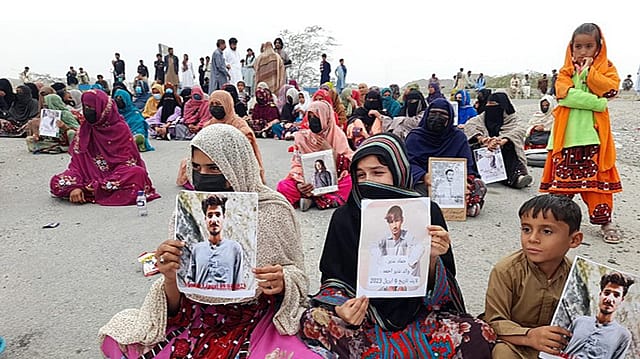
Two cases from Balochistan, one an alleged enforced disappearance and the other the return of a man missing for over a year, have renewed concerns over disappearances in the province, as per a report in The Balochistan Post.
Sher Baz Bangulzai, son of Khan Mohammad and a resident of Isplinji in Mastung district, was allegedly taken away on July 18, 2025, from the Terah Meel area of Dasht in Mastung, according to the report. He reportedly worked as a bus conductor.
His family has alleged that personnel of the Frontier Corps and the Counter Terrorism Department were involved. No official confirmation or response to the allegation has been issued, and his whereabouts remain unknown.
In a separate case, Shoaib Baloch, son of Mohammad Asif Baloch and a resident of Killi Almas near Airport Road in Quetta, has reportedly returned to his family after more than a year. His relatives said he was allegedly disappeared on August 4, 2025. He was reportedly recovered on September 25, 2026, from the Jabal-e-Noor area of Quetta.

The Modi Years
02 Oct 2026 - Vol 05 | Issue 40
A Nation Rebuilt
CONCERNS OVER DUE PROCESS
Families of missing persons, rights groups and Baloch political organisations have repeatedly accused state institutions of detaining individuals without due process and keeping them incommunicado.
Pakistani authorities have rejected allegations of systematic involvement in enforced disappearances in various cases. They have maintained that security operations in Balochistan are conducted within the framework of the law, the report said.
Rights activists and relatives of missing persons have also argued that many disappearances are not reported publicly soon after they occur. They cite fear of reprisals, security concerns and social pressures as reasons for the delays, which they say could leave the scale of the problem underreported.
THE LARGER PICTURE
Enforced disappearances in Balochistan have been a source of tension for years. Analysts trace the surge to the escalation of military operations in the region in the early 2000s, and groups such as the Voice for Baloch Missing Persons (VBMP) and the Human Rights Commission of Pakistan have documented large numbers of cases involving activists, students, journalists and ordinary citizens. The Pakistani state denies involvement in enforced disappearances.
The government set up the Commission of Inquiry on Enforced Disappearances in 2011. By the commission's own count, it received 10,636 complaints nationwide between March 2011 and September 2025, of which 8,986 had been disposed of and 1,650 remained under investigation.
In a January 2024 report to the Supreme Court, the commission put Balochistan's total at 2,752 reported cases, of which 2,284 had been resolved and 468 were pending. The same report said the commission had issued 744 production orders for missing persons, but only 52 were complied with.
Rights groups say the official numbers fall well short. Rights organisations argue that the real number of missing persons is significantly higher and includes cases dating back to the early 2000s. A Balochistan government spokesperson has acknowledged the issue as "real" but said the figures cited by families and rights groups are often exaggerated.
The commission itself has faced criticism as such bodies are often faulted for a lack of independence and effectiveness, and Pakistan has yet to ratify the International Convention for the Protection of All Persons from Enforced Disappearance.
Balochistan Chief Minister Sarfraz Bugti has claimed that the missing persons issue has been "permanently resolved," citing a new legal framework that allows authorities to interrogate suspects. The Balochistan Post's latest reports sit uneasily with that claim.
With inputs from ANI