US, Iran Hold Indirect Talks After Hormuz Proposal Rejection; Tehran Awaits Reply
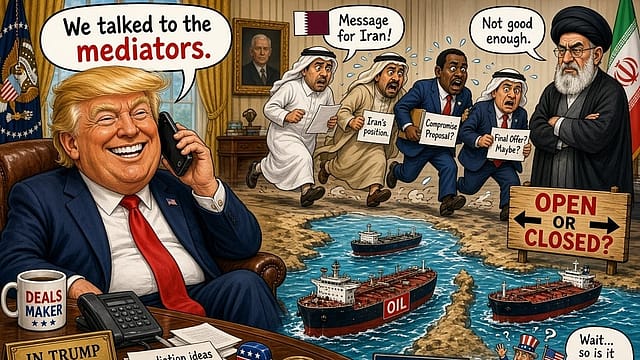
The United States and Iran held fresh discussions through mediators on Monday, keeping diplomacy alive days after President Donald Trump rejected Tehran’s seven-day proposal to reopen the Strait of Hormuz.
Iranian Foreign Minister Abbas Araghchi said Qatari intermediaries had presented ideas to narrow differences between the two sides. Tehran was awaiting an official American response, “hopefully” by Tuesday, Al Jazeera reported.
Trump separately confirmed that US officials had spoken to mediators, but offered no details of the discussions. Speaking at the White House, he repeated his prediction that Washington would win the war against Iran “very soon” and that fuel prices would fall once it ended.
The diplomatic developments emerged as Trump hosted a separate Oval Office announcement of a proposed $18 billion steel investment in Iowa by Essar Group’s US subsidiary, Mesabi Metallics.

Losing Memory
16 Oct 2026 - Vol 05 | Issue 42
The making of a medical and social emergency
Qatar Carries Fresh Ideas Between the Two Sides
Araghchi said his latest discussions in New York focused on Iran’s conditions for resolving the crisis and reopening the Strait of Hormuz.
“Our mission was to communicate these conditions to the American side as well as to all other nations, ensuring the international community is aware that Iran has a plan in this regard,” he told reporters.
According to Araghchi, Qatari mediators offered fresh suggestions intended to help implement Tehran’s proposal and were relaying those ideas to Washington. The talks were indirect, with no American representatives expected at the Iranian delegation’s meeting.
“Such communications and messages exchanged by Qatari and Pakistani intermediaries have always existed. But now, given the proposal Iran has put forward, the process has taken on a more serious nature,” he said.
A Qatari delegation had also presented Iran’s proposal to American officials during a visit to the United States last week.
Why Washington Rejected the Seven-Day Plan
Iran’s proposal envisaged reopening the Strait of Hormuz within seven days if Washington met specified conditions, including economic relief and an easing of military pressure.
US Ambassador to the United Nations Mike Waltz said on Sunday that the administration rejected the plan because Tehran wanted sanctions relief and access to “billions in frozen assets” before negotiations on its nuclear programme.
Waltz said the two countries would ultimately need “some type of agreement”, while emphasising that Trump would retain all options.
Araghchi disputed that account, saying Waltz had not seen the proposal. He maintained that Iran was willing to negotiate while preparing for renewed fighting.
“We don’t care about U.S. midterm elections. We care about our national interests. At the same time, we stand ready for diplomacy. It is up to President Trump to choose,” he told NBC’s Meet the Press.
Neither side announced a breakthrough following Monday’s contacts.
Separately, Trump Announces Essar-Backed Iowa Steel Plant
At the Oval Office event, Trump said Mesabi Metallics planned to build what he described as the largest steel plant in American history, with annual production capacity of 10 million tonnes.
The proposed Iowa facility would source raw material from the company’s iron ore operation in Minnesota. Mesabi Metallics chairman Rewant Ruia said his family was investing $3 billion in the Minnesota mine and promised an integrated supply chain “from mine to mill”.
“In other words, this steel will be mined, melted, and made right here in the USA,” Trump said.
Ruia, who said he was born in India and had spent half his life in the United States, described the investment as “a true homecoming”.
The figures cited at the event differed: the owners put the proposed investment at roughly $18 billion, while Commerce Secretary Howard Lutnick quoted $17.5 billion for the combined mine-and-plant investment.
Tariffs and Jobs Dominate the Investment Pitch
Trump said the project would support up to 6,000 construction jobs and nearly 2,000 permanent manufacturing and mining positions. Production is expected around 2030.
Both Trump and Lutnick credited the administration’s 50 per cent tariffs on foreign steel with encouraging the investment.
Without those tariffs, Lutnick said, “this mine doesn’t get built, and this steel plant does not get built”.
Trump said companies were choosing to manufacture in America “because they don’t want to pay tariffs”. The plant is privately funded, while the US Export-Import Bank has helped finance the mine.
Essar’s involvement in Minnesota dates to 2007, when it acquired Minnesota Steel. The proposed Iowa mill would expand that presence into an integrated American steelmaking operation.
With inputs from ANI