Trump-Xi Summit: Trade Truce Holds, but Taiwan & Security Divides Remain
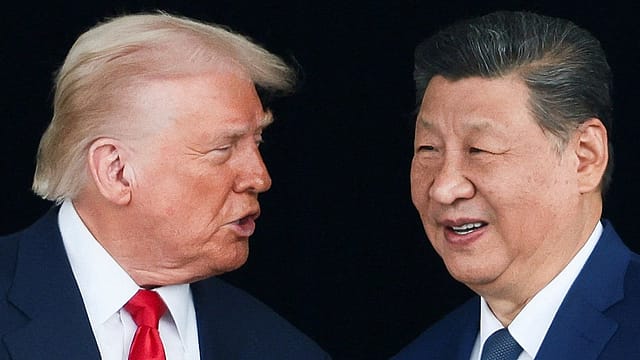
Donald Trump and Xi Jinping left their Washington summit with a longer trade truce, plans for talks on artificial intelligence and public assurances of a more stable relationship. Their differences over Taiwan, military influence and strategic competition remained largely intact.
The September 23–25 state visit produced agreements that could help Washington and Beijing manage tensions. But the contrasting official accounts, and questions over what was discussed, highlighted the limits of the rapprochement.
Drew Thompson, a senior fellow at Singapore’s S. Rajaratnam School of International Studies, described the outcome as a “respectful, cordial stalemate”—a form of stability that could give officials room to negotiate in the coming months.
Trade Delivers the Clearest Result
Thompson identified negotiations between US Treasury Secretary Scott Bessent and Chinese Vice Premier He Lifeng before the summit as the source of its most tangible outcome: an extension of the trade truce through January 2027.

Losing Memory
16 Oct 2026 - Vol 05 | Issue 42
The making of a medical and social emergency
Beijing’s statement listed eight deliverables and understandings, beginning with a commitment to a “constructive China-US relationship of strategic stability” based on respect, fairness and reciprocity.
The two sides also highlighted economic consultations, the Board of Trade, tariff reductions and counter-narcotics cooperation. They agreed to support each other’s hosting of the APEC and G20 gatherings.
Such arrangements keep channels open, but their implementation will determine how much the summit changes the relationship.
Taiwan Remains Unresolved
Taiwan exposed the gap between diplomatic reassurance and substantive agreement.
US Ambassador to China David Perdue said Washington’s position had not changed. He stressed the desire for peace across the Taiwan Strait, rejected coercion and reiterated that the United States did not support Taiwanese independence.
Trump, however, suggested the issue had received limited attention.
“We didn’t talk about it too much. Right now it’s, you know, fine. It’s just moving along. But we didn’t spend a lot of time talking about Taiwan,” he told reporters.
Thompson argued that remarks unsettling Taipei would not necessarily alter the longer-term direction of American security commitments. He nevertheless predicted that the next US arms-sales notification to Taiwan would come only in early 2027, after the November APEC meeting and December G20 summit.
That remains an analyst’s assessment, rather than an announced timetable.
Reported Weapons Offer Raises Questions
Perdue’s account that Trump had offered to sell weapons to Beijing drew scrutiny over how the president viewed China’s military challenge and America’s regional partnerships.
Ryan Hass, director of the Brookings Institution’s John L. Thornton China Center, warned that such an offer would trouble US partners facing Chinese military pressure.
“Trump’s offer to sell weapons to China will be unsettling to American partners at the pointy edge of China’s spear,” Hass said.
The reported offer did not establish that a weapons agreement had been reached. It nevertheless sharpened questions about Washington’s priorities while major arms packages for Taiwan remained on hold.
AI Talks Advance, Military Communication Is Less Clear
The summit produced plans for a bilateral dialogue on artificial intelligence, with the next exchange due by November and a communication channel intended to address AI incidents.
Both sides also agreed that Iran should not develop nuclear weapons and that international waterways should not be subject to tolls.
Military crisis management was more ambiguous. Beijing referred to a memorandum of understanding on crisis communication and prevention to be established as soon as possible. The White House fact sheet did not mention it, and one US official reportedly said the subject had not been discussed during the summit.
The differing accounts left the status of that proposed arrangement unclear.
Two Readouts, Different Priorities
Washington’s account emphasised the contribution of the US forward military presence to a free and open Indo-Pacific. Beijing’s statement avoided that point.
The American readout also recorded Trump’s call for trilateral arms-control negotiations involving the United States, Russia and China. China’s statement did not mention that proposal.
The omissions matter because they concern the underlying balance of power. Agreement on continued engagement has not produced a shared view of the military order in Asia or the terms of future arms-control talks.
Evan A. Feigenbaum, a former adviser to two US secretaries of state, said the overlap between what Beijing and Washington wanted from the relationship had narrowed substantially.
“Form and function are diverging rather dramatically,” he said, contrasting the current pace of summits with the more extensive regional and global coordination of the 2000s.
What Can a Summit Realistically Achieve?
Thompson cautioned against judging the visit solely by whether it delivered major breakthroughs.
“The summit was never the place for detailed discussions. It is an opportunity for the two leaders to present authoritative positions and increase mutual understanding,” he said.
High-level meetings, in his assessment, also create deadlines that push officials on both sides to negotiate outcomes in advance.
The ceremony and hospitality therefore had political value, even where policy differences persisted. Xi received a prominent Washington welcome, while Trump could present continued engagement as evidence that he was managing a difficult relationship.
The unresolved question is whether that goodwill will generate concessions.
Thompson asked whether Xi would encourage Chinese officials to compromise in exchange for American concessions, or instruct them to hold their positions and press Washington to accommodate Beijing.
For now, the summit’s clearest achievement is a period of greater predictability. The trade truce and planned dialogues provide opportunities for further negotiation; Taiwan and the wider security rivalry remain the harder tests.
With inputs from ANI