US F-22 Jets Land in Israel as Donald Trump Warns Iran He Will “Never” Allow Nuclear Weapon
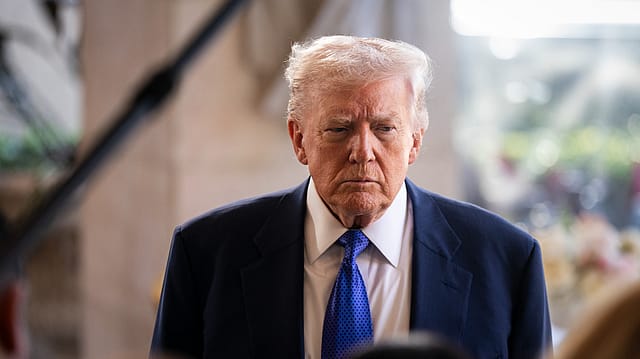
Amid rising tensions between United States and Iran, American F-22 stealth fighters have landed in Israel even as US President Donald Trump sharpened his warning to Tehran in his State of the Union address, declaring he would “never” allow it to develop a nuclear weapon.
Why have US F-22 fighter jets landed in Israel?
Around a dozen US Air Force F-22 fighter jets have landed in Israel, according to a report in The Times of Israel. The deployment comes amid heightened tensions between the US and Iran that could potentially erupt into a broader conflict, alongside an ongoing build-up of American military assets in West Asia.
The stealth fighters were spotted taking off from the Lakenheath airbase in the United Kingdom on February 24 morning before flying to Israel, the Israeli daily reported, citing open-source flight tracking data and aircraft spotters.
American news outlets also reported that a US official confirmed the fifth-generation aircraft landed at an Israeli air force airbase in south Israel. The fighters reportedly flew with their transponders deactivated but were accompanied by refuelling tankers that kept their transponders on, according to ABC News.

Look Who's Talking Regime Change
23 Oct 2026 - Vol 05 | Issue 43
Dozens of fighter jets, including F-35s, F-22s, F-15s and F-16s, have been spotted heading to the Middle East in recent days by the Military Air Tracking Alliance, a team of about 30 open-source analysts that routinely analyses military and government flight activity.
Israeli officials are said to believe that a US strike is inevitable, and top military brass from the two countries have reportedly been in contact. One official quoted by Channel 12 news on Tuesday said that a diplomatic resolution to the conflict would be the “surprise of the year,” as per The Times of Israel report.
What did Donald Trump say in his State of the Union address?
Speaking during his State of the Union address to Congress, Trump said US strikes last year had “obliterated Iran’s nuclear weapons programme” during a 12-day war between Israel and Iran.
Referring to the US airstrikes as “Operation Midnight Hammer,” he said: “After Midnight Hammer, they were warned to make no future attempts to rebuild their weapons program--yet they continue, and are at this moment again pursuing their sinister nuclear ambitions.”
Trump warned lawmakers that Iran is developing long-range missiles capable of reaching American territory.
“They've already developed missiles that can threaten Europe and our bases overseas, and they're working to build missiles that will soon reach the United States of America,” he said.
Reiterating his red lines, the US President declared: “My preference is to solve this problem through diplomacy--but one thing is certain: I will never allow the world's number one sponsor of terror to have a nuclear weapon.”
He added that Iran wants to make a deal to avoid further US strikes but has yet to commit to permanently abandoning nuclear weapons ambitions.
“We haven't heard those secret words: We will never have a nuclear weapon,” Trump said, adding that Iran cannot have a nuclear weapon. “Can't let that happen.”
Calling his approach “peace through strength,” Trump said his tough stance on Iran formed part of a renewed doctrine aimed at deterring adversaries while pursuing negotiated outcomes from a position of leverage.
Ahead of the address, US Secretary of State Marco Rubio and CIA Director John Ratcliffe briefed senior members of the House and Senate about the administration’s military build-up against Iran.
“This is serious,” Senator Chuck Schumer said. “and the administration has to make its case to the American people,” according to The New York Times.
What is Iran’s response and what happens next?
Negotiations between the US and Iran over Tehran’s nuclear programme are ongoing, with the two sides due to meet in Geneva for another round of talks. Diplomacy resumed earlier this month in Muscat, with a second round held in Geneva.
Iran has repeatedly denied seeking nuclear weapons, insisting its programme is for civilian purposes.
Iranian Foreign Minister Abbas Araghchi said in a post on X hours before Trump’s speech that “Iran will under no circumstances develop a nuclear weapon”.
Speaking to CBS’ “Face the Nation” on Sunday, Araghchi said he was still working on a proposal and that political leadership in Tehran had yet to sign off on it. He said the proposal would include elements accommodating both sides’ “concerns and interests” and would be discussed in Geneva to try and reach “a fast deal.”
Iranian President Masoud Pezeshkian said after the second round of talks that negotiations had “yielded encouraging signals” but warned that Iran was prepared for “any potential scenario.”
Meanwhile, Trump’s Middle East envoy Steve Witkoff told Fox News that Iran could be about “a week away” from producing industrial-grade bomb-making material, noting that Tehran has enriched uranium up to 60 per cent.
Oman’s Foreign Minister Badr Albusaidi said the next round of Iran-US talks would be held in Geneva on February 26 “with a positive push to go the extra mile towards finalizing the deal,” according to Oman News Agency.
As fighter jets gather in the region and negotiations continue in Europe, the standoff now hinges on whether diplomacy can outpace military escalation.
(With inputs from ANI)