‘Until Our Last Breath’: Pezeshkian Vows Resistance as Trump Rejects Iran’s Ceasefire Plan
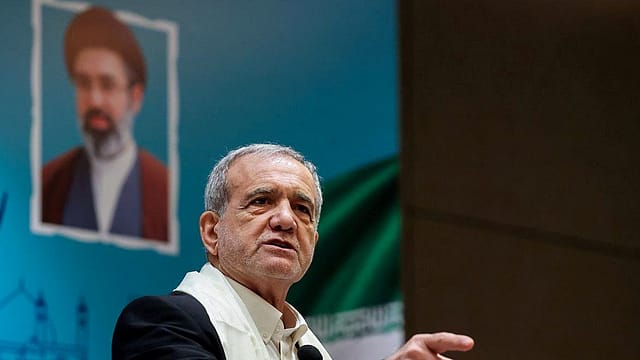
Iranian President Masoud Pezeshkian vowed that his government would “stand until our last breath” as US President Donald Trump rejected Tehran’s seven-day proposal to end the fighting, reopen the Strait of Hormuz and restart nuclear negotiations.
Speaking to supporters who welcomed him at the airport after his return from the United Nations General Assembly in New York, Pezeshkian pledged continued service to the Iranian people.
“We stand firm with strength, we are at the service of our people, we will stand until our last breath,” he said.
His remarks coincided with a warning from Iran’s armed forces against American intervention in the management of Hormuz.
Military Warns US Against Intervention
Brigadier General Abolfazl Shekarchi, senior spokesperson for the Iranian Armed Forces, told state television that Iran had resolved to make “not the slightest retreat in the face of the enemy”.

Zeroing In on ECI
09 Oct 2026 - Vol 05 | Issue 41
Constitutional legitimacy versus political opportunism
Describing Iran as highly experienced in asymmetric warfare, he warned Washington against attempting to control the strategic waterway.
“The Americans should not dream of interfering in the management of the Strait of Hormuz, and if they interfere, they will receive a slap from the Iranian Armed Forces; they must leave our region,” he said.
Shekarchi also threatened ships using routes other than those designated by Tehran.
“Any ship that passes through the Strait of Hormuz outside the route designated by Iran will not have security,” he said.
What Tehran’s Seven-Day Plan Proposed
Pezeshkian and Foreign Minister Abbas Araghchi presented the roadmap during their visit to the United States for the UN gathering.
Under the proposal, Washington would lift its naval blockade of Iranian ports, waive sanctions on Iranian oil sales, release an estimated $12 billion in frozen Iranian assets and observe a regional ceasefire covering Lebanon and Yemen.
Iran, in return, would reopen Hormuz, with negotiations on a final agreement concerning its nuclear programme beginning on the seventh day.
Araghchi said the initial measures would take four to five days, followed by the reopening of the waterway on the sixth day.
Trump rejected the proposal while speaking to reporters on Saturday.
“I reject this agreement,” he said, claiming Iran was seeking a deal because it was “severely failing”.
‘No Trust in the American Side’
In an Al Jazeera interview aired on Saturday, Pezeshkian said previous negotiations followed by attacks and sanctions had eroded Iran’s confidence in Washington.
“We have no trust in the American side and do not know on what basis an understanding can be reached with it,” he said.
He identified Qatar and Pakistan as intermediaries conveying Iranian messages to the United States.
According to Pezeshkian, the discussions were based on a memorandum of understanding reached in June that had since lapsed. He said Washington needed to clarify its position on that framework.
Iran Says Talks Could Reopen Shipping Route
Pezeshkian disputed responsibility for blocking Hormuz, alleging that the United States had “closed the routes before us”. He characterised Iran’s actions as “a natural response when routes are cut off to Iran”.
Despite his criticism of Washington, he said negotiations could resolve the crisis and allow commercial shipping to resume if they produced an end to the war.
He also accused the United States and Israel of drawing regional countries into the conflict in the expectation that Iran’s political system would collapse within days.
Trump’s rejection leaves Tehran’s proposed sequence of sanctions relief, maritime reopening and nuclear talks without an agreed path forward, while Iran’s military warnings add to uncertainty over shipping through Hormuz.
With inputs from ANI