EXPLAINED | Oxford Returns 39 Naga Ancestors. How Do You Bring the Dead Home?
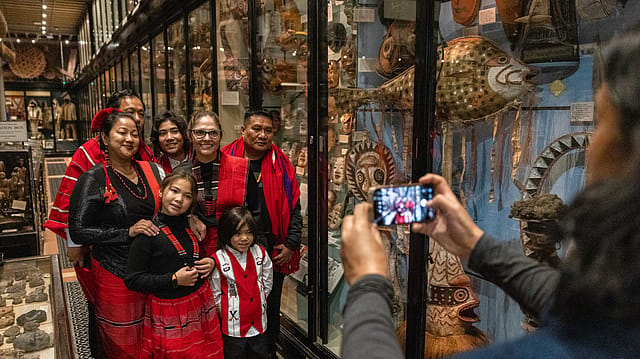
At Oxford’s Pitt Rivers Museum on 9 November 2026, Naga representatives received the remains of 39 ancestors taken during British colonial rule. Most are skulls. Some had been displayed in the museum. Now the delegation is bringing them to Nagaland, where a site for their burial is being prepared. “We shall put them to respectful rest,” tribal leader Thejao Vihienuo told AFP.
In June 2025, when Naga delegates first had access to the remains after their removal from display, they laid traditional shawls in homage. That visit ended with a formal declaration asking for the ancestors to come home. The handover took another seventeen months.
How did the ancestors end up in Oxford?
Most were brought to the museum between about 1910 and 1940 by John Henry Hutton and James Philip Mills, British colonial administrators who also studied Naga societies. The Nagas are several peoples whose homelands extend beyond the borders of present-day Nagaland.

The Wealth Issue 2026
06 Nov 2026 - Vol 05 | Issue 45
Portraits of Dreamers and Doers under 35
Oxford’s records offer a glimpse of what collecting meant under British rule. In 1936, Mills went to Pangsha with an armed escort and demanded heads that had been taken from a village. Oxford says remains and objects were often confiscated on such expeditions. The records leave gaps about how individual ancestors were taken. Naga representatives have challenged the colonial portrayal of the skulls as trophies and say communities also cared for the remains of their own dead.
Who asked Oxford to give them back?
Naga tribal leaders made the claim, with the Forum for Naga Reconciliation coordinating the work. In 2020, after Pitt Rivers decided to remove all human remains from display, Naga anthropologist Dolly Kikon contacted its director, Laura Van Broekhoven. The forum set up a research team called Recover, Restore and Decolonise in 2021. The team held workshops and listened to elders and tribal councils, known as Hohos. In June 2025, delegates took the claim to Oxford and set out their plan for a shared resting place.
Why did Oxford approve 39 and refuse one?
Oxford’s governing council said the evidence supported the Naga origin of 39 remains. When it approved their return on 13 July 2026, it turned down the request for one further set because its origin was unclear. Museum staff call the history of where something came from and how it entered a collection its provenance. A catalogue label, a collector’s letter and a community’s own knowledge may each supply part of that history. Oxford’s published policy weighs the evidence and the claimant’s connection to the remains case by case.
Who had the authority to receive them?
Oxford proceeded with the claim brought by the tribal representatives and facilitated by the forum. Days before the ceremony, the Federal Government of Nagaland, an organisation operating within the Naga National Council’s framework, asked Oxford to pause. It said it supported bringing ancestors home in principle and disputed the authority and procedures behind this claim. The tribal representatives and the forum went ahead with the handover on 9 November. The disagreement shows why establishing where an ancestor came from is only one part of a return. The institution also has to decide whose mandate it will recognise.
What does a museum have to do before a return?
It has to review the claim, decide who can receive the remains and arrange the physical transfer. In this case, Oxford’s council made the decision in July, the museum announced it in September, and the November ceremony transferred the remains to Naga representatives. The parties also had to organise specialist transport. The wider Oxford catalogue lists 219 entries under Naga human remains, including objects that contain or may contain human hair. That is a count of catalogue entries. The July decision covered the 39 ancestors and leaves the wider collection for separate discussions.
Where else have museums sent ancestors home?
From Oxford to Haida Gwaii. In 2010, staff from Pitt Rivers accompanied a Haida ancestor to the islands off Canada’s Pacific coast and took part in burial ceremonies. Haida delegates had made a formal request during a visit the previous year.
From Vienna to New Zealand. In 2022, Te Papa welcomed the remains of about 64 Māori and Moriori ancestors from Vienna’s Natural History Museum. Te Papa said it would care for them in a sacred space while researchers traced their origins and families and communities were consulted about where they should rest. Arrival in New Zealand was one stage of the return.
From Leipzig to New Orleans. In May 2025, New Orleans laid to rest 19 African Americans whose skulls had been sent to Germany in the 1880s for racially biased research. Leipzig University traced the history of the collection and worked with partners in New Orleans on the return.
Has India brought home remains before?
In 1974, the remains of Indian independence activist Udham Singh were brought back from England and cremated in Sunam, Punjab. He had been executed and buried at London’s Pentonville Prison in 1940. His case was a return from a known prison grave.
Ajnala, also in Punjab, illustrates a different problem. In 2014, skeletal remains were recovered from a well in India. A 2022 study of teeth found evidence pointing towards origins in the Gangetic plain, consistent with the theory that the dead were soldiers killed in the aftermath of the 1857 uprising. The researchers could estimate geographic origins. Individual identities remained unresolved.
Is there an international rule that makes museums return remains?
The UN Declaration on the Rights of Indigenous Peoples recognises the right to repatriation of human remains and calls for fair procedures developed with Indigenous peoples. The route to a return depends on the country and the institution. New Zealand funds a team at Te Papa to research and negotiate returns on behalf of Māori and Moriori. In the US, a federal law sets out repatriation duties for covered institutions. The Naga claim went through Oxford’s own decision-making process.
Where will the 39 ancestors be laid to rest?
The planned burial site is Naga Solidarity Park in Kohima. The park’s management committee began preparing the ground on 7 November, two days before the Oxford ceremony. The delegation’s next step is to bring the ancestors to Nagaland. The tribal leaders’ plan is to lay them together beneath a memorial where future generations can remember them.