UNGA Showdown: Trump’s Iran Annihilation Threat, Hormuz Strait Diplomacy and Global Energy Stakes
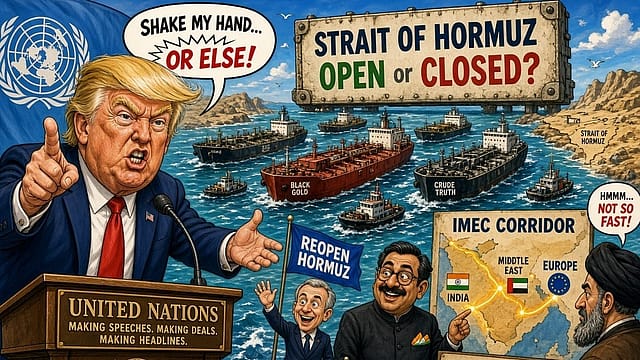
Donald Trump threatened Iran with annihilation from the United Nations podium. Hours later, he was praising talks aimed at reaching a deal with Tehran.
That sequence captured the tensions running through the UN General Assembly in New York on September 22: Washington kept military threats on the table as negotiators explored an agreement, France pushed to reopen the Strait of Hormuz, and India warned of the pressures that conflict and disrupted trade were placing on developing countries.
The waterway emerged as a connecting thread across those discussions. Iran set conditions for reopening it, French President Emmanuel Macron made restoring navigation a priority, and Trump backed the India–Middle East–Europe Economic Corridor (IMEC) while arguing for energy infrastructure less exposed to Iranian control.
A Threat at the Podium, Talks on the Sidelines
Addressing the 81st UN General Assembly, the US president presented Iran with a choice between an agreement that would allow it to rebuild and a devastating escalation.

Zeroing In on ECI
09 Oct 2026 - Vol 05 | Issue 41
Constitutional legitimacy versus political opportunism
“Or do I annihilate the Islamic Republic, and do it quickly, never giving them a chance to kill and destroy people and countries again?” Trump said, according to ANI.
He also suggested an agreement could follow the US midterm elections, asserting that Tehran was waiting for the outcome. That was Trump’s assessment of Iran’s calculations.
Later, during a meeting with Ukrainian President Volodymyr Zelenskyy, Trump said discussions involving his envoys Steve Witkoff and Jared Kushner had lasted three hours.
“It was a very good meeting,” he said.
Witkoff subsequently offered a more precise description of the diplomatic contact: the US and Iranian delegations had communicated through intermediaries.
“Today, on the sidelines of the United Nations General Assembly, we engaged in lengthy talks with the Iranian delegation through the mediators, who shuttled between the two sides throughout the day,” he wrote on X, according to ANI.
He said the mediators would continue their work and expressed hope that the discussions would prove constructive and promising. The statements offered an opening for further diplomacy, without announcing an agreement.
Tehran’s Terms—and Its Rebuttal
Iranian state broadcaster IRIB gave a different account of the format, reporting that Foreign Minister Abbas Araghchi had met Witkoff at the US envoy’s request.
According to the IRIB account cited by Al Jazeera and carried by ANI, Araghchi used the contact to restate Tehran’s conditions for reopening Hormuz: an immediate end to the naval blockade, the release of frozen Iranian assets and an end to the war on all fronts, including Lebanon.
The accounts should be read with that distinction intact: Witkoff described shuttle diplomacy, while Iranian state media reported a meeting between the two officials.
Iran’s military, meanwhile, condemned Trump’s UN remarks. In a statement, the General Staff of the Armed Forces and the Khatam al-Anbiya Central Headquarters accused him of using the UN platform to justify aggression and create insecurity.
His threats were “merely a tool for domestic propaganda”, the statement said, according to ANI.
Trump also claimed that the US Navy had escorted more than one billion barrels of oil out of Hormuz and that flows were higher than at any point since the war began. Those figures were claims made by the president; the supplied reports did not independently substantiate them.
Macron: Reopen Hormuz, Reject Regime Change by Bombing
For Macron, the immediate diplomatic objective was to secure a deal that would restore passage through Hormuz and ease the global energy crisis.
Speaking to ABC News, the French president also challenged the premise that military force could deliver political transformation in Iran.
“Having a regime change by bombing a country is not something I think feasible,” Macron said, according to ANI’s account of the interview. He described that approach as a mistake repeated in previous decades.
In his UNGA address, Macron said the strait should not be used for “blackmail” and emphasised both freedom of navigation and respect for international law.
France was also considering a new UN Security Council resolution on Hormuz, Reuters reported on September 22, citing diplomats. The initiative would seek to protect shipping through an international mission, although the proposal remained a diplomatic effort rather than an agreed arrangement.
Macron separately criticised conditions in Gaza, questioning the credibility of international claims of peace when humanitarian deliveries remained obstructed. He called the situation “shameful”.
His interventions connected the immediate need to move ships and supplies with a wider challenge for the assembly: whether diplomatic declarations could produce practical relief.
Trump Backs IMEC as Energy Routes Come Under Scrutiny
At a meeting with Gulf Cooperation Council and Arab leaders on the UNGA sidelines, Trump argued that attacks on commercial shipping demonstrated the need to shift the region’s energy infrastructure away from what he called “Iranian checkpoints”.
He placed IMEC within that argument.
“That’s why my administration strongly supports the India-Middle East-Europe Economic Corridor,” Trump said, according to ANI, also referring to pipelines and other means of transporting oil.
Unveiled in 2023, IMEC envisages an eastern corridor linking India with the Gulf and a northern corridor connecting the Gulf to Europe, using maritime and rail connections.
Trump’s endorsement gave the project a place in the discussions on energy security. His remarks did not announce that the corridor was operational or establish that it could immediately replace shipping through Hormuz.
India Flags the Costs for the Global South
External Affairs Minister S Jaishankar focused on how geopolitical conflict was affecting countries already contending with debt, climate shocks and inadequate development finance.
At a meeting of Global South countries, he called for closer cooperation on supply chains, financing and connectivity. In a post on X describing the discussions, he highlighted pressure on trade, fragmented investment flows and growing strains on international norms.
His priorities included preventing the manipulation of energy availability and prices, protecting grain and fertiliser supplies, and promoting fair economic and trade practices.
Jaishankar also stressed the security of commercial shipping and seafarers, stronger industrial and production capabilities, and a greater voice for developing countries in decisions affecting them.
“We must forge closer economic, technological & environmental cooperation, use existing platforms to highlight our concerns, while striving for Reformed Multilateralism,” he wrote, according to ANI.
Artificial intelligence featured in his appeal too: countries needed to manage the technological transition without allowing it to deepen divisions.
That concern came as Trump used his UN address to reject international control over AI development. White House excerpts of his speech recorded his opposition to a global regulatory framework and his preference for calling the technology “Super Intelligence”.
India and Italy Put Connectivity on the Agenda
Jaishankar’s meeting with Italian Deputy Prime Minister and Foreign Minister Antonio Tajani brought the Gulf situation, IMEC and the Ukraine conflict into the same bilateral discussion.
Tajani said the countries were expanding cooperation across defence, security, artificial intelligence, space, critical technologies and energy. He also reiterated a target of €20 billion in bilateral trade by 2029.
Freedom of navigation, he said in a post on X quoted by ANI, was essential to secure trade routes, connectivity and economic growth.
Across the meetings, leaders approached Hormuz from different directions: military pressure, negotiated reopening, alternative infrastructure and protection against economic disruption. The immediate test was whether the renewed diplomatic contacts could produce terms Washington and Tehran would both accept.
With inputs from ANI