Two Rockets, Two Coasts, 38 Minutes: SpaceX is Turning Spaceflight Into Routine
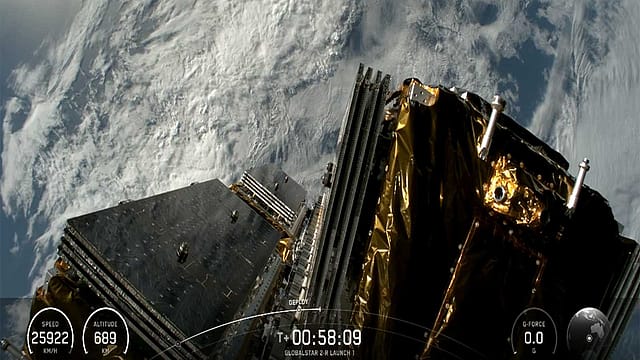
Thirty-eight-and-a-half minutes.
That was all SpaceX needed to move from launching commercial communications satellites from Florida to sending a classified US military payload into orbit from California.
The two Falcon 9 launches broke SpaceX's own record for the shortest gap between orbital missions. But the number tells only half the story. The bigger achievement is that SpaceX can increasingly treat rocket launches less like rare, bespoke events and more like a repeatable transportation business.
A Falcon 9 lifted off from Cape Canaveral Space Force Station in Florida, carrying eight satellites for Globalstar. While its upper stage was still in flight, SpaceX was already counting down on the other side of the United States. Just 38.5 minutes later, another Falcon 9 blasted off from Vandenberg Space Force Base in California carrying USSF-366, a classified mission for the US Space Force.

Losing Memory
16 Oct 2026 - Vol 05 | Issue 42
The making of a medical and social emergency
SpaceX's previous record was 65 minutes, set in August 2024 with two Starlink launches. This doubleheader chopped more than 26 minutes off that mark.
And SpaceX wasn't finished when the rockets left the ground.
Both first-stage boosters returned safely. The booster carrying Globalstar's satellites was flying for the 14th time and landed back at Cape Canaveral about eight minutes after launch. The Falcon 9 carrying USSF-366 used a booster on its 18th flight, which landed aboard the droneship Of Course I Still Love You in the Pacific.
Spaceflight Now reported that the second recovery represented the 650th successful Falcon booster landing.
That is where the achievement becomes more significant than a stopwatch record. SpaceX launched two previously flown rockets, recovered both, operated simultaneously from opposite sides of the United States and served two radically different customers. One commercial. One classified. One rocket was carrying a piece of the coming satellite-phone war
The Globalstar mission is particularly interesting because those eight satellites are pieces in a much bigger chessboard. They are replenishment spacecraft designed to strengthen Globalstar's existing low-Earth-orbit communications constellation. Globalstar had originally planned the mission for May 17 but postponed it to give its teams more time to prepare the satellites. All eight spacecraft were successfully deployed.
But Globalstar itself is now in the middle of a major reshaping of the satellite communications industry. Amazon announced in April that it had agreed to acquire Globalstar. The company plans to combine Globalstar's satellites, spectrum and communications infrastructure with Amazon Leo, its low-Earth-orbit network, to develop direct-to-device services capable of connecting ordinary mobile devices beyond terrestrial cellular coverage.
There is an Apple connection too. Globalstar already provides satellite connectivity supporting features on compatible iPhones and Apple Watches. Under an agreement announced alongside Amazon's acquisition, Amazon Leo is expected to support satellite services for Apple devices, including Emergency SOS, messaging, location sharing and roadside assistance.
So, the first Falcon 9 wasn't simply replenishing an ageing satellite constellation. It was launching infrastructure sitting at the intersection of Amazon's satellite ambitions, Apple's off-grid connectivity strategy and the increasingly fierce race to connect phones directly from space.
And who dominates that industry today? SpaceX itself, through Starlink. That creates a fascinating twist: SpaceX is launching satellites for infrastructure that could ultimately strengthen competitors to its own communications empire.
Then came the mission nobody wants to talk about. USSF-366 is very different. It belongs to the US Space Force, and almost everything about its payload remains classified. Spaceflight Now reported that Space Systems Command would say only that the mission had been assigned under a previously awarded National Security Space Launch Phase 3 Lane 1 task order. SpaceX ended its broadcast shortly after the booster landing, standard practice on sensitive national-security launches.
Space.com noted that outside observers have speculated that the mission could involve classified low-Earth-orbit satellites based on SpaceX's Starshield architecture, but neither SpaceX nor the US Space Force has publicly confirmed that assessment.
The secrecy itself makes the double launch revealing. SpaceX's launch machine can now move almost seamlessly between commercial communications and America's most sensitive national-security missions.
Rocket companies traditionally competed over payload capacity, reliability and price. SpaceX has added another weapon: cadence. These were Falcon 9 launches No. 95 and 96 of 2026, according to Space.com. Roughly three-quarters of those flights have carried Starlink spacecraft. That works out to roughly one Falcon 9 launch every 2.4 days so far this year. The US Air Force and Space Force's 2026 almanac provides an even starker indication of how far the model has travelled. Falcon 9 flew 165 times in 2025, more launches than every other launch vehicle combined, according to the publication.
Reusability helped drive that transformation. Once rockets can fly repeatedly, the competitive question changes. How quickly can you inspect them, integrate the next payload, fuel them, launch them, recover them and fly again? SpaceX compressed the answer into 38.5 minutes. One booster returned to land. Another dropped onto a ship in the Pacific. Eight commercial satellites headed into orbit. A secret military payload disappeared into the classified world.
And somewhere inside SpaceX, another Falcon 9 was being prepared to fly. The record is 38.5 minutes. The bigger milestone is what those minutes represent: SpaceX is making rocket launches look almost routine. For an industry built around extraordinary events, that may be the most extraordinary achievement of all.
(With inputs from ANI)