Trump’s Iran Trap: Operation Economic Outcast, Escalating Sanctions and the Looming Threat of Military Strikes
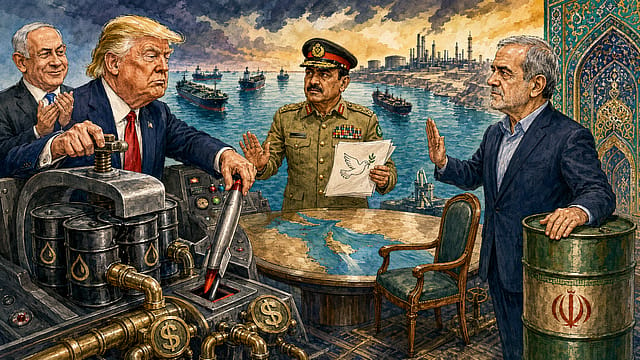
Donald Trump has offered Iran two doors. Behind the first lies “complete global isolation and a subsistence economy”. Behind the second waits a return to the international economy, provided Tehran accepts Washington’s terms.
US Treasury Secretary Scott Bessent presented those as Iran’s only choices while launching Operation Economic Outcast, a new sanctions campaign designed to sever the financial, technological and maritime networks that keep the Iranian economy moving. But Washington has left a third door visible and it is marked military force.
US Defence Secretary Pete Hegseth has warned that America is “by no means” ruling out fresh strikes around Iran or in the Strait of Hormuz. Israeli Prime Minister Benjamin Netanyahu has applauded the economic squeeze. Iranian President Masoud Pezeshkian, meanwhile, has told Pakistan Army Chief Asim Munir that negotiations cannot advance while the United States speaks through “coercion and bullying”.

Zeroing In on ECI
09 Oct 2026 - Vol 05 | Issue 41
Constitutional legitimacy versus political opportunism
Four developments. One tightening trap. Washington wants sanctions to drag Iran towards negotiations while the threat of missiles prevents it from resisting too aggressively. Tehran wants dialogue without appearing to surrender under pressure. Pakistan is trying to keep diplomacy alive. Israel wants the pressure intensified.
The confrontation has moved from the battlefield to bank accounts, oil tankers, satellite imagery and shell companies. The military option, however, has never left the room.
Operation Economic Outcast Targets Iran’s Escape Routes
The United States has sanctioned nearly 60 individuals, entities and vessels accused of supporting Iran’s military procurement, cyber operations and petroleum trade.
The objective is larger than placing more Iranian names on an American blacklist. Iran has lived under US sanctions for decades and built a web of intermediaries to move oil, technology and money around them.
Operation Economic Outcast targets that web. The first round stretches across Iran’s petroleum and petrochemical trade, shadow tanker fleet, military supply chains and technology networks. Washington has also opened five sectors to greater secondary-sanctions risk: digital assets, technology, gold, aviation and shipping.
Secondary sanctions give the campaign its global reach. A company does not need to be American to become a target. A foreign bank, ship manager, broker or business dealing with designated Iranian sectors can lose access to the US financial system.
The choice is designed to be brutal: retain the Iranian customer or retain the dollar. “Today, in that same spirit, we are launching an economic onslaught against Iran’s financial connections around the globe,” Bessent said, comparing the campaign to the beginning of the Allied D-Day offensive during the Second World War. “Our goal is to sever every economic lifeline that sustains this tyrannical regime.”
The State Department said the measures were intended to restrict the revenue Iran uses for military operations, support for armed groups and domestic repression. Among the targets is Dadenegar Startup Studio, which Washington alleges procured commercial Chinese satellite imagery to help the Iranian military identify targets and assess damage during Operation Epic Fury.
The US also designated the Islamic Revolutionary Guard Corps’ Cyber-Electronic Command and targeted senior Iranian military figures, including IRGC Commander-in-Chief Ahmad Vahidi. The Rewards for Justice programme is offering up to $10 million for information on Vahidi and other senior IRGC leaders.
The sanctions additionally pursue Iran’s “shadow fleet”, a network of tankers, vessel managers and intermediaries accused of disguising the origin and movement of Iranian petroleum. These ships may change names or flags, manipulate tracking signals, transfer cargo at sea or travel through layers of shell companies. The practices make Iranian oil harder to trace and place legitimate vessels and trade routes at risk, according to the US State Department.
Trump has warned that countries allowing their banks, businesses, airports or government bodies to provide Iran with a lifeline could face “tremendous economic consequences”.
Yet the opening strike also reveals Washington’s caution. The sanctions list does not include the major Chinese financial institutions suspected of facilitating payments for Iranian oil, Reuters reported. China remains Iran’s most important oil customer and one of the largest obstacles to complete economic isolation. Going after smaller intermediaries tightens the net around Iran. Striking a major Chinese bank could turn the campaign into a direct financial confrontation with Beijing.
For all its talk of an economic D-Day, Washington has not yet deployed its most explosive economic weapon. That restraint shows the calculation beneath the spectacle. Trump wants Iran cornered without immediately forcing every country trading with Tehran into open conflict with the United States.
Iran has promised retaliation against governments that cooperate with the campaign. Its Economy Minister Ali Madanizadeh has said the country is prepared to withstand the sanctions, while officials argue that China and Russia will reject Washington’s attempt to dictate their economic relationships. Netanyahu sees the same pressure very differently.
Netanyahu Applauds as Washington Tightens the Noose
“Congratulations President Trump and Secretary Bessent,” the Israeli prime minister wrote on X. “You justly exact a steep price from that cruel dictatorship and from those who assist its continued aggression.”
Netanyahu’s support places Israel firmly behind the American attempt to isolate Iran beyond its borders. Every tanker, broker, bank and technology supplier squeezed by Washington weakens Tehran without requiring another Israeli strike.
That is the strategic attraction of Operation Economic Outcast. Military action can destroy a facility. Sanctions attempt to prevent Iran from buying the parts, software, finance and shipping capacity needed to rebuild it.
The campaign also expands the battlefield into third countries. Companies operating in the UAE, Hong Kong, China, Singapore, Switzerland and Europe have reportedly been swept into the first set of actions.
Israel wants that external support system dismantled because sanctions imposed only on Iran leave the routes around them intact.
But Netanyahu’s applause also complicates diplomacy.
Iran routinely presents American pressure as part of a joint US-Israeli attempt to force regime change. The more explicitly Israel celebrates the sanctions, the easier it becomes for Iranian hardliners to cast any negotiation as capitulation to both Washington and Tel Aviv.
Bessent insists Tehran still has a route back.
“Iran now faces a clear choice, with only two paths before them: complete global isolation and a subsistence economy, or a path to normalcy with the opportunity to rejoin the global economy,” he said.
The offer contains its own contradiction. Washington says negotiations remain possible. It is simultaneously trying to strip Iran of enough money, friends and military options to determine how those negotiations begin and where they end. Pezeshkian wants the sequence reversed. Change the American tone, establish respect and then discuss the dispute. Pakistan has stepped into that narrowing space.
Pakistan Searches for a Door to Diplomacy
Meeting Asim Munir in Tehran, Pezeshkian accused the United States of relying on coercion rather than negotiation.
“The United States must correct its tone and approach in its interactions with Iran, because relying on coercion and bullying will only complicate the implementation processes,” he said, according to the Iranian presidency.
The Iranian president also called for greater political, economic and security cooperation among Iran’s neighbours and other Islamic countries. That appeal serves two purposes.
It asks regional governments to support diplomacy. It also warns them against joining Washington’s campaign of isolation.
Pakistan is attempting to occupy the role of intermediary without appearing to carry an American ultimatum into Tehran. Munir said diplomatic processes must be considered with “complete precision and meticulousness” if the sides are to reach a comprehensive agreement.
His visit demonstrates that channels remain open even as Washington escalates.
But the mediator’s problem is formidable.
The United States wants Iran’s nuclear threat eliminated, its oil-evading networks dismantled and its capacity to pressure shipping through Hormuz curtailed. Iran wants sanctions relief, respect for its sovereignty and security guarantees against further attacks.
Neither side wants to move first.
For Tehran, negotiations opened under maximum pressure could resemble surrender. For Washington, easing pressure before Iran makes concessions could allow the regime to recover.
Pakistan must, therefore, persuade each government that talking does not reward the other. The sanctions make that work harder. The military threat makes it urgent.
Hegseth Keeps the Missiles Beside the Sanctions
Asked whether American strikes had been paused, Hegseth gave a one-word answer. “No.”
“If we need to use kinetic strikes, we’ll use them,” he said. “If Iran is foolish enough to overplay their hand or mess with the American military, we’ll do what we need to do.”
He added that Washington was “by no means” ruling out strikes anywhere in the Strait of Hormuz or around Iran.
The message completes Trump’s pressure architecture. Bessent controls the financial weapon. Hegseth keeps the military one visible. Economic pressure is preferable because it can weaken Iran without exposing American forces to another direct confrontation. Yet sanctions take time, leak through intermediaries and depend on cooperation from other countries. Military force remains the threat Washington can activate if Tehran attacks US assets, disrupts shipping or refuses to bend.
Hegseth claimed that previous American operations had severely weakened Iran’s navy, radar network and missile capability, allowing the US to protect shipping through Hormuz. Iran retains military, drone and missile capabilities, however, and has warned that attacks on its infrastructure could bring retaliation against American interests.
That leaves the Strait of Hormuz as both an economic artery and a military tripwire. Washington says it can keep oil moving while denying Iran the ability to profit from its own exports. Tehran argues that it can raise the cost for everyone if its economy is strangled.
The risk is that each side begins believing the other has fewer options than it actually possesses. America sees an Iranian economy under extreme stress and concludes that more pressure will force negotiations. Iran sees Washington avoiding its toughest sanctions against Chinese banks and concludes that the United States still fears a wider economic shock. Trump’s plan is to remove every escape route until Tehran chooses his diplomatic door. Iran’s answer is to make the corridor leading to that door dangerous enough that Washington changes the terms.
Between them stands a Pakistani mediator with peace papers, an Israeli prime minister applauding the squeeze and an American defence secretary resting his hand near the military lever. Two doors are on offer. Too many fingers remain close to the trigger.
(With inputs from ANI)