Missiles, Money & Allies: Can Saudi Arabia Stop the Houthi Assault?
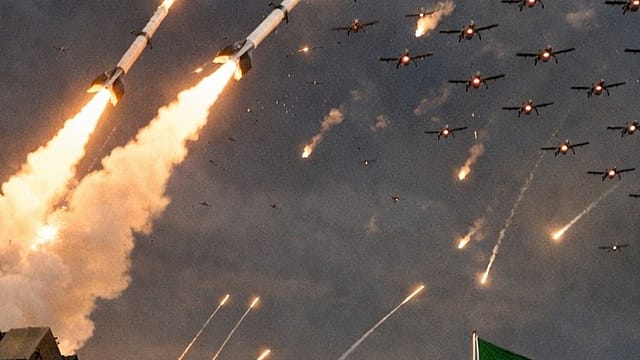
Saudi Arabia can destroy incoming missiles. The question is how long it can sustain that defence—and how much damage the attacks can cause even when most are intercepted.
The Wall Street Journal’s report that Saudi officials are concerned about dwindling interceptor stocks puts military endurance at the centre of the crisis. An expensive defence system needs missiles available to fire, functioning sensors and trained crews around the clock. A determined attacker needs only occasional breakthroughs to impose substantial costs.
Here is what Saudi Arabia has, who is helping and what its options can realistically achieve.
WHAT HAS CHANGED IN THE LATEST ATTACKS?
The October 10 attack on Riyadh’s King Khalid International Airport killed 13 people, including an Indian national who subsequently died. A separate attack on October 11 killed another person and injured 11, according to Saudi authorities cited by Reuters.

Zeroing In on ECI
09 Oct 2026 - Vol 05 | Issue 41
Constitutional legitimacy versus political opportunism
The coalition also reported successful interceptions of a cruise missile, a drone and a ballistic missile. This is a mixed picture: Saudi defences are intercepting threats, while damaging attacks are still reaching civilian infrastructure.
The airport attacks make the consequences visible to passengers, airlines and businesses. Protecting infrastructure now involves both preventing strikes and maintaining confidence that essential services can operate.
IS SAUDI ARABIA REALLY RUNNING OUT OF MISSILES?
The reported shortage concerns interceptor missiles, the weapons fired to destroy incoming threats. It does not mean Saudi Arabia has exhausted its entire military arsenal.
The WSJ report, cited by ANI, attributes the assessment to Saudi officials. Publicly available information does not establish the exact remaining stock, consumption rate or replenishment schedule.
That limits what can responsibly be concluded. “Running low” signals pressure on the defence; it does not tell us when a particular battery would run out. Nor does possessing a large defence budget guarantee immediate replacement. Missiles must be manufactured, allocated, transported and integrated into operational stocks.
WHAT AIR DEFENCES DOES SAUDI ARABIA HAVE?
Two important elements are the US-made Patriot system and Terminal High Altitude Area Defense, or THAAD.
Patriot is part of the kingdom’s air and missile defence network. Its PAC-3 interceptors are designed to engage threats including tactical ballistic missiles and cruise missiles. Lockheed Martin identifies PAC-3 as a capability supporting Saudi defence.
THAAD has a different principal task: intercepting ballistic missiles during the final stage of flight, inside or outside the atmosphere. The US Missile Defense Agency describes it as an upper-level element of missile defence.
These systems complement each other. THAAD is not a universal answer to drones and low-flying cruise missiles. Protecting against different threats requires layers of sensors and weapons.
WHY CAN MISSILES GET THROUGH SUCH EXPENSIVE DEFENCES?
Because air defence is a sequence of demanding tasks: detect the threat, identify it, track it, decide how to engage it and destroy it before it reaches the target.
Ballistic missiles, cruise missiles and drones present different problems. Cruise missiles can fly low, reducing the time available for ground-based sensors to detect and engage them. US Army material explains why integrated defence requires multiple sensors, weapons and protective measures.
Repeated or simultaneous attacks can also place pressure on crews, engagement capacity and missile stocks.
These are general vulnerabilities. Without detailed operational evidence, we cannot identify which factor caused a particular Riyadh interception failure. A strike alone does not reveal whether the problem was detection, positioning, equipment, ammunition or the interception itself.
CAN A SUCCESSFUL INTERCEPTION STILL LEAVE PEOPLE AT RISK?
Yes. Destroying a missile in flight can prevent its intended impact, but falling debris may still cause injuries and damage.
The supplied ANI report, citing the WSJ, says debris from an intercepted ballistic missile struck a kindergarten and a medical clinic complex on Thursday.
This is why civilian protection cannot end with interceptors. Warning systems, emergency procedures, resilient buildings and decisions about suspending operations also matter.
An airport may need to close while authorities assess risks even if nearby threats have been intercepted. The military and civil aviation decisions are connected, but they answer different questions.
DOES SAUDI ARABIA HAVE THE MONEY TO HANDLE THIS?
Saudi Arabia has substantial resources. SIPRI estimates its military expenditure at $83.2 billion in 2025, making it the world’s eighth-largest military spender.
Money can purchase equipment, training and replenishment. It cannot instantly create production capacity or guarantee uninterrupted protection.
The immediate issue is how efficiently Saudi Arabia can match its weapons to the threats. Using sophisticated interceptors against comparatively inexpensive attacks can create a costly contest, particularly when the attacks recur.
US Army research explicitly discusses developing lower-cost defences against drones and cruise missiles so advanced Patriot interceptors can be preserved for more demanding threats.
WHO IS HELPING SAUDI ARABIA?
Several partners are involved, but their roles differ.
The United States remains central to Saudi missile-defence supply. Pakistan and Turkey have activated commitments under their defence arrangement with Riyadh. Britain has agreed to provide defensive air-to-air refuelling support. Yemeni government forces are fighting the Houthis on the ground.
UAE-backed Giants Brigades have also coordinated with Saudi air power in the current offensive.
India and Australia have condemned the attacks. Those statements express solidarity; they should not be presented as commitments to combat operations.
The practical question is what each partner supplies: ammunition, sensors, personnel, intelligence, logistics or direct military action. An alliance announcement does not make those contributions interchangeable.
WILL THE UNITED STATES PROVIDE MORE INTERCEPTORS?
There is an established supply route. On January 30, 2026, the US approved a possible $9-billion sale covering 730 Patriot PAC-3 Missile Segment Enhancement missiles and associated equipment to Saudi Arabia.
The crucial word is “possible”. Approval of a sale does not establish that all the missiles have been delivered or are ready for use.
The public notification cannot therefore be treated as a count of Saudi Arabia’s current inventory.
Faster replenishment would depend on available stocks, production schedules, contractual arrangements and US decisions. Washington’s political support and its ability to deliver equipment promptly are related but separate issues.
ARE PAKISTAN AND TURKEY FIGHTING THE HOUTHIS?
Their support is clearer than the extent of their combat involvement.
Reuters reported that Turkey, Pakistan and Saudi Arabia invoked their August defence agreement and pledged rapid deployment of forces and capabilities. Turkish assistance was described as mainly defensive and technical, including equipment, intelligence, logistics and planning support.
Reuters separately reported that Pakistan agreed to deploy additional forces, but troop numbers, missions and command arrangements were undisclosed. It remained unclear whether those troops would participate in operations against the Houthis.
Reports claiming Pakistani air strikes have also faced Pakistani denials. Direct combat involvement should therefore not be stated as settled fact.
WHAT ABOUT BRITAIN—AND WILL TRUMP JOIN THE STRIKES?
Britain has agreed to defensive air-to-air refuelling support for Saudi jets, according to The Guardian.
That can support aircraft operations, but it does not replace interceptor stocks.
Trump has said the US is considering joining Saudi strikes. A statement that intervention is under consideration is not confirmation that a new US combat operation has begun.
There is also a distinction between helping defend Saudi territory and launching another campaign inside Yemen. The first addresses immediate protection; the second carries broader military and political consequences.
COULD A BIGGER BOMBING CAMPAIGN END THE THREAT?
It could damage launch capabilities, weapons stores and support infrastructure. It cannot guarantee that every future attack will stop.
The US reported destroying Houthi command facilities, air defences, manufacturing facilities and weapons stores during its 2025 campaign.
Yet Reuters subsequently reported that the campaign had not severed supply lines or dismantled senior leadership, with experts warning of recovery.
Our assessment: Saudi air superiority can help suppress the threat. Converting that advantage into lasting security requires reliable intelligence, disruption of replenishment and a workable political outcome in Yemen.
A larger campaign also risks civilian casualties and further retaliation. Its success should be judged by whether attacks diminish sustainably, rather than by the number of targets struck.
CAN IRAN OR OMAN HELP DE-ESCALATE THE CONFLICT?
Diplomacy remains relevant.
Iran’s relationship with the Houthis gives Tehran potential influence, but influence should not be confused with complete control. A promise to encourage dialogue would need to produce verifiable changes in attacks.
Oman has a demonstrated mediation role. Its Foreign Ministry announced the US-Houthi ceasefire agreement on May 6, 2025.
That precedent shows negotiations can change behaviour between particular parties. It also illustrates their limits: an agreement involving Washington and the Houthis cannot automatically be assumed to protect Saudi Arabia.
Any new arrangement would need clear commitments on Saudi territory, civilian infrastructure and compliance.
SO, CAN SAUDI ARABIA TACKLE THIS?
Saudi Arabia can defend against many attacks and impose military costs on the Houthis. It cannot promise an impenetrable shield or a quick end to the threat.
Our assessment is that its best prospect combines sustained interceptor supply, stronger protection against drones and cruise missiles, coordination with allies, civilian emergency preparedness and diplomacy.
The Houthis do not need to match Saudi Arabia’s military expenditure to impose serious costs. Occasional strikes can disrupt airports, unsettle investors and force the kingdom to spend heavily on continuous protection.
Saudi success would mean fewer damaging attacks, dependable civilian services and a defence that can be maintained over time.
The decisive test is whether Riyadh and its partners can make ordinary life reliably safe while reducing the threat at its source.