Trump, Xi and Putin Set for First Three-Way Summit in Shenzhen as Nuclear Arms Control Looms
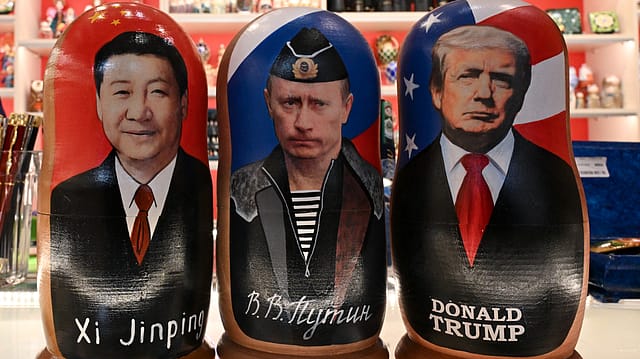
US President Donald Trump met Chinese President Xi Jinping and then Russian President Vladimir Putin in Shenzhen on Thursday, ahead of the first summit to bring the leaders of the three countries together. There were handshakes and a group photograph with fellow Asia-Pacific Economic Cooperation leaders before the scheduled three-way talks. Among the issues expected to come up later in the day was one on which Washington has struggled to bring Beijing to the table: nuclear disarmament.
Trump chose a different starting point in his public remarks. He recalled the agreement his administration helped broker between Cambodia and Thailand a year ago, saying it had allowed people displaced by the conflict to go home. He then turned to what he hoped the three presidents could achieve in China.

The Wealth Issue 2026
06 Nov 2026 - Vol 05 | Issue 45
Portraits of Dreamers and Doers under 35
“And here in China, I look forward to a historic trilateral meeting with President Xi and President Putin later today to discuss more opportunities for all three,” Trump said. He did not identify a specific agreement he expected the leaders to reach.
WHY NEW START HANGS OVER THE TALKS
The expiry of the US-Russia New START treaty earlier this year gives the Shenzhen meeting particular significance. Washington wants Beijing involved in a broader discussion on nuclear reductions. China has traditionally resisted direct negotiations on those terms, pointing to the disparity between its arsenal and the much larger stockpiles held by the US and Russia.
That leaves a basic question for any arms discussion among the three: who should be expected to make the first reductions? Washington wants a conversation that includes all three nuclear powers. Beijing’s position is that the size of the American and Russian arsenals gives those two countries a different responsibility. China has nevertheless described the meeting itself as being of “ground-breaking significance”, saying closer engagement among major powers could help preserve peace and strategic stability.
The expected agenda extends to the Russia-Ukraine war, the conflict involving Iran and global trade. Trump’s remarks in Shenzhen also made clear where his administration stood on international oversight of artificial intelligence. He called the US the world leader in what he termed “Super Intelligence” and said Washington would oppose attempts at global regulation that it believed could hold back the technology. He did not say AI regulation would form part of the trilateral talks.
XI AND PUTIN COMPARE NOTES BEFORE TRUMP ARRIVES
By the time Trump arrived in China for the APEC Economic Leaders’ Meeting, Xi and Putin had already held bilateral talks in Shenzhen. On Wednesday, the two discussed how Beijing and Moscow should respond to international uncertainty. They continued their conversation over a working breakfast, according to Russian media reports cited by ANI.
Xi said relations between China and Russia “stand as firm as a mountain amid wind and rain”. He urged both governments to take a long view of the partnership and argued that closer cooperation could give other countries a measure of stability. He described the relationship as one between equals, built on mutual respect and benefits for both sides.

Putin said political cooperation with Beijing continued to work well despite the difficult international climate. Both presidents argued for a world order in which power is shared more widely. Xi said major powers had a responsibility to advance that change; Putin pointed to the Asia-Pacific as a region where countries were already asserting greater independence over their economic and foreign policy choices.
PUTIN CHALLENGES THE REACH OF SANCTIONS
On trade, Putin drew a distinction between the damage economic restrictions can inflict and what the countries imposing them can ultimately achieve. He acknowledged that tariffs, export controls and sanctions affect growth. His contention was that even powerful economies could no longer rely on those measures to halt a competitor’s development.
Putin accused countries that once dominated the global economy of trying to restrict the rise of faster-growing rivals. Such measures offended the principle of fair competition, he argued, and could work against the interests of the governments that adopted them. “But they are not capable of fully stopping growth or destroying the economies of the competition,” he said of the restrictions.
Putin said he expected the meeting with Xi and Trump to be of “great use”. For all three presidents, the immediate distinction was between agreeing to meet and agreeing on terms. Shenzhen had secured the first. On the nuclear question in particular, neither Trump’s remarks nor the preceding Xi-Putin talks indicated that Beijing had changed its position on who should cut first.
With inputs from ANI