Trump Meets Xi and Putin at APEC as Nuclear Arms, Iran and Ukraine Talks Loom
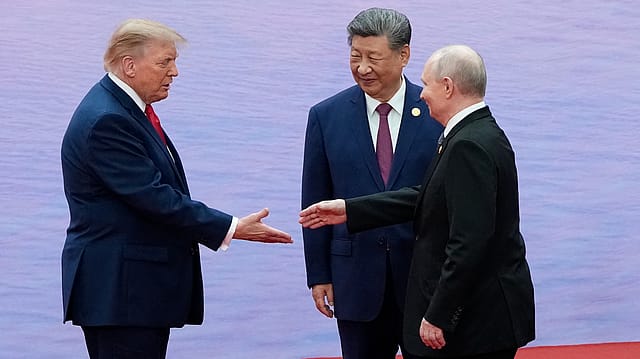
US President Donald Trump arrived at the 33rd APEC Economic Leaders’ Meeting in Shenzhen, China, where Chinese President Xi Jinping welcomed him before he met Russian President Vladimir Putin.
The leaders exchanged handshakes and joined other world leaders for a group photograph at the summit. The encounters came ahead of a trilateral meeting scheduled for later on Thursday, November 19, with nuclear disarmament, Iran, global trade and the Russia-Ukraine war expected to dominate discussions.
The proposed talks would bring Trump, Xi and Putin together for their first trilateral summit, placing three of the world’s most influential powers at the same table amid disputes over security, economic restrictions and international arms control.
Xi and Putin Pledge Closer Cooperation
Diplomatic activity intensified in Shenzhen on Wednesday, when Xi and Putin held bilateral discussions ahead of Trump’s arrival for the APEC meeting.

The Wealth Issue 2026
06 Nov 2026 - Vol 05 | Issue 45
Portraits of Dreamers and Doers under 35
The Chinese and Russian presidents reaffirmed the stability of their relationship and their commitment to advancing a multipolar world order amid growing international uncertainty.
Xi said China-Russia relations “stand as firm as a mountain amid wind and rain”. He urged both countries to take a long-term strategic view and contribute greater stability and certainty to global affairs.
Putin said political cooperation between Moscow and Beijing remained constructive despite the difficult international environment.
“Russian-Chinese political cooperation is working favourably and constructively in a difficult political situation,” Putin said.
“We are committed to constructive approaches to form a fairer multipolar world order,” he added.
According to Russian media reports, the two leaders continued their discussions over a working breakfast in Shenzhen on Wednesday. Both stressed the need to deepen cooperation and advance multipolarisation.
Putin described the foreign policy relationship as stable and developing positively. Xi, meanwhile, called on China and Russia to take on greater responsibilities as major powers.
“We must firmly shoulder the responsibilities expected of major powers, lead and advance the multipolarisation of the world and the democratisation of international relations,” Xi said.
He also sought deeper cooperation across sectors, saying the partnership had helped bring stability and certainty to an increasingly turbulent world. Xi characterised Russia-China relations as a model built on equality, mutual respect and mutually beneficial cooperation.
Putin Targets Tariffs, Sanctions and Economic Pressure
Putin’s Shenzhen engagements included an address to business representatives at the APEC CEO Summit, where he criticised the use of economic pressure and restrictions to compete with other countries.
He said “tools of economic coercion” were increasingly becoming a thing of the past as countries sought greater sovereignty and independence in a changing economic and geopolitical environment.
“The regional model serves as a vivid example of strengthening a fairer, more democratic and equal world order,” Putin said, referring to developments in the Asia-Pacific region.
He accused formerly dominant powers of trying to restrain countries making economic progress. Such efforts, he argued, undermined fair competition and could ultimately damage the interests of the countries imposing them.
Putin acknowledged that tariffs, export restrictions and sanctions continued to affect economic development.
“But they are not capable of fully stopping growth or destroying the economies of the competition,” he added.
Against that backdrop, the Russian president said he expected “great use” from Thursday’s trilateral meeting with Trump and Xi.
Trump Sets Out Nuclear, Iran and Ukraine Agenda
Before leaving for Asia, Trump outlined a broad agenda for the proposed meeting, identifying nuclear disarmament, the conflict involving Iran, trade and the Russia-Ukraine war as subjects for discussion.
“We’re going to be talking about denuclearisation...We’ll talk about Iran,” Trump told reporters ahead of his departure.
He also said Ukraine would feature prominently, citing what he described as the continuing human cost of the war.
“We’ll also talk about my favourite subject, Ukraine. Ukraine is losing. Ukraine and Russia are losing 25,000 souls per month, so we’ll be talking about that. We’ll also discuss economics and trade,” Trump said.
Ukraine’s inclusion in the agenda carries particular significance amid concerns in Kyiv about major powers discussing the war without Ukrainian participation.
The proposed discussions also bring together leaders whose governments remain divided over tariffs, technology controls and the organisation of global supply chains. Alongside the security agenda, those disputes are expected to give the talks a substantial economic dimension.
Arms Control Talks Follow New START’s Expiration
The summit comes at a sensitive point for international arms control following the expiration of the US-Russia New START treaty earlier this year.
Washington has sought to involve Beijing in broader discussions on reducing nuclear weapons. China has traditionally resisted direct negotiations, citing the much larger nuclear arsenals held by the United States and Russia.
Beijing has described the proposed trilateral meeting as being of “ground-breaking significance”, presenting it as an opportunity to safeguard world peace and promote strategic stability among major powers.
The leaders are also expected to examine the geopolitical and economic consequences of the conflict involving Iran, alongside their continuing disagreements over trade and technology.
With Trump’s encounters with Xi and Putin preceding the planned three-way talks, the APEC gathering has become a venue for diplomacy extending well beyond the forum’s economic agenda. The bilateral exchanges and proposed trilateral summit place Shenzhen at the centre of discussions over nuclear security, two ongoing conflicts and relations among Washington, Beijing and Moscow.
With inputs from ANI