Trump Would ‘Love’ a Third Term. There’s Just One Problem: The Constitution
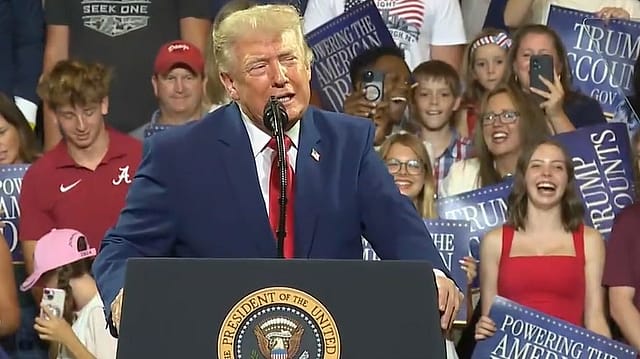
Donald Trump rarely sounds like a man ready to leave the stage.
His supporters apparently aren't ready either.
At an event in Ohio, chants of “2028!” rang out for the US President. Hours later, when reporters asked Trump about the prospect of doing something no American president has done since Franklin D Roosevelt, winning a third presidential election, his answer contained both desire and reality.
“I'd love to run, but the law is very strong.”
For a president who has repeatedly entertained questions about remaining in power beyond his second term, it was one of Trump's clearest acknowledgements yet that there is a rather formidable obstacle between him and Trump 3.0: the US Constitution.

Rise of the Pivotal Power
18 Sep 2026 - Vol 05 | Issue 38
The BRICS declaration is a strategic victory for Modi
Speaking to reporters at Joint Base Andrews in Maryland, Trump said he was constantly being asked about another presidential campaign. “Everybody asks me that question, and you know that the law is very strong on that,” he said. He pointed to the chants from supporters in Ohio as evidence of the enthusiasm. “Even tonight, they're screaming at the event, ‘2028!’” Trump said, before adding: “Everybody wants me to do it, but the law is very strong.”
In fact, constitutionally, he can't run for another elected term under the rules as they currently stand.
The amendment standing between Trump and 2028
The obstacle is the 22nd Amendment, which states that no person can be elected president more than twice. Trump won his first presidential election in 2016, lost to Joe Biden in 2020 and returned to win again in 2024.
Two victories. Two elected terms. That puts him squarely within the constitutional limit. The amendment was proposed by Congress in 1947 and ratified in 1951, following the extraordinary presidency of Franklin D Roosevelt.
Why could Roosevelt do what Trump can't? Because there was no constitutional two-term limit when Roosevelt was president. For more than a century, American presidents largely followed the precedent established by George Washington, who voluntarily left office after two terms.
Roosevelt broke with that tradition. He won a third term in 1940, followed it with a fourth in 1944 and died in office in April 1945. Congress subsequently moved to ensure that no future president could repeat the feat, turning Washington's convention into a constitutional rule. More than seven decades later, that amendment has landed squarely in the middle of the Trump conversation. His supporters may be chanting “2028”. Trump may “love to run”. The Constitution, however, has already cast its vote.
(With inputs from ANI)