Trump Taunts Iran’s Leadership, Hegseth Faces Anti-War Protests as Tehran Talks Tough
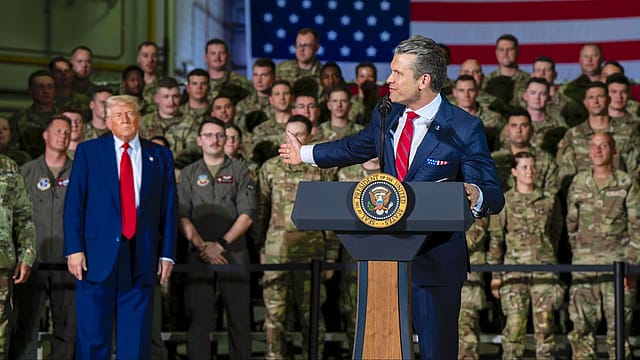
US President Donald Trump mocked Iran’s leadership at an Arizona campaign rally as Pentagon chief Pete Hegseth faced repeated interruptions from anti-war protesters in Washington, with both reiterating that Tehran would not be allowed to acquire a nuclear weapon.
Iran, meanwhile, struck a defiant note. Parliament Speaker Mohammad Bagher Ghalibaf said the country had strengthened its military capabilities and was combining fighting with negotiations to force Washington to accept its demands.
The exchanges came alongside competing US and Iranian accounts of maritime security incidents around the Strait of Hormuz, underscoring the continuing risks to shipping through the vital trade route.
‘WHO WOULD LIKE TO BE THE PRESIDENT OF IRAN?’
Speaking in Arizona on Wednesday, Trump questioned who would want to take charge of Iran before suggesting that his remarks may have gone too far.

Zeroing In on ECI
09 Oct 2026 - Vol 05 | Issue 41
Constitutional legitimacy versus political opportunism
“Who would like to be the president of Iran? Please raise your hand. No. I don’t want to be. I probably went a little too far. I’m sorry because I don’t know who the hell we’re dealing with,” he said, according to Fox News.
His comments followed a more explicit warning at an earlier campaign appearance in Alaska.
“Wait till you see what we do to Iran. We’re going to we’re going to do a number. Wait till you see,” Trump said.
He also claimed that Iran’s nuclear capability was buried beneath thousands of tonnes of rock and reiterated that the country would not obtain a nuclear weapon. His warning followed reports that the Pentagon had been directed to prepare for a possible resumption of major combat operations.
HEGSETH HECKLED AT ARMY FORUM
In Washington, Hegseth said the United States would do “what is necessary” to prevent Iran from acquiring nuclear weapons, despite repeated protests during a panel at the Association of the US Army’s annual meeting.
“The protesters spouting off slogans—Iran really will never have a nuclear weapon,” he said, according to Al Jazeera.
Demonstrators interrupted the discussion at least five times in its first half-hour, the New York Post reported. They condemned the Iran war and the Israel-Palestine conflict, with some calling Hegseth a “war criminal” and a “coward”.
“She thinks highly of me,” Hegseth responded after one interruption. As the protests continued, he remarked: “Appears we have a bit of a tactic.”
Security personnel removed the demonstrators. The New York Post reported that officers carried at least one woman out while she continued shouting.
The Association of the US Army said protest was a fundamental right but argued that the interruptions breached the code of conduct accepted by attendees.
The panel concerned Project Agincourt, a Pentagon initiative to accelerate the development and deployment of autonomous military systems, including drones and robotics.
IRAN SAYS IT IS FIGHTING AND NEGOTIATING
Ghalibaf, one of Tehran’s senior negotiators, said Iran’s firepower, offensive capabilities and air defences had grown significantly between the 12-day war and the more recent conflict with the US and Israel.
“The enemy mistakenly felt that Iran was weak and attacked. We must frustrate the enemy by becoming stronger in order to achieve sustainable deterrence,” he said in an interview shared through his official Telegram channel.
He identified military strength, control over the Strait of Hormuz, Iran’s regional allies and national cohesion as central to that strategy.
“Instead of the cycle of war, negotiation, and peace, we create a new equation: war, negotiation, and deterrence,” he said.
Ghalibaf argued that military action and diplomacy were complementary tools intended to translate battlefield gains into political outcomes. He accused Washington of violating its commitments and demanded a change in US behaviour.
“America must be punished and change its behaviour and be made to understand that it must accept the legitimate demands of the Iranian people,” he said.
COMPETING CLAIMS OVER MARITIME ATTACKS
US Central Command said American forces destroyed an Iranian-affiliated dhow in the Gulf of Oman on October 6, alleging that it had been conducting surveillance and targeting US Navy ships.
The command said the crew had been safely removed before the vessel was destroyed and that repatriation efforts were continuing.
CENTCOM also rejected allegations from Iran’s representative to the International Maritime Organisation that US forces had used threatening language against Iranian mariners. It maintained that its blockade had been professionally communicated and that commercial ships continued to transit the Strait of Hormuz with protection from US forces and regional partners.
Separately, Iran’s Islamic Revolutionary Guard Corps Navy claimed that a container ship carrying more than 2,500 containers struck a naval mine, caught fire and sank in the southern waters of the strait.
The claim was carried by Iranian broadcaster IRIB. Al Jazeera separately reported that two Singaporean cargo vessels had been attacked with projectiles, with one sinking and the other reaching port safely.
Iran has warned ships against transiting the strait without its approval, while the US military has been directing vessels along a route closer to Oman’s coast.
INFLATION ENTERS THE WAR OF WORDS
Ghalibaf also seized on rising US inflation to criticise the Trump administration, sharing a CNN report showing annual consumer-price inflation increased to 3.7 per cent in September from 3.4 per cent in August.
Consumer prices rose 0.6 per cent over the month, according to the report, adding to affordability concerns before November’s midterm elections.
“We’re in a world now of inflation at 3.7 per cent and wage gains for the typical American at 3 per cent; that’s a big gap,” Heather Long, chief economist at Navy Federal Credit Union, told CNN.
For Trump, the latest exchanges bring together two pressures on the campaign trail: defending his approach to Iran and confronting voter concerns about the cost of living.
With inputs from ANI