Trump Claims US Strike Captured Venezuela’s President Maduro, Caracas Denounces “Military Aggression”
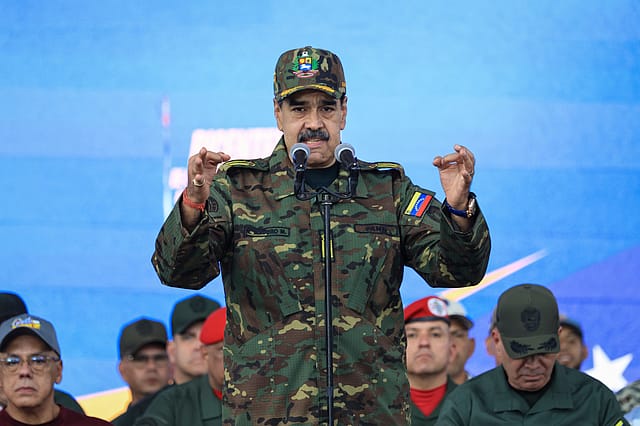
US President Donald Trump on Saturday claimed that the United States had carried out a large-scale military strike against Venezuela, during which President Nicolas Maduro and his wife were captured and flown out of the country, dramatically escalating tensions between Washington and Caracas.
In a post on Truth Social, Trump said the operation was conducted in coordination with US law enforcement agencies and described it as a decisive action against what he has repeatedly labelled a “narco-terrorist” government. He said further details would be shared at a press conference scheduled for later in the day at Mar-a-Lago.
The claim comes amid a prolonged standoff between the US and Venezuela, marked by sanctions on Venezuelan oil shipments, stepped-up US military activity in regional waters, and repeated calls by Trump for Maduro to step down. Washington has accused Caracas of involvement in drug trafficking and hostile actions against US interests.
Venezuela swiftly rejected Trump’s claims, condemning what it called a “military aggression” by the United States. In an official statement, the Venezuelan government accused Washington of launching attacks on civilian and military targets in Caracas and the states of Miranda, Aragua and La Guaira, calling the action a flagrant violation of the United Nations Charter and international law.
The statement alleged that the strikes were aimed at seizing Venezuela’s strategic resources, particularly oil and minerals, and forcibly imposing regime change. Invoking the legacy of Simón Bolívar, the government said the Venezuelan people would once again defend their sovereignty and independence.

Iran After the Imam
06 Mar 2026 - Vol 04 | Issue 61
Dispatches from a Middle East on fire
Authorities announced the deployment of the Bolivarian National Armed Forces nationwide, the activation of national defence plans, and the declaration of a State of External Commotion. Caracas said it would raise the issue before international bodies including the UN Security Council, the UN Secretary-General, CELAC, and the Non-Aligned Movement, while reserving the right to self-defence under Article 51 of the UN Charter.
Reports of loud explosions in Caracas early Saturday, accompanied by power outages in several neighbourhoods, added to the uncertainty surrounding events on the ground.
Regional concern mounted as Colombian President Gustavo Petro called for an urgent meeting of the UN Security Council to assess the legality of US actions against Venezuela, warning of the risk to regional stability.