Who Is Nidal Hasan, the Fort Hood Shooter Facing Execution by Firing Squad?
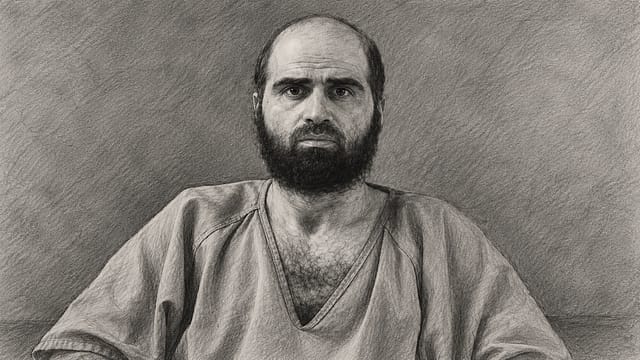
Thirteen years after a military court sentenced Nidal Malik Hasan to death for the Fort Hood massacre, President Donald Trump has approved his execution by firing squad, according to the Pentagon.
The announcement moves the case closer to a punishment the US military has not carried out for more than six decades. It also raises questions that the declaration alone cannot answer: why does the president have to approve a military execution, why has the case taken so long, and can civilian judges still intervene?
The distinction matters. A death sentence, presidential approval and an execution date are separate steps.
WHAT HAS TRUMP APPROVED?
Pentagon spokesperson Sean Parnell said on October 5 that Trump had approved a recommendation from Pete Hegseth to execute Hasan by an Army firing squad. The Army secretary will determine the time and place, Parnell said.

The Modi Years
02 Oct 2026 - Vol 05 | Issue 40
A Nation Rebuilt
The announcement concerns carrying out the death sentence imposed in 2013; it is not a new conviction or sentencing proceeding. AFP independently reported the Pentagon’s announcement.
WHO IS HASAN, AND WHAT HAPPENED AT FORT HOOD?
Hasan was an Army major and psychiatrist when he opened fire at Fort Hood, Texas, on November 5, 2009. The attack took place at a processing facility used by soldiers preparing for deployment.
Thirteen people were killed—12 soldiers and a civilian—and more than 30 were wounded.
According to the Army’s account of his court-martial, Hasan was convicted of 13 counts of premeditated murder and 32 counts of attempted premeditated murder. The panel sentenced him to death on August 28, 2013.
Hasan represented himself during the trial. He called no witnesses, offered no testimony and did not dispute that he had carried out the shooting.
WHY DOES THE PRESIDENT HAVE TO SIGN OFF?
Military law expressly requires presidential approval before a court-martial death sentence can be carried out.
The current provision, Article 57 of the Uniform Code of Military Justice, also gives the president powers to commute or remit the sentence. It separately requires completion of appellate review before execution.
Presidential involvement is therefore a legal requirement in the military process, rather than simply an expression of political support for the punishment.
WHY HAS IT TAKEN SO LONG SINCE THE 2013 SENTENCE?
A military death sentence triggers extensive judicial scrutiny.
At the time of Hasan’s sentencing, the Army explained that the case would automatically proceed through the Army Court of Criminal Appeals and the Court of Appeals for the Armed Forces. His decision to offer little defence at trial did not remove those safeguards.
The later court record illustrates that lengthy process. The Court of Appeals for the Armed Forces issued its detailed opinion in March 2024. Hasan subsequently sought Supreme Court review; the justices declined to hear his petition on March 31, 2025.
The Supreme Court’s refusal to hear a case leaves the lower court’s judgment in place. It should not be described as a fresh trial or a new finding of guilt.
CAN A CIVILIAN COURT STILL STOP THE EXECUTION?
Potentially. A May 2026 article in The Army Lawyer, written by military law professors Majors Alexandria J. Altimas and Allyson J. Montgomery, explains that a prisoner can pursue a federal habeas corpus challenge after presidential approval.
That procedure allows a challenge to the legality of imprisonment on constitutional grounds. The prisoner can also seek a stay of execution while the court considers the case.
A stay is not automatic, and the availability of this route does not establish that Hasan has already secured one.
HAS PRESIDENTIAL APPROVAL FAILED TO PRODUCE AN EXECUTION BEFORE?
Yes. Ronald Gray provides a relevant precedent. President George W. Bush approved Gray’s military execution in 2008, but a judge halted it. According to the Associated Press, Gray remains imprisoned at Fort Leavenworth.
That history shows why presidential approval cannot be treated as a guarantee of an imminent execution. It does not establish that Hasan’s litigation would produce the same result.
WHY A FIRING SQUAD?
The administration’s reasoning has not been publicly explained in the reporting reviewed.
The Wall Street Journal reported that the White House and Pentagon had not immediately answered questions about why Hegseth recommended that method or when the execution might occur.
There is also an important regulatory distinction. The Army Lawyer says earlier guidance prescribed lethal injection, but the framework described in its May article leaves the method to the Army secretary.
That explains the administrative discretion. It does not explain why a firing squad was selected in Hasan’s case.
WAS THE LAST US MILITARY EXECUTION ALSO BY FIRING SQUAD?
No. The last military execution was by hanging.
Private John A. Bennett was executed at Fort Leavenworth on April 13, 1961, after convictions for rape and attempted murder, according to the Army.
The accurate historical comparison is therefore that Hasan’s execution, if carried out, would be the first US military execution since 1961. The 1961 case does not establish when the military last used a firing squad.
WHAT HAPPENS NEXT?
The Army must announce the execution arrangements, while any further court filings will determine whether judges intervene.
The May Army Lawyer article describes a scheduling window of 60 to 150 days after presidential approval. But it also explains that a judicial stay can prevent an execution while litigation continues. That window should therefore not be presented as an unconditional deadline.
For now, Trump’s decision clears a required presidential step. Whether it results in the military’s first execution in 65 years depends on what follows in the Army and the courts.
With inputs from ANI & agencies