Tokyo Earthquake Explained: How Strong Was Japan’s 5.9-Magnitude Quake and is There an Aftershock Risk?
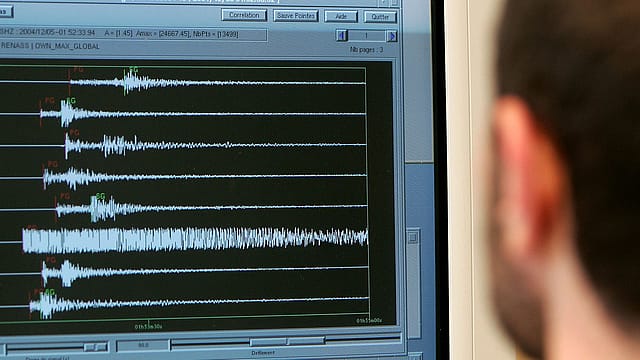
Tokyo’s earthquake alarms erupted just after 2 am. Smartphones flashed warnings. Buildings swayed. Sleeping residents scrambled out of bed as a 5.9-magnitude earthquake sent strong tremors through the Japanese capital and surrounding prefectures.
The quake struck beneath southern Ibaraki Prefecture, northeast of Tokyo, at a depth of nearly 70 kilometres. It registered lower 5 on Japan’s seven-point seismic-intensity scale in parts of Tokyo, Ibaraki, Saitama and Chiba. At least 37 people were injured across five prefectures, most of them after falling or colliding with furniture while trying to move in the dark. Train services were delayed or temporarily suspended, a water pipe ruptured in Tokyo and authorities began inspecting infrastructure across the region. There was, however, no tsunami threat and no abnormalities were reported at nearby nuclear facilities.
So, how powerful was the earthquake, why did a magnitude of 5.9 cause such sharp shaking and what should Japan expect next?
Where did the earthquake strike?
The earthquake struck at approximately 2 am local time on August 23. Its epicentre was in southern Ibaraki Prefecture, about 60 kilometres northeast of central Tokyo.
The Japan Meteorological Agency placed the hypocentre at a depth of about 70 kilometres and calculated a magnitude of 5.9. Its detailed analysis assigned the earthquake a moment magnitude of 5.8 and identified reverse faulting, in which one section of rock is pushed over another by compression underground. Although the quake originated beneath Ibaraki, tremors spread across a broad sweep of northeastern and central Japan. Strong shaking was recorded in parts of Ibaraki, Saitama and Chiba, as well as Tokyo’s Adachi Ward.

Zeroing In on ECI
09 Oct 2026 - Vol 05 | Issue 41
Constitutional legitimacy versus political opportunism
How strong was the shaking in Tokyo?
Parts of the region registered “lower 5” on Japan’s seismic-intensity scale, known as shindo. Magnitude and seismic intensity measure different things. Magnitude measures the energy released at the earthquake’s source. The shindo scale measures the strength of shaking experienced at a particular location. This means one earthquake has a single magnitude but can produce several intensity readings depending on distance, depth, soil conditions and local geology.
At lower 5, many people experience fear and feel the need to hold on to something stable. Unsecured objects can fall, furniture may move and windows can break. Walking becomes difficult for some people, particularly if they are awakened suddenly. A 5.9-magnitude earthquake may not sound enormous by Japanese standards, but its proximity to the densely populated Tokyo metropolitan region meant that millions experienced noticeable shaking.
Why did high-rise buildings sway?
Authorities recorded long-period ground motion of Class 2 in Tokyo’s 23 wards and parts of Chiba and Saitama, according to Japanese broadcaster FNN Prime Online. Long-period seismic waves move relatively slowly and can make tall buildings sway for longer than low-rise structures. The motion can continue even after the strongest immediate shaking has passed, causing furniture and fixtures on upper floors to move substantially. This explains why residents of high-rise buildings may experience prolonged swaying even during a moderate earthquake whose epicentre is some distance away. No major structural damage to Tokyo’s skyscrapers was immediately reported.
How many people were injured?
At least 37 people were injured across Tokyo, Saitama, Kanagawa, Chiba and Ibaraki, the Associated Press reported, citing prefectural officials and Japan’s Fire and Disaster Management Agency. Tokyo accounted for 15 injuries, followed by nine in Saitama, eight in Kanagawa, four in Chiba and one in Ibaraki. Most injuries were described as minor.
Several people fell while getting out of bed or struck furniture and doors after the sudden shaking jolted them awake. An elderly woman in Yokohama suffered a hip injury after falling as she tried to leave her bed. It was reported as the most serious injury linked to the quake. The circumstances explain why even an earthquake that causes limited structural damage can produce dozens of casualties. When a tremor strikes at night, darkness, disorientation and hurried movement can become hazards themselves.
What damage has been reported?
The earthquake caused limited damage based on initial assessments. A building in Saitama suffered minor damage, while a water main ruptured in Tokyo’s Koto Ward. Metropolitan authorities investigated whether the pipe failure had been caused directly by the earthquake. The leak was subsequently repaired. No widespread collapse, major fire or extensive power failure was reported.
The earthquake’s depth may have helped limit the damage. Shallower earthquakes of a similar magnitude often produce more destructive surface shaking because their energy travels a shorter distance before reaching buildings and infrastructure. The quake followed heavy rain in parts of the region. Authorities warned that shaking could have loosened already saturated soil, raising the danger of landslides or falling rocks in vulnerable areas.
How badly were trains affected?
Rail operators slowed, suspended or delayed services while tracks and systems were inspected. The Keisei Line, which connects Tokyo’s Ueno area with Narita International Airport, temporarily faced disruption before normal operations resumed. Some Tobu Railway express services remained suspended for longer. JR East reported delays and temporary interruptions on several routes around the metropolitan region. Express services were among those affected, although Japan’s high-speed bullet trains continued operating normally, according to the Associated Press. Such stoppages do not necessarily indicate damage. Japan’s rail system is designed to slow or halt trains when strong tremors are detected so that tracks, power equipment and signalling systems can be inspected before normal speeds resume.
Why was there no tsunami warning?
The Japan Meteorological Agency said the earthquake posed no tsunami threat. The quake originated beneath southern Ibaraki rather than under the seabed and occurred at a depth of about 70 kilometres. Destructive tsunamis generally require a significant vertical displacement of the seafloor, usually caused by a large and relatively shallow undersea earthquake. A magnitude of 5.9 at this location and depth did not produce the kind of seabed movement required to generate a dangerous tsunami. This is why strong shaking can be felt across Tokyo without a corresponding warning for coastal communities.
Were Japan’s nuclear facilities affected?
No operational abnormalities were reported at the Tokai No. 2 nuclear power plant in Ibaraki or at the Fukushima Daiichi and Fukushima Daini facilities farther north. Plant operators conducted checks following the earthquake, but there were no immediate reports of safety-system failures or abnormal radiation readings. Nuclear-facility checks are closely watched after any significant earthquake in eastern Japan because the magnitude-9.0 earthquake and tsunami of March 2011 triggered meltdowns at the Fukushima Daiichi plant. The absence of a tsunami threat and the quake’s substantially smaller magnitude meant that the circumstances were very different from the 2011 disaster.
Did Japan’s earthquake-warning system work?
Yes. Japan’s automated system issued an emergency earthquake alert shortly after detecting the first seismic waves. According to the Japan Meteorological Agency, the system detected the earthquake at 2:00:50 am and issued its first forecast approximately three seconds later. Earthquake early warnings cannot predict a tremor before it begins. They detect the faster-moving primary waves generated after an earthquake starts and try to send alerts before the more damaging secondary waves reach surrounding areas. Near the epicentre, the warning may arrive almost simultaneously with the strong shaking. Farther away, it can provide several valuable seconds for trains to slow, lifts to stop and people to move away from unstable objects.
Why is southern Ibaraki prone to earthquakes?
The greater Tokyo region sits above one of the world’s most complicated tectonic junctions. Several plates interact beneath and around Japan, generating frequent earthquakes at different depths. Southern Ibaraki has experienced repeated moderate earthquakes. In March 2024, a magnitude-5.3 earthquake struck the region at a depth of 46 kilometres and also produced lower-5 shaking. The Japan Meteorological Agency said that event occurred near the boundary between the Philippine Sea Plate and the overlying continental plate. The latest earthquake occurred deeper, at nearly 70 kilometres. The agency’s preliminary focal-mechanism analysis also identified reverse faulting produced by compression underground. The location explains why earthquakes beneath Ibaraki can shake Tokyo strongly despite originating outside the capital.
Could a stronger earthquake follow?
The Japan Meteorological Agency has warned that an earthquake producing shaking of up to lower 5 remains possible over the coming week. The first two or three days require particular caution because stronger aftershocks are more likely during the period immediately following a significant tremor. This does not mean another damaging earthquake will occur. Aftershock warnings describe an elevated possibility, not a prediction. Japanese authorities generally issue the week-long warning because previous earthquake sequences show that tremors of comparable intensity sometimes follow the initial event. People in strongly shaken areas have been advised to secure unstable furniture, avoid damaged structures and remain alert to landslides and falling objects.
Is Tokyo facing a larger earthquake emergency?
There is no official indication that the 5.9-magnitude earthquake marks the beginning of a much larger event. Its location in a seismically active part of the Kanto region makes it significant, but not extraordinary. Japan experiences frequent earthquakes because several tectonic plates converge around the archipelago. The immediate picture is therefore serious but contained: dozens of injuries, disrupted transport and limited infrastructure damage, with no tsunami, widespread destruction or nuclear emergency. For Tokyo, however, the quake offered another abrupt reminder of how quickly an ordinary night can begin to move.
(With inputs from ANI)