The New Great Game Runs Through the Strait of Hormuz
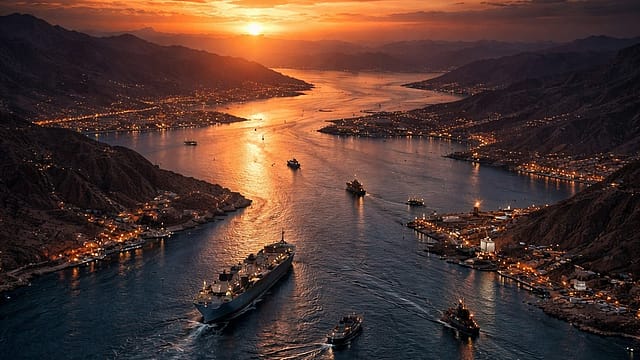
Every few hours, another headline emerges. A fresh demand from Tehran. Another naval update from Washington. A diplomatic signal from Oman. An official statement from Iran's leadership.
Individually, they appear to be routine developments. Together, they tell the story of a geopolitical confrontation that is quietly redefining power in the Middle East and putting one of the world's most important maritime corridors at the centre of a global contest.
This is no longer merely a dispute over whether the Strait of Hormuz remains open or closed. It is about who decides the future of the world's most strategic waterway.
The Strait of Hormuz carries nearly a fifth of global oil supplies and a substantial share of the world's liquefied natural gas exports. Any disruption immediately reverberates through energy markets, shipping routes and national economies far beyond the Gulf.
Rise of the Pivotal Power
18 Sep 2026 - Vol 05 | Issue 38
The BRICS declaration is a strategic victory for Modi
That is precisely why the latest developments matter. Iran has now made it clear that a full reopening of the Strait will depend on far more than shipping arrangements. Senior Iranian leaders say Washington must first address Tehran's political and security demands before normal commercial traffic can resume without restrictions.
Those demands are sweeping. Iran's Supreme National Security Council wants the United States to withdraw military forces participating in what Tehran calls a naval blockade, end military threats, compensate Iran for losses suffered during the recent conflict, lift sanctions and release frozen Iranian assets.
Only then, Iranian officials argue, can the region move towards lasting stability.
At the same time, diplomacy has not entirely broken down. Foreign Minister Abbas Araghchi said negotiations with neighbouring Oman over a new shipping framework were "very close" to completion. Oman has long played the role of quiet mediator between Tehran and Washington, and officials hope a new maritime arrangement could eventually restore commercial confidence in the Gulf.
But Tehran has also made it clear that technical agreements alone will not resolve the crisis.
Political questions must come first. President Masoud Pezeshkian struck a carefully balanced tone, describing the current moment as "the best time to reach an agreement" while insisting Iran would never compromise on what it considers its sovereign rights.
His message was straightforward. Iran is prepared to negotiate. It is not prepared to negotiate from a position of weakness. He also reaffirmed his government's complete backing for Supreme Leader Mojtaba Khamenei, saying decisions on war and peace ultimately rest with the country's leadership and military commanders, while the civilian government remains focused on sustaining the country through the crisis.
That message acquired additional significance after Iran's semi-official Mehr News Agency released an undated video showing Khamenei appearing healthy and meeting visitors. The footage followed days of speculation triggered by Israeli media reports claiming the Iranian leader's health had deteriorated. Although the video carried no timestamp, it appeared intended to reassure domestic audiences and counter growing international speculation over Iran's leadership during a period of heightened regional tensions.
Across the Gulf, Washington continues to move in the opposite direction. The United States says military pressure will remain in place until it is convinced that commercial shipping can operate without interference. According to US Central Command, American forces have already redirected dozens of commercial vessels, boarded ships and disabled others as part of operations designed to enforce the current maritime blockade. More than 30 humanitarian vessels have been allowed safe passage, but naval deployments remain firmly in place. Vice President JD Vance said the United States is working simultaneously on two fronts: maintaining military pressure on Tehran while helping establish secure commercial shipping routes through Hormuz.
For Washington, reopening the waterway is not enough. The United States wants confidence that the Strait will remain open without future disruptions. That divergence captures the essence of the current confrontation. Iran sees Hormuz as leverage. The United States views uninterrupted navigation as a strategic necessity. Neither side appears ready to surrender its position.
Meanwhile, Oman continues trying to prevent military escalation from overwhelming diplomacy. Its mediation efforts may ultimately determine whether Hormuz returns to being a commercial shipping lane or remains a bargaining chip in one of the world's most consequential geopolitical standoffs.
For energy markets, the stakes could hardly be higher. Every delay in restoring normal shipping raises concerns over crude supplies, insurance costs and freight rates. Any prolonged disruption would ripple across economies already grappling with geopolitical uncertainty and volatile energy prices.
Yet the contest unfolding around Hormuz is no longer just about oil. It is about influence, military deterrence, economic pressure, diplomatic leverage, and the ability to shape the rules governing one of the world's most strategically valuable waterways. The missiles may have fallen silent for now. But the struggle over the Strait of Hormuz has entered a new phase.
Increasingly, it is being fought through negotiations, naval deployments, sanctions and strategic bargaining rather than open warfare. Because whoever ultimately decides when Hormuz fully reopens will shape far more than maritime traffic. They may well shape the next chapter of the Middle East itself.
(With inputs from ANI)